86 days left#Painting
To Know the Joy of Fishing
Chinese original:
漁樂圖──知漁之樂特展
Painters through the ages have depicted the lives of fisherfolk and the waterside scenery they move through. Drawing on the museum's collection, this exhibition gathers such paintings under the theme of the joy of fishing and groups them in two types: scenes of fishing communities at work and at ease on the water, and scholars who take the fisherman's figure as a way to express their wish to withdraw from the world. Side by side, the two show how one subject carries different moods.
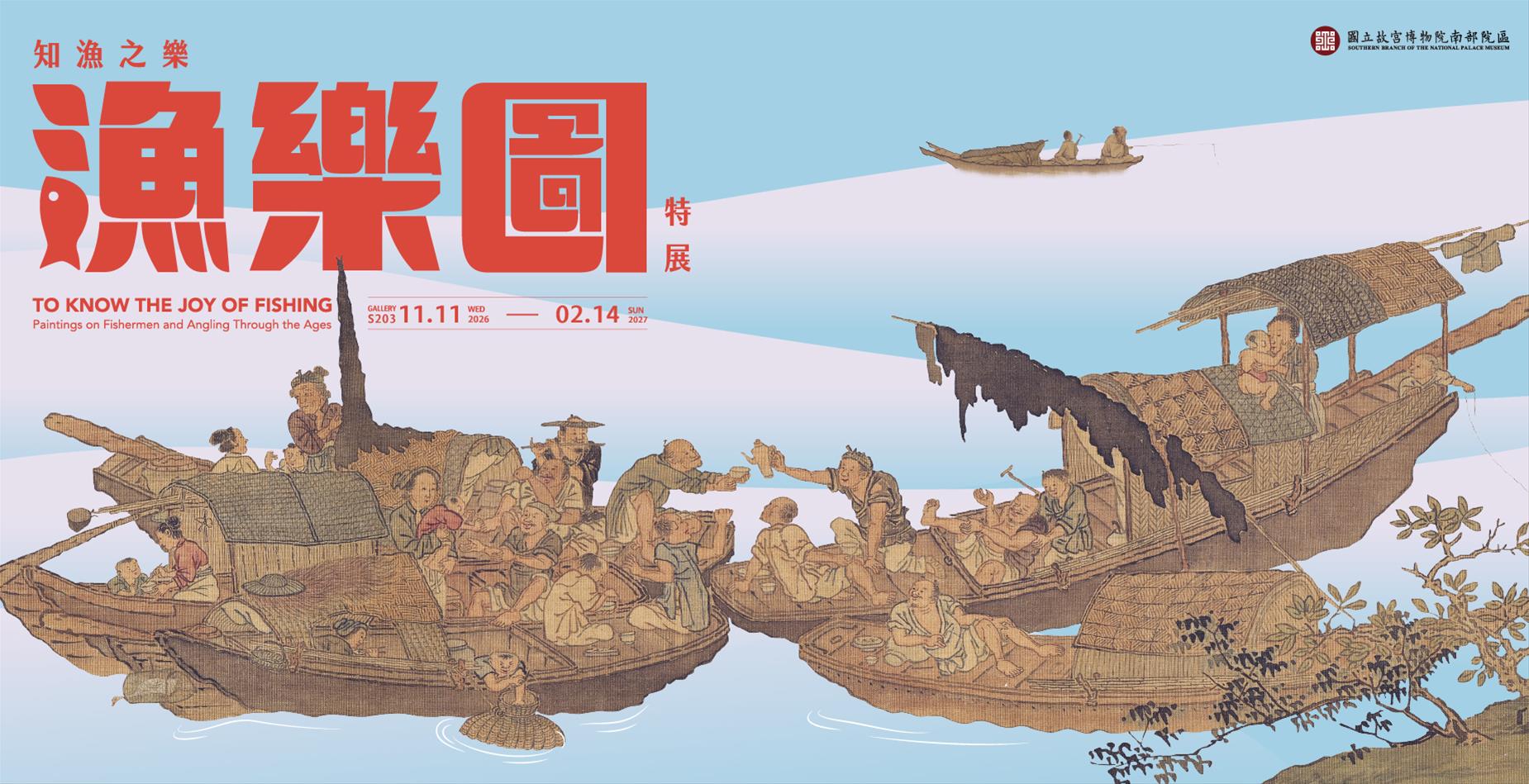
1 / 4 Image: National Palace Museum Southern Branch 漁樂圖──知漁之樂特展 展覽主視覺(官網專頁橫幅)
- Dates
- Nov 11, 2026 – Feb 14, 2027
- Venue
- National Palace Museum Southern Branch (國立故宮博物院南部院區) · Chiayi嘉義縣太保市故宮大道888號
Getting there
From Chiayi HSR Station, Exit 2, take BRT 7212 to the Southern Branch (Hall 1 shuttle stop); from Chiayi railway station (rear exit), BRT 7212 takes about 40 min
- Hours
- 09:00–17:00 · Closed: Mon
- Artists
- 唐棣
- 仇英
- 周臣
- 唐寅
- 陸治
- 袁瑛
The calendar entry covers the whole run, so you won't need to look the dates up again. Please check opening hours and closing days before your visit.
Entry notes
The galleries of the National Palace Museum Southern Branch are open Tuesday to Friday 9:00–17:00 and Saturday and Sunday 9:00–18:00; they are closed on Mondays, and open 9:00–18:00 on national holidays and long weekends. A visit ticket is NT$150. Visitors under 18, people with disabilities plus one companion, Taiwanese students, and Taiwanese visitors aged 65 and over on weekdays enter free with proof; Taiwanese visitors aged 65 and over enter free on holidays through 31 December 2026, and Chiayi County and City residents can exchange for a free ticket after 15:00. Individuals can buy tickets online, and an unused whole ticket can be refunded with no fee.
- The galleries of the National Palace Museum Southern Branch are open Tuesday to Friday 9:00–17:00 and Saturday and Sunday 9:00–18:00; they are closed on Mondays, and open 9:00–18:00 on national holidays and long weekends. A visit ticket is NT$150. Visitors under 18, people with disabilities plus one companion, Taiwanese students, and Taiwanese visitors aged 65 and over on weekdays enter free with proof; Taiwanese visitors aged 65 and over enter free on holidays through 31 December 2026, and Chiayi County and City residents can exchange for a free ticket after 15:00. Individuals can buy tickets online, and an unused whole ticket can be refunded with no fee. (Source: 國立故宮博物院南部院區:票價資訊, 2026)
From the organizer's announcements and press reports. Arrangements can change; please check the official site before your visit.
Knowledge cards
Literati painting文人畫Painting by scholars who brought the free brushwork of calligraphy into ink painting, rather than aiming at polished detail.Read moreClose
01About
Literati painting (wenrenhua, 文人畫) was developed by Chinese scholars trained in the classics, history, and philosophy, who also practiced calligraphy and painting. Where professional painters favoured careful finish, the scholars favoured brushwork that shows the individual hand and looks casual, mostly in ink. Chinese literati painting later came to be called Southern school painting. Landscape and plants such as bamboo and orchid became its main subjects, partly out of the scholar's wish to commune with nature. The brush ties it closely to calligraphy: in the Yuan dynasty, paintings of the plum, orchid, chrysanthemum, and bamboo, known as the Four Gentlemen, flourished because these plants stood for the noble character of the gentleman, and their brushwork follows the principle that calligraphy and painting share one source (shu hua ben lai tong, 書畫本來同). In theory, Chinese literati painted for their own pleasure and did not sell their work; in Japan, where the style is called bunjinga, many painters made it their livelihood.
02In the gallery
Find a bamboo, a rock, or a tree and look at the line itself: does it thicken and thin, speed up and slow down, the way a written stroke does?
Wall label terms in Chinese
- 文人畫
- Literati painting
- 南宗畫
- Southern school painting
- 四君子
- Four Gentlemen (plum, orchid, chrysanthemum, bamboo)
03Notes
Literati painting is looked at for its personal, easy-going brushwork rather than for how finely it is finished.
This time, at To Know the Joy of Fishing —
Where does the brush move freely, and where does it slow down to describe something?