The Season
Tokyo Winter Exhibitions 2026–27From the end of the year into early spring, in Tokyo's museums
By the Anthology editors ·
Chosen by the Anthology editors and checked against each venue's official site. No paid listings. About this anthology
On now
The Louvre's Renaissance collection, and a Leonardo in Japan for the first time.

This Leonardo is usually called La Belle Ferronnière. La Ferronnière is said to have been a mistress of King François I of France; she appears in the records only in the seventeenth century, and today she is mostly thought to be a fiction. The name first belonged to a different portrait, painted in profile, and after the French Revolution the two pictures were confused. In the early nineteenth century a print after a work by Ingres circulated widely, and the name stayed with this painting.
Who sat for it is still unsettled. Lucrezia Crivelli, a mistress of the Duke of Milan, is the name most scholars favour.
Leonardo painted it in Milan in the 1490s. Portraits there were still mostly in profile; he used the three-quarter view developed by painters in the north. A study in 2014 and 2015 found that he had adjusted the outline of the back of her head and neck so that head and body turn in slightly different directions, and that he had moved the pupil of her right eye, which leaves her gaze hard to pin down.
The National Art Center, Tokyo shows more than fifty works from the Louvre, with Leonardo as the thread, in four themes: travel, technique, antiquity, and the portrait. Dürer's woodcut Rhinoceros is among them. The profile portrait that first carried the name "Ferronnière" is on view as well.
Knowledge cardsRenaissance
- Booking required
Opening soon
Takehisa Yumeji's paintings of women, and the chiyogami, hand towels and yukata he designed for everyday life.

Kurofuneya, from 1919, shows a woman in a yellow kihachijō kimono holding a black cat, seated on a wooden box marked "Kurofuneya". Besides the yellow and black, her collar is orange, her obi green, and a little pink and purple shows at her underrobe. At the time, people believed a black cat could help against tuberculosis, and the painting is thought to have been made with Yumeji's beloved Hikono, who was ill, in mind.
Takehisa Yumeji (1884–1934) was a painter who also wrote poetry, worked as a journalist, and made designs and illustrations. His slender, wide-eyed women came to be called "Yumeji-style" and were much loved by young magazine readers. In 1914 he opened a shop in Nihonbashi, Minatoya Ezōshiten, selling chiyogami paper, envelopes, hand towels and han-eri collars of his own design. A painter turning his work into goods and selling them himself was something new then, and young artists such as Tōgō Seiji often came by.
The National Museum of Modern Art, Tokyo has borrowed about 500 works and materials from Yumeji collections across Japan and arranged them in five chapters: his magazine illustrations, his designs for everyday things, paintings of women that mix nostalgia with a taste for the foreign, his later years, when his popularity fell after the Great Kantō Earthquake and his plan for an art institute at Mount Haruna was never realized, and finally the modern girls of the magazines. Kurofuneya is shown in Tokyo again for the first time in about forty years.
Knowledge cardsBijinga (pictures of beautiful women)Illustration (sashie)
- Works change during the run
- Open on certain days only
Turner from Tate, and contemporary works that answer him two hundred years later.

In the late eighteenth century, Burke and Kant both wrote about a feeling they called the sublime: before something far larger than ourselves, there is fear, and with it a pull toward the thing. Turner (1775–1851) painted many such scenes. In The Fall of an Avalanche in the Grisons, exhibited in 1810, a great rock is coming down on a hut in the mountains; in the late Stormy Sea with Dolphins, forms withdraw to the edges and what remains is mostly light and water.
He also lived in the age of the steam engine. Whaling ships and coal smoke drifting into the mist appear in his pictures too.
Every work here comes from Tate. Turner left his life's work to Britain, which is why Tate holds more Turners than anywhere else. In each chapter the National Museum of Western Art places a later work beside his. Olafur Eliasson's The glacier melt series 1999/2019 is thirty pairs of photographs of the same glaciers taken twenty years apart. The Otolith Group's video Hydra Decapita turns to the slave trade on those seas.
Burke wrote that terror becomes sublime only at a certain distance. Standing before the glacier photographs, that distance seems a little shorter.
Knowledge cardsThe sublime
- Open on certain days only
Mariko Mori, from the cyborgs of the 1990s to light from the cosmos.

In the mid-1990s, Mariko Mori photographed and filmed her own performances and, with computer graphics still in their infancy, turned herself into the cyborgs of science fiction. Those works were about Japan at the time: anime, gender, the line between people and machines.
Her concerns then turned, little by little, to Buddhist ideas of death and the cosmos, and to large installations one can walk into, evoking nirvana or the Pure Land. From the 2000s she has spoken of "Oneness", the idea that all life is connected across time and space, and has worked with scientists and scholars on the ancient cultures of the Jōmon and the Celts, Yogācāra thought, particle physics and cosmology. Tom Na H-iu (2006) turns neutrinos from supernova explosions into visible light; Primal Rhythm: Sun Pillar (2011) was made for the winter solstice sun.
The exhibition is organized by the Mori Art Museum with the Solomon R. Guggenheim Foundation, New York. Her last large solo exhibition in Japan was Pure Land, at the Tokyo Metropolitan Museum of Photography in 2002. The Japanese title, Sansan, refers to light: the light of compassion and wisdom in Buddhism, the halo behind a Buddha, and the sun deity of Shinto. The largest work, Wave UFO (1999–2002), is a pod one can enter, where the visitors' brainwaves are turned into projected images.
Knowledge cardsMedia art and video art
- Limited places
Maruyama Ōkyo's painting from life, and the rooms he filled with pictures for one temple.

As a young man, Maruyama Ōkyo (1733–1795) painted megane-e, "spectacle pictures" made for a peep box: put your eye to the lens and the street inside gains the depth of Western perspective. It was here that Ōkyo trained his sense of distance and light. Later his painting was called shasei, painting from life, from close observation of real things; what he watched was not only shape, but the presence of an animal and the movement of light.
In his last years he widened this observation to a whole space. Daijōji, a temple in Kami, Hyōgo, known as "Ōkyo's temple", keeps his wall and door paintings in the Peacock Room, the Banana Plant Room and the Landscape Room. Subject and composition were planned for each room, and the sliding doors and walls follow on from one another into a single world. In the great Kyoto fire of 1788 Ōkyo too lost his home; he finished his work for the rebuilding of the imperial palace before returning to complete Daijōji. Pine Tree and Peacocks is dated to the seventh year of Kansei, 1795, the year he died.
The exhibition follows his life in five chapters, by era name, from his beginnings to his last years. Among the works are a peep box itself, the screens Ice from the British Museum, and the Important Cultural Properties Landscape and Pine Tree and Peacocks from Daijōji. The organizers call his handling of space a "spatial revolution".
Knowledge cardsMaruyama–Shijō school
- Works change during the run
- Open on certain days only
Sutras copied, pagodas raised and Buddhas made for the Lotus Sutra.
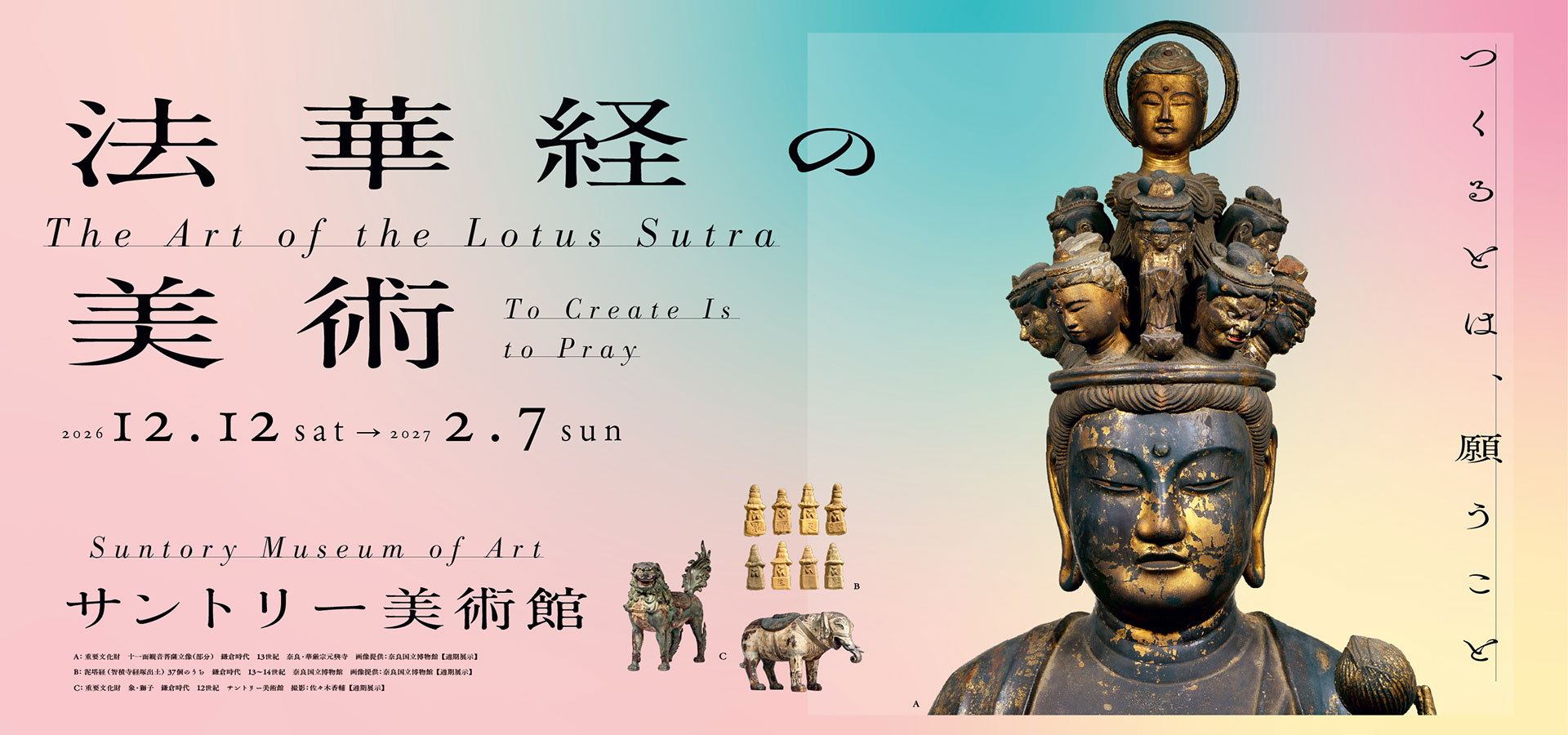
The Lotus Sutra teaches that everyone can attain Buddhahood and be saved from the suffering in front of them. It also teaches that copying the sutra, decorating its scrolls, building pagodas and making images of the Buddha are good deeds, called sazen. So for more than a thousand years, people did not only read the sutra; they copied it stroke by stroke and carved it cut by cut.
The nobles of the Heian period were especially devoted. People then believed that so long had passed since the Buddha's death that the world was entering mappō, the age when no one could practice the teaching rightly. They copied sutras together, decorated the scrolls lavishly, and offered them to temples and shrines or buried them in the ground; so that the words would not decay, they also wrote them on metal plates, clay tablets and stones. The National Treasure sutra box with gilt and silvered floral scrolls, excavated at Yokawa on Mount Hiei, was made in 1031 to hold sutra scrolls.
Suntory Museum of Art arranges the exhibition in three chapters, building pagodas, copying and offering sutras, and making images, with the National Treasures Bronze Plaque of the Lotus Sutra Preaching Scene from the Asuka to Nara periods and the Fan-shaped Lotus Sutra booklets from Shitennōji. There is also a pair of Kamakura-period figures, an elephant and a lion (Important Cultural Properties), once the mounts of the bodhisattvas Fugen and Monju; they entered the museum's collection in 2025 and are shown here for the first time. The last chapter turns to Edo painters; Katsushika Hokusai is said to have recited the Lotus Sutra as he walked.
Knowledge cardsMerit-making and decorated sutras
- Works change during the run
- Open on certain days only
The Tokyo National Museum's first exhibition on The Tale of Genji, from Heian scrolls to Edo ukiyo-e.

People began painting The Tale of Genji soon after it was written. The National Treasure Tale of Genji Scrolls date from the first half of the twelfth century, about a century after the novel, and are the oldest surviving Genji paintings. Tokyo shows "Kashiwagi III", in which Genji holds the newborn Kaoru. In the story, Kaoru is in fact the child of Kashiwagi and Genji's wife; Genji knows this, and still holds the child in his arms.
The organizers call it the largest exhibition ever devoted to Genji. It runs from the Heian scrolls to the Genji paintings of the Warring States period; Tosa Mitsunobu's Tale of Genji album, the oldest surviving work of its kind with scenes from all fifty-four chapters, returns to Japan from the Harvard Art Museums. The Kyoto venue centred on Noh; Tokyo turns to ukiyo-e. In the Edo period Genji became a favourite subject for pictures of beautiful women, and Isoda Koryūsai's Beauty with a Cat is shown only in Tokyo.
A single novel has been painted for a thousand years. The Heian scrolls dwell on what the characters keep in their hearts, the screens of the Warring States period paint crowded scenes, and Edo ukiyo-e turns the people of the story into the beauties of the street.
Knowledge cardsGenji-e (Genji pictures)
- Works change during the run
About this anthology: the season's major exhibitions, chosen by the Anthology editors and updated through the season. Every exhibition is checked against the venue's official site or announcement (as of Oct 19, 2026), and no listing is paid for. If dates or prices change, please refer to the venue's own announcement.
The Japanese original of each title and venue name is shown in gray below it.
A little more art in your life
Every month, we write a letter about exhibitions we love and why we recommend them. Subscribing is free, and you can cancel at any time.
We will use your email address only to send the newsletter. Privacy