The Monthly
Tokyo Anthology: NovemberLate autumn, in Tokyo's museums and galleries
By the Anthology editors ·
Chosen by the Anthology editors and checked against each venue's official site. No paid listings. About this anthology
On now
Forty years of the Society for Street Observation, and a question: who does the street belong to?
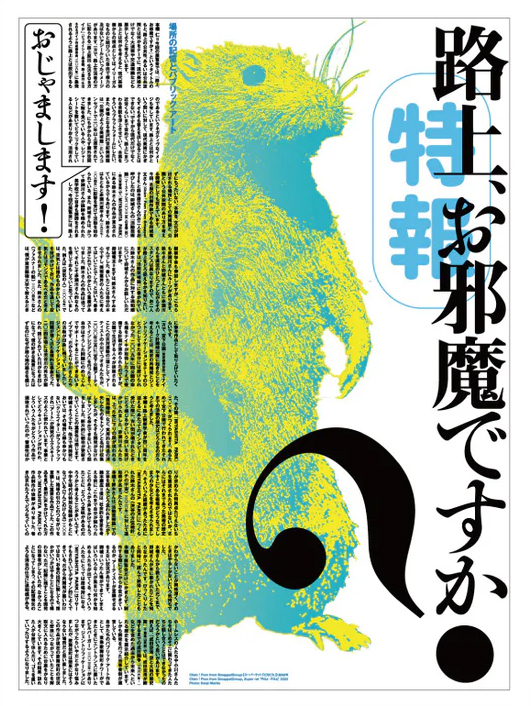
In 1972, in Yotsuya in Tokyo, Akasegawa Genpei came across a staircase that ended at the top and led nowhere, though its handrail had been kept in good repair. He and his friends went on to find more and more such things in the street: door frames with no door, windows bricked into walls. In 1982 he named them all "Hyperart Thomasson," after a highly paid foreign batter for the Yomiuri Giants who kept swinging and missing.
In 1986, Akasegawa founded the Society for Street Observation with the architectural historian Fujimori Terunobu, the illustrator Minami Shinbo, and Hayashi Joji, Sugiura Hinako, Aramata Hiroshi, and others. A society in name only, it was a group of people walking the streets and looking, with a little humor, at what the city and nature leave behind without meaning to. This is its fortieth year, and the society is the exhibition's academic partner.
The Shoto Museum of Art takes the subject further. The exhibition begins with kugai, the spaces of medieval Japan where power hardly reached and people could come and go freely. The street is such a place, and it is also where some people are pushed out and live without security. In 2020, a woman spending the night at a bus stop in Shibuya was killed; her attacker said she had been "in the way." The title, Rojo, ojama desu ka?, means "Am I in your way on the street?"
Alongside material from the Society for Street Observation are works by Suzuki Yasuhiro, Chim↑Pom from Smappa!Group, and the photographers Yamada Shuji and Sakokawa Naoko, records of Gilyak Amagasaki, who has danced in the street for many years, and play equipment from parks. Sento Dashi Junkobu turned a public bathhouse into a float that can be pulled through the streets, and its Sento Float (2021) is in the galleries too.
Knowledge cardsStreet observation
- Open on certain days only
Katsushika Oi's View of Yoshiwara Through the Lattice, and the night in ukiyo-e.

View of Yoshiwara Through the Lattice shows a night in the Yoshiwara pleasure quarter. Lamps burn behind the latticed window, and the courtesans sit in the bright room; outside, the customers stand with the light behind them, reduced to dark outlines, their shadows falling on the ground. Japanese painting seldom makes dark places truly dark, but this picture separates light from shade layer by layer.
Oi, born Ei, was the daughter of Katsushika Hokusai. She married Minamizawa Tomei, one of Hokusai's pupils, later divorced, and returned to her father, looking after him while helping with his work. Her art name, Oi, is said to come from the "Oi!" with which Hokusai called her. Only a little over ten paintings are known to be certainly by her hand.
Night scenes have a long tradition in ukiyo-e. The Ota Memorial Museum of Art places this painting back in that line, alongside night scenes by Suzuki Harunobu, Torii Kiyonaga, and Utagawa Hiroshige, and by Kobayashi Kiyochika of the Meiji era. Kiyochika brought the light and shade of Western prints into woodblock and pictured Tokyo under gas lamps; his landscapes later came to be called kosenga, "light-ray pictures."
The last section turns to work that is rarely discussed. In the late Meiji era, ukiyo-e was fading in Japan, while abroad there was demand for prints in large numbers. Publishers such as Hasegawa Takejiro and Watanabe Shozaburo made night scenes that copied or paid tribute to Hiroshige and Kiyochika and sold them overseas; Kobayashi Eijiro's A High Bridge by Night is one of them. View of Yoshiwara Through the Lattice belongs to the Ota Memorial Museum of Art and is shown again after three years.
Knowledge cardsUkiyo-e
- Works change during the run
- Open on certain days only
European paintings from the Cincinnati Art Museum, and a Cézanne with a portrait hidden beneath it.

In 1865, the twenty-six-year-old Cézanne sent Still Life with Bread and Eggs to the Paris Salon, and it was rejected. Its simplified forms and thick paint were far from the manner the Salon approved of. The painting entered the Cincinnati Art Museum in 1955. In 2022, the museum's chief conservator noticed unusual cracks in its surface and had it X-rayed, revealing a portrait underneath. The museum believes it may be a self-portrait by Cézanne, and possibly his earliest surviving work.
The Cincinnati Art Museum opened in 1881, one of the first art museums in the United States. The money to build it was gathered little by little from the city's residents. Its collection now numbers more than 73,000 works, and many of its Monets, Renoirs, and late Van Goghs were given by women collectors in the mid-twentieth century. Admission is still free today.
Of the 84 works that have come to the Ueno Royal Museum, 81 are being shown in Japan for the first time. The exhibition runs in six sections, from the academic tradition and the rebellion of Courbet and Cézanne, through Impressionism and Post-Impressionism, to Picasso and Hodler in the twentieth century. Tissot's Young Women Looking at Japanese Objects (1869) is set in his own studio, and Courbet's Sunset, Vevey, Switzerland (1874) was the first Courbet to reach America.
Van Gogh painted Undergrowth with Two Figures in the summer of 1890; he died that July. Purple poplar trunks run straight through the picture, its colors chosen by what he felt rather than by what was before him.
Knowledge cardsThe Paris SalonJaponisme
Opening soon
Robes for bugaku dance, and a set made for the memorial of Tokugawa Ieyasu.
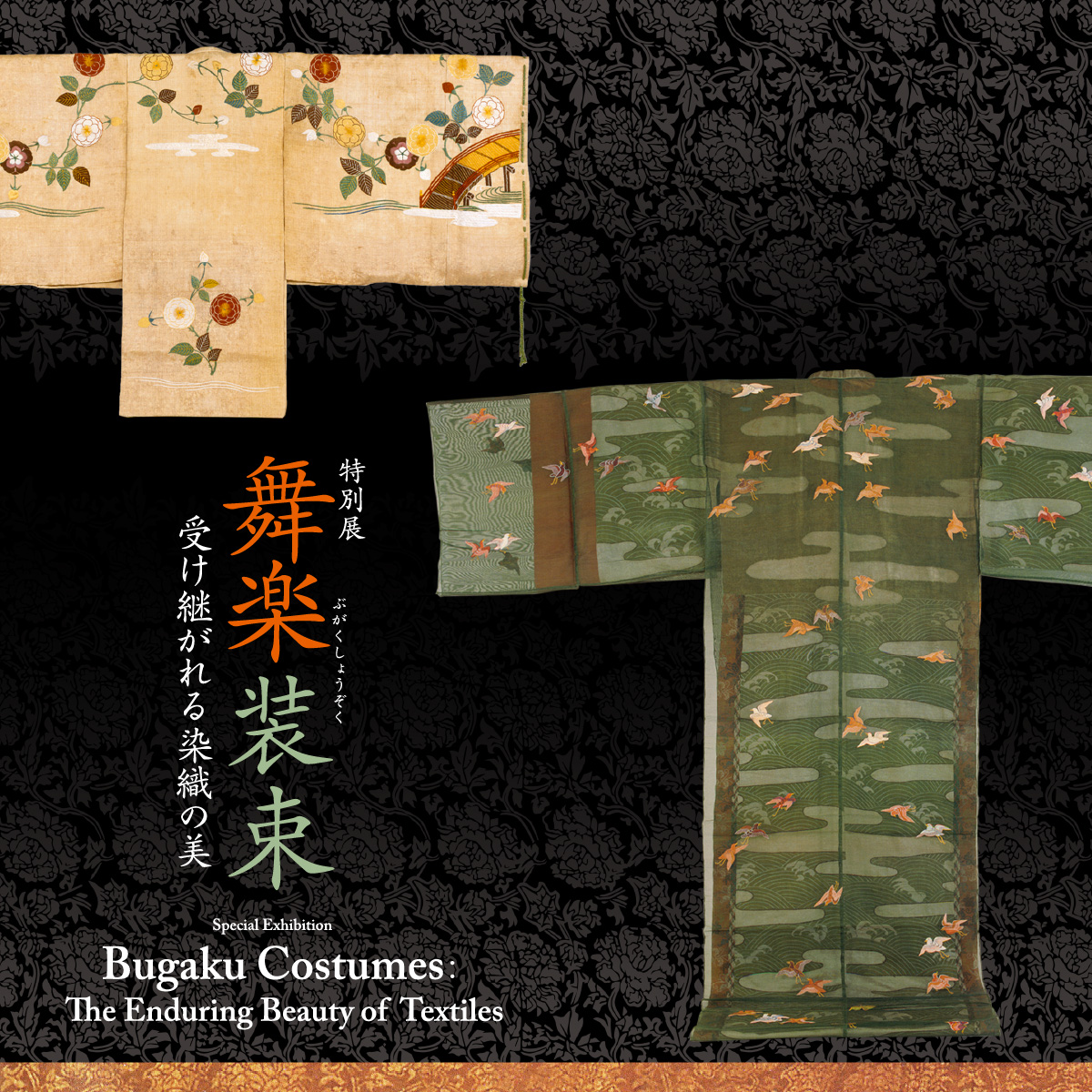
In 1636, Tokugawa Iemitsu held a memorial service at Nikko for the twentieth anniversary of his grandfather Ieyasu's death. For the bugaku dances at the service he had a whole set of costumes made, later kept by Rinnoji temple in Nikko. Some of them are on view here for the first time in about forty years.
Bugaku is the danced part of gagaku, Japan's court music, and its repertoire is divided into a left side and a right side. Pieces of the left mostly come from the music brought over from China, and their dancers wear red; pieces of the right are mostly tied to the music brought from the Korean Peninsula, and their dancers wear blue. Karyobin is a left-side dance for children: four children wear bird wings on their backs and strike small brass cymbals, sounding the call of a bird of the Pure Land. Rinnoji's Karyobin robes come in two colors, red and a fresh yellow-green.
The Onin War of the late fifteenth century left court music in decline for a time. When the court and those in power rebuilt it, the costumes kept at temples and shrines gradually came to follow the same patterns. What they looked like before has to be seen in older survivals: costumes handed down at the Amano Shrine (Niutsuhime Shrine), guardian shrine of Mount Koya, keep dyeing and weaving of the fourteenth and fifteenth centuries, and a ryoto vest in the Tokyo National Museum bears the year 1378.
The Nezu Museum's special exhibition also includes the Taiheiraku robe of Shitennoji in Osaka and a pale pink suikan with roses and arched bridges from Kongobuji on Mount Koya, both Important Cultural Properties, as well as the Bugaku Handscroll from the Asian Art Museum of San Francisco. Rinnoji's Seigaiha robe and under-robe are shown in Gallery 2.
Knowledge cardsDyed and woven patterns
- Booking required
Nobuko Tsuchiya's sculpture, in which industrial materials and fragments of everyday things grow into forms like living creatures.

Nobuko Tsuchiya was born in Yokohama in 1972 and studied art in Florence and at Goldsmiths in London. She gathers things around her that she is drawn to by instinct, fragments of everyday objects and industrial materials of many textures, puts them together, and sometimes casts the result. What she makes looks like parts of a machine, and also like a creature still growing. In 2003 she took part in the Venice Biennale.
This solo show, Ace of Hearts, is at SCAI THE BATHHOUSE, a gallery in a two-hundred-year-old public bathhouse in Yanaka. It is curated by Martin Clark, director of Camden Art Centre in London. His essay for the exhibition begins with Edwin A. Abbott's 1884 novel Flatland, whose two-dimensional inhabitants cannot imagine a third dimension.
Clark likens Tsuchiya's works to small engines, each driven by a kind of primal will. He also writes that the space between the works matters as much as the works themselves, and that it is full of unseen energy. Spread across the walls and the floor, the pieces act on one another, moving between solid and liquid, light and sound, map and model.
In a short 2026 text, Hitorigoto (Talking to Myself), Tsuchiya writes of the physicists' idea that the universe has ten dimensions, of existence at the scale of particles, and of the stillness of sleep. Her 2011 work at the same gallery was called 11th Dimension Project. The show is also part of Art Week Tokyo.
Knowledge cardsModern sculpture: from mass to space
- Open on certain days only
The Tokyo Metropolitan Art Museum's centenary show: five artists, five ways of reading the world.
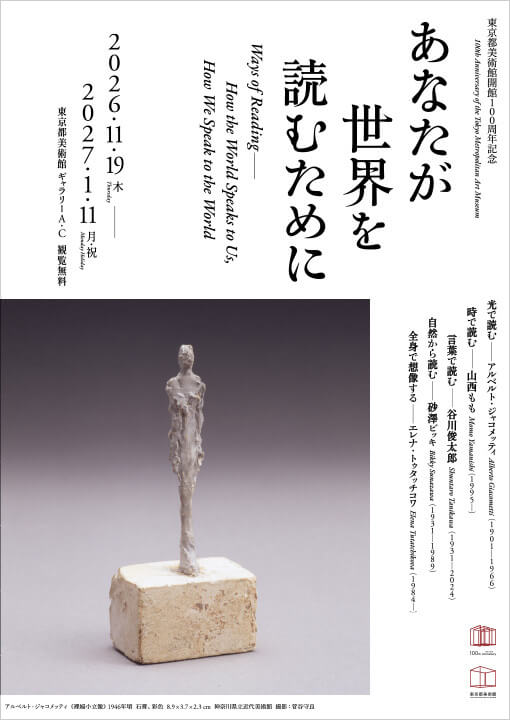
In May 1926, the Tokyo Prefectural Art Museum opened in Ueno, the first public art museum in Japan. The money to build it came from Sato Keitaro, a coal merchant from Kyushu, who gave one million yen to Tokyo Prefecture, said to be about half his fortune. Today's Tokyo Metropolitan Art Museum began there.
The centenary exhibition takes reading as its theme. By reading, the museum means the act of walking toward the unknown and slowly deepening one's understanding. Five artists of very different backgrounds each stand for one way of reading.
Alberto Giacometti (1901–1966) stands for Reading through Light; the figures he made after the war grew ever thinner. The poet Shuntaro Tanikawa (1931–2024) stands for Reading through Words. Bikky Sunazawa (1931–1989), for Reading through Nature, was an Ainu sculptor from Asahikawa who spent his last years working in a closed school in the village of Otoineppu; he called the marks that wind and snow left on wood "a chisel named wind and snow."
The other two are younger. Elena Tutatchikova (1984–) takes Imagining with the Whole Body, and all her works are planned to be new, including the ceramic series Islands. Momo Yamanishi (1995–) works with a pinhole camera, where a single exposure often takes a long time; Reading through Time centers on new photographs she took in Nepal in December 2025.
Knowledge cardsModern sculpture: from mass to space
- Open on certain days only
Nikolai Astrup, and the garden he cleared by hand in western Norway.
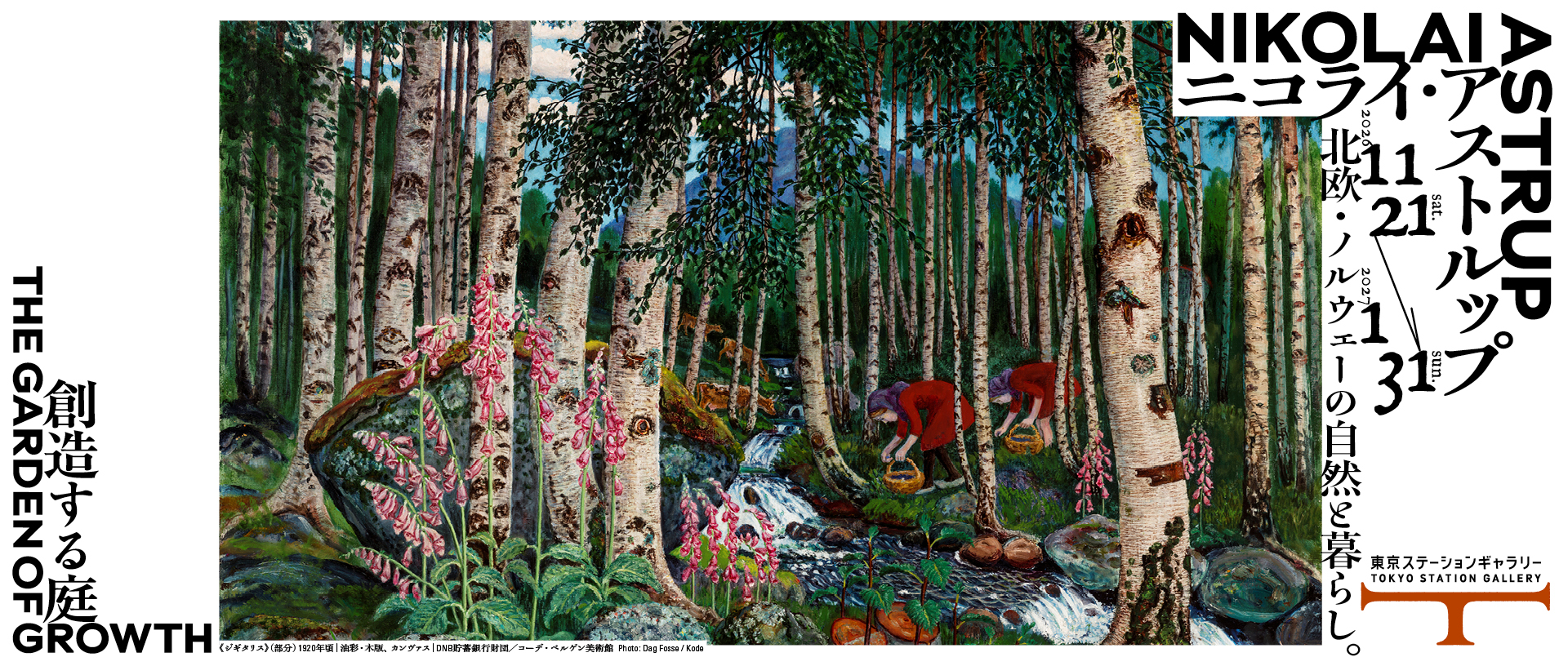
In 1908, Nikolai Astrup (1880–1928) said he was probably one of the most earthbound painters in the country. He grew up by a lake in Jølster in western Norway and spent his childhood in the parsonage. Later he bought a piece of land nearby and cleared it into a garden from nothing, the place now known as Sandalstrand. Most of the pictures of his life stay close to these two gardens.
He was also a keen gardener. In 1918 he wrote that he wanted to try growing every kind of plant, including crops that might or might not survive in a mountain village. His pictures hold rhubarb, foxgloves, and apple trees in bloom, as well as bonfires lit on midsummer night. His mother was a leading textile artist in the area; before he devoted himself to painting, he designed textiles based on local plants, which she wove and which won prizes at an exhibition in Norway.
His method sits between oil painting and woodcut. After printing a woodblock, he worked on each sheet by hand; at times he combined woodblock printing and painting on canvas. Living far from the workshops of the cities, he did every stage himself and worked out his technique on his own, and the influence of Japanese ukiyo-e prints can be seen in it. In 1927 he said that if every print came out exactly the same, it would be dull.
Seventeen years younger than Munch, Astrup was well known in Norway but long hidden abroad by Munch's fame. This is his first major retrospective in Japan, organized by Tokyo Station Gallery with KODE in Bergen, and his prints are shown with the carved blocks. His best-known work, Spring Night and Willow, dates from between 1917 and 1927.
Knowledge cardsJaponisme
- Open on certain days only
About this anthology: chosen each month by the Anthology editors. Every exhibition is checked against the venue's official site (as of Oct 19, 2026), and no listing is paid for. If dates or prices change, please refer to the venue's own announcement.
The Japanese original of each title and venue name is shown in gray below it.
A little more art in your life
Every month, we write a letter about exhibitions we love and why we recommend them. Subscribing is free, and you can cancel at any time.
We will use your email address only to send the newsletter. Privacy
Seoul · Taipei
Anthology in other cities. Each is its own local edition, opening with this month's anthology.