50 days left
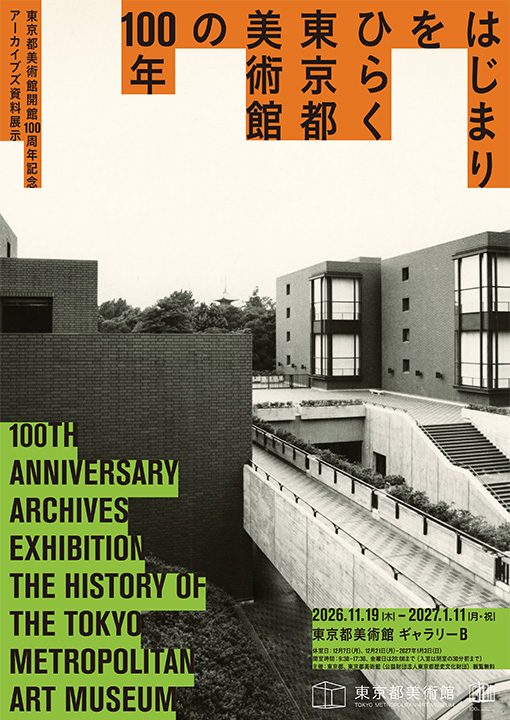
100th Anniversary of the Tokyo Metropolitan Art Museum: Ways of Reading—How the World Speaks to Us, How We Speak to the World
Japanese original:
東京都美術館開館100周年記念 あなたが世界を読むために
The Tokyo Metropolitan Art Museum, which opened in 1926 as Japan's first public art museum, turns 100. This anniversary exhibition takes dialogue with the world as its theme, offering five ways of reading the world through five artists from different times and backgrounds: reading by light, by time, by words, from nature, and imagining with the whole body. They are Alberto Giacometti, Bikky Sunazawa, the poet Shuntarō Tanikawa, Elena Tutatchikova, and Momo Yamanishi, whose new pinhole photographs were taken in Nepal.
Featured in: Tokyo Anthology: December · Tokyo Anthology: November
1 / 6 Image: Tokyo Metropolitan Art Museum
- Dates
- Nov 19, 2026 – Jan 11, 2027
- Venue
- Tokyo Metropolitan Art Museum (東京都美術館) · Ueno Park東京都台東区上野公園8-36
Getting there
7 min walk from the Park Exit, JR Ueno Station
- Hours
- 09:30–17:30
- Admission
- FreeOriginal: 無料
- Artists
- Alberto Giacometti
- Yamanishi Momo
- Shuntarō Tanikawa
- Bikky Sunazawa
- Elena Tutatchikova
- Organized by
The calendar entry covers the whole run, so you won't need to look the dates up again. Please check opening hours and closing days before your visit.
Entry notes
Admission is free (Gallery A and C). Closed on December 7 and from December 21 to January 3, 2027. Open 9:30–17:30, until 20:00 on Fridays; last entry is 30 minutes before closing.
- Admission is free (Gallery A and C). Closed on December 7 and from December 21 to January 3, 2027. Open 9:30–17:30, until 20:00 on Fridays; last entry is 30 minutes before closing. (Source: 東京都美術館:あなたが世界を読むために, 2026)
From the organizer's announcements and press reports. Arrangements can change; please check the official site before your visit.
Knowledge cards
Alberto GiacomettiAlberto Giacometti (1901–1966)Alberto Giacometti (1901–1966) was a Swiss artist. He arrived in Paris in 1922 to study sculpture, discovered African art and Cubism in the mid-1920s, then joined the Surrealists and broke with them in 1935. He spent the Second World War in Switzerland; after returning to Paris in 1945 he began the elongated standing figures and the distinctive portrait paintings of his later work, and in 1962 he won the grand prize for sculpture at the Venice Biennale.Read moreClose
01Characteristics of his style
Four features to look for in Giacometti's work:
- elongated, stick-thin figures that contrast with the weight and permanence of traditional marble sculpture (Standing Woman "Leoni", Walking Man I)
- heavily textured, crusty surfaces that respond to light (Standing Woman "Leoni")
- the human head, his subject throughout his life, with a special focus on the sitter's gaze (Gazing Head)
- portraits in which he paints, overpaints and repaints, framing the face with lines and brush marks in black, grey and white
02Periods and key works
Paris and African and Oceanic art (1922–30)
Giacometti arrived in Paris in January 1922 to study sculpture. In the mid-1920s he discovered African art and Cubism and for a while explored abstract figures, responding to the formal innovations of sculptors such as Henri Laurens and Constantin Brâncuși and to the abstraction of African and Oceanic objects. In 1927 Spoon Woman and The Couple were shown at the Salon des Tuileries in Paris and first brought him to public attention; in 1929 Gazing Head caught the attention of the Surrealist group.
Spoon Woman (1927) · Fondation Giacometti, Paris
Its shape is taken from a ceremonial spoon of the Dan culture of West Africa, while also reflecting the influence of Cubism; transposing a ritual object into sculpture, it is arguably his first standing woman.
Gazing Head (1929) · Fondation Giacometti, Paris
A rectangular plaque, shown in both its plaster and terracotta versions.
The Surrealist years (to 1935)
Giacometti joined the Surrealists but broke with them in 1935, after being harshly criticised by their leader André Breton for his decision to return to working from live models; for the Surrealists these "realistic" works after models were a form of treason. Even so, Surrealist procedures continued to play an important part in his work: dreamlike visions, montage and assemblage, objects with metaphorical functions, and a magical treatment of the figure.
Suspended Ball (1930–31) · Fondation Giacometti, Paris
The cage is made of thin black metal rods, while the tray, ball and crescent are dark brown wood, and the treated surface shows lacquer flows, especially on the ball.
Woman with Her Throat Cut (1932) · Peggy Guggenheim Collection, Venice
Body parts are translated into schematic abstract forms; the whole reads as a hybrid of plant and insect, and its tense, pointed shapes also suggest a trap about to shut.
Woman Walking (1932–36) · Peggy Guggenheim Collection, Venice
A graceful, calm plaster whose pose seems to derive from the frontal figures of ancient Egypt, with the left foot slightly ahead of the right.
Heads and the war years (1935–45)
Between 1935 and 1940 he showed his Surrealist works in group exhibitions across several countries, and at the same time pursued his own line of research into the head. The human head was the central subject of his research throughout his life, and he concentrated above all on the sitter's gaze. In May and June 1940 the German army swept into France and Paris was occupied; visiting his mother in Geneva, he was refused a visa to go back to France and stayed in Switzerland for the rest of the war, dividing his time from 1942 to 1945 between Geneva, Stampa and Maloja.
Woman with Chariot (1943–45) · Fondation Giacometti, Paris
A standing figure faces forward, arms at her sides and her face expressionless; he modelled the image of his English friend Isabel from memory.
The postwar years (1945–66)
In September 1945 he went back to Paris and to his rue Hippolyte-Maindron studio, where he started making the elongated figures that mark his postwar sculpture, focusing on single standing or walking figures as well as figural groupings in different spatial situations. These thin, emaciated figures contrast with the weight and permanence of traditional marble sculpture; he is also known for sculptures with highly textured surfaces and for his distinctive portrait paintings. In 1962 he won the grand prize for sculpture at the Venice Biennale.
The Nose (1947) · Fondation Giacometti, Paris
Only the grotesquely long nose pokes out of the cage; the head hangs from a rope and sways in air currents, but never far enough to get free.
Standing Woman "Leoni" (1947) · Peggy Guggenheim Collection, Venice
More elongated and dematerialised than Woman Walking, it keeps that sculpture's frontality and immobility; the crusty surfaces give a sense of ghostly fragility.
Walking Man I (1960) · Fondation Giacometti, Paris
The figure hardly bends at the knee; by developing a standing woman and a walking man in opposite directions, he accentuated the contrast between stillness and dynamism.
03Where to see his work
Principal collections
Fondation Giacometti Paris, France
Its holdings include Spoon Woman (1927), Gazing Head (1929), Suspended Ball (1930–31), Woman with Chariot (1943–45), The Nose (1947), Three Men Walking (1948) and Walking Man I (1960).
Peggy Guggenheim Collection Venice, Italy
Its holdings include Woman with Her Throat Cut (1932), Woman Walking (1932–36) and Standing Woman "Leoni" (1947).
Other collections
Kunsthaus Zürich Zurich, Switzerland
Its online collection lists 308 artworks by Giacometti.
04In the gallery
First look for slender figures with rough surfaces: these belong to the years after his return to Paris in 1945. A plaque-like head, or a figure whose shape comes from an African ceremonial object, belongs to the mid-to-late 1920s. A cage of thin metal rods with a suspended ball belongs to the Surrealist period of the early 1930s.
Notes
Notice whether the figure is slender or solid, its surface smooth or rough.
This time, at Ways of Reading—How the World Speaks to Us, How We Speak to the World —
How large does the figure appear next to the space around it?
05Related
Modern sculpture: from mass to space近現代の彫刻:量塊から空間へSculpture since the 20th century: not only a solid mass carved or modelled, but forms built from many materials that count the surrounding space and light as part of the work.Read moreClose
01About
Traditional sculpture has two ways of working: carving, which removes material, and modelling, which adds it, as with clay; a modelled form may then be cast in metal. In the early 20th century the Cubists assembled works from different materials, and construction became a new way of making sculpture. In 1920 Naum Gabo, with his brother Antoine Pevsner, published the Realistic Manifesto in Moscow, calling for an art freed from volume and mass and grounded in space and time. Sculpture since then has used industrial materials such as steel, acrylic, and glass; some works move (kinetic sculpture), and some take light as their material. In Japan, too, postwar abstract sculpture turned away from academic figurative work that prized mass and stability, toward space and the environment.
02In the gallery
Walk once around the work, and look from a different height. With surfaces that reflect or let light through, watch how the work changes with where you stand and with the light in the room; with open or linear forms, look at the shape of the space that passes through them.
Wall label terms in Japanese
- 彫刻(カーヴィング)
- Carving
- 塑造
- Modelling
- 鋳造
- Casting
- 構成(コンストラクション)
- Construction
- 量塊(マッス)
- Mass
- キネティック・アート
- Kinetic art
03Notes
Twentieth-century sculpture doesn't just make a mass; it brings the surrounding space and light into the work.
This time, at Ways of Reading—How the World Speaks to Us, How We Speak to the World —
After walking around it, where do you think the work ends?
04Related
Nearby, after this one
Same venue · Tokyo Metropolitan Art Museum

Same neighborhood · Ueno Park
Shows open on the same days as this one are listed first (regular closing days only).