Tokyo Metropolitan Art Museum
Japanese original:
東京都美術館
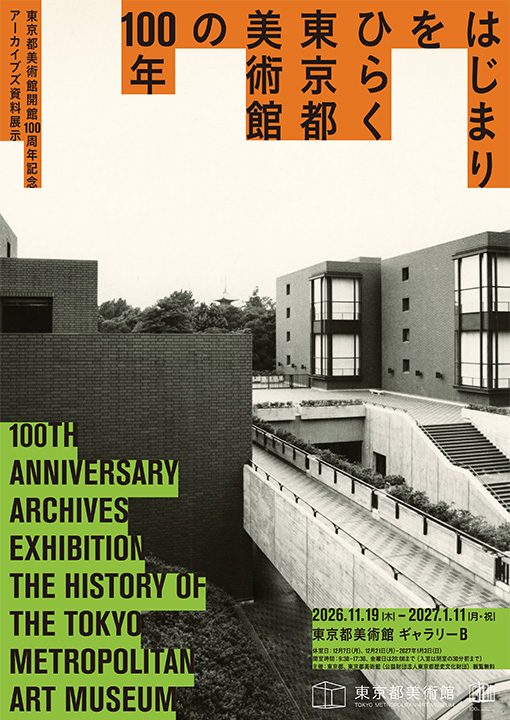
Opened in 1926 as the Tokyo Prefectural Art Museum, Japan's first public art museum, funded by a donation from Kyushu coal merchant Sato Keitaro. It has long been the main venue for juried exhibitions held by art societies. The present building, designed by Maekawa Kunio, was completed in 1975 and reopened in 2012 after renovation.
- Area
- Ueno Park
- Address
- 東京都台東区上野公園8-36
- Getting there
- 7 min walk from the Park Exit, JR Ueno Station
- Hours
- 09:30–17:30
- Closed
- Mon
- Admission
- Entry to the building is free; exhibition prices vary
Regular closing days only. For public holidays, please check each venue's notices.
Directions and admission checked against the venue's website on Oct 20, 2026.
First visit
- Photos and video are generally not allowed in the galleries; exhibitions that differ say so on site.
- Put large bags in the lockers (¥100, refunded); umbrellas cannot be taken inside and go in the stands at the entrance.
- Use pencils in the galleries.
From the venue's visitor guidelines, checked on Oct 21, 2026.
Guided tours
Architecture tour led by the 'Tobira' volunteers (about 45 minutes): free, 30 places, advance application required (Dec 9–16).
- TourJan 23 (Sat)Architecture tour led by the 'Tobira' volunteers (about 45 minutes): free, 30 places, advance application required (Dec 9–16).
- TourMar 13 (Sat)Architecture tour led by the 'Tobira' volunteers (about 45 minutes): free, 30 places, advance application required (Feb 3–10).
Source: 東京都美術館 イベント. From the venue's and organizer's announcements. Schedules, languages and fees can change; please check the official site before your visit.
On now and coming up
Exhibitions (Open now 3 · Opening soon 1)
The Japanese original of each title and venue name is shown in gray below it.

Past exhibitions
- Tokyo Metropolitan Art Museum 100th Anniversary Commemoration: The British Museum’s Collection of Japanese Art—A Blossoming Array: Edo-Period Paintings Across the SeasJul 25 – Oct 18, 2026
- Commemorating the 100th Anniversary of the Tokyo Metropolitan Art Museum: Landscapes of These Places—Ueno, Omuta, Buenos AiresJul 23 – Oct 7, 2026
Related knowledge cards
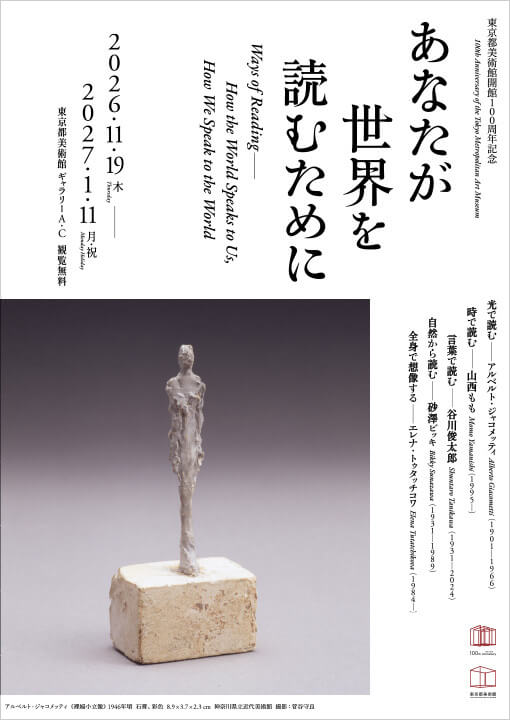
- Modern sculpture: from mass to spaceSculpture since the 20th century: not only a solid mass carved or modelled, but forms built from many materials that count the surrounding space and light as part of the work.
- Dyed and woven patternsA pattern on cloth comes either from colored threads woven in on the loom (weaving), or from dyeing or printing the finished cloth (dyeing).
- ImpressionismA painting movement that emerged in Paris in the 1870s: painting outdoors, in short strokes of unmixed colour, to catch a passing moment of light and air.
- Claude MonetClaude Monet (1840–1926) was a French painter and one of the painters of Impressionism. From the shimmering water of La Grenouillère to the Gare Saint-Lazare, haystack, and Rouen Cathedral series, he returned to motifs to track changing light and atmosphere. The Water Lilies cycle occupied three decades, from the late 1890s until his death in 1926, and resulted in almost 300 paintings, more than 40 of them in large format.
- Vincent van GoghVincent Willem van Gogh (1853–1890) was a Dutch painter, regarded as one of the Post-Impressionists. He began working as an artist in 1880, largely self-taught, and in ten years left nearly 900 paintings and more than 1,100 works on paper. His canvases moved from dark early tones to bright colour in Paris; the Fauves and the German Expressionists took notice of his work, and he is regarded as a vanguard figure in the history of modern art.
- Jean-François MilletJean-François Millet (1814–1875) was a French painter, born at Gruchy in Normandy and already a pupil of Paul Delaroche in Paris by 1837. He spent some years mainly painting idylls modelled on eighteenth-century French painters, turned to peasant subjects in 1848, and in 1849 settled in Barbizon, joining artists influenced by the landscape and light of the region. His compositions, themes and atmosphere influenced the Hague School, and his example reached the early style of Vincent van Gogh.
- Pierre-Auguste RenoirPierre-Auguste Renoir (1841–1919) was a French painter and one of the founding members of Impressionism. In the summer of 1869 he painted beside Claude Monet at La Grenouillère, outside Paris, where short, quick brushstrokes and a brightened palette helped shape the Impressionist aesthetic; at the end of the 1870s he turned to the old masters in search of structure and permanence, and after a trip to Italy in 1881 his figures became more clearly outlined and more sculptural. In later life he lived mostly in the south of France and took up sculpture.
- Paul GauguinPaul Gauguin (1848–1903) was a French artist who began as a painter within the Impressionist movement and then shifted towards Synthetism and Symbolism. At Pont-Aven he became the centre of a group of avant-garde artists, including Émile Bernard and Paul Sérusier, who followed an artistic philosophy they called synthétisme; his pictures use expressive colour, flat planes and simplified, distorted forms. His use of colour and form had a profound influence on twentieth-century avant-garde art and set the stage for Fauvism and Expressionism, and the Nabis took him as their example.
- Alberto GiacomettiAlberto Giacometti (1901–1966) was a Swiss artist. He arrived in Paris in 1922 to study sculpture, discovered African art and Cubism in the mid-1920s, then joined the Surrealists and broke with them in 1935. He spent the Second World War in Switzerland; after returning to Paris in 1945 he began the elongated standing figures and the distinctive portrait paintings of his later work, and in 1962 he won the grand prize for sculpture at the Venice Biennale.
Nearby for the same trip · Ueno Park



Further reading

On a fine day at noon I take a bento box or a rice ball to a park nearby and sit on a bench to eat. The sun is on my back, and when I lift the lid the steam from the rice comes up first. Other people are on the benches too, each with a lunch box in hand, eating on their own, and nobody speaks. When I finish I look up at the sky and the trees beside me. The wind passes, the leaves move with it, and the shadows on the ground have shifted a little, which is how I know I have been sitting there a while. There is work in the afternoon, so I cannot stay long. I put the box back in the bag, stand up and walk back. I go to the park at noon for the sunlight and the meal, and also so that I will sleep better at night. When things get busy, this short stretch of time is the first to go. I eat while working, realise afterwards that I never tasted the food, and that night I sleep badly. On a day when I have sat down and finished a meal slowly, I sleep a little better, and the next morning my steps feel lighter.