Opens in 153 days#Painting
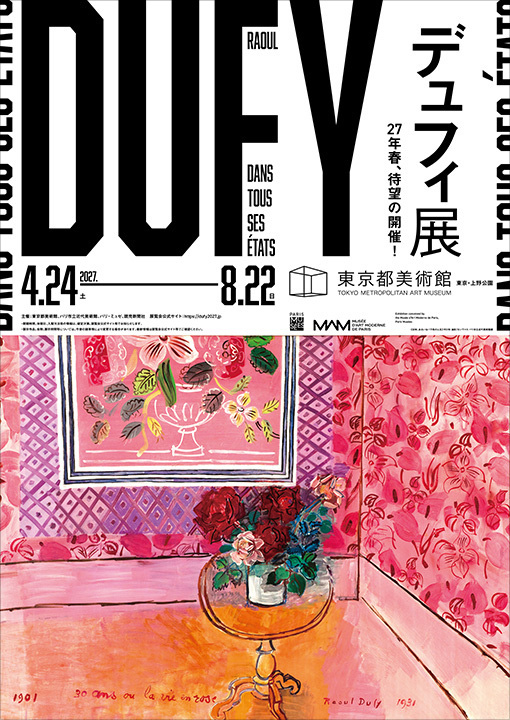
Dufy Exhibition
Japanese original:
デュフィ展
Raoul Dufy (1877–1953) was a 20th-century French painter who often took the sea, boats, music, wheat fields and the countryside as subjects. His work went beyond canvas to textiles, costume design, ceramics, tapestries and furniture. For the 150th anniversary of his birth, the show draws mainly on the Musée d'Art moderne de Paris and includes the 6-metre-wide, one-tenth-scale painting for his mural La Fée Électricité, made for the 1937 Paris International Exposition.
- Dates
- Apr 24 – Aug 22, 2027
- Venue
- Tokyo Metropolitan Art Museum (東京都美術館) · Ueno Park東京都台東区上野公園8-36
Getting there
7 min walk from the Park Exit, JR Ueno Station
- Hours
- 09:30–17:30 · Closed: Mon
- Artists
- Raoul Dufy
- Organized by
- Tokyo Metropolitan Art Museum
- Musée d'Art Moderne de Paris
- Paris Musées
- The Yomiuri Shimbun
The calendar entry starts on opening day and covers the whole run, so you won't need to look the dates up again. Please check opening hours and closing days before your visit.
Entry notes
The exhibition runs from 24 April to 22 August 2027 in the Special Exhibition Gallery of the Tokyo Metropolitan Art Museum. During special exhibitions the museum is open 9:30–17:30 (last entry 17:00), and until 20:00 on Fridays; special and planned exhibitions are closed on Mondays (the next weekday when Monday is a public holiday or substitute holiday). Ticket prices and sales have not yet been announced on the official page.
- The exhibition runs from 24 April to 22 August 2027 in the Special Exhibition Gallery of the Tokyo Metropolitan Art Museum. During special exhibitions the museum is open 9:30–17:30 (last entry 17:00), and until 20:00 on Fridays; special and planned exhibitions are closed on Mondays (the next weekday when Monday is a public holiday or substitute holiday). Ticket prices and sales have not yet been announced on the official page. (Source: 東京都美術館:デュフィ展, 2026)
From the organizer's announcements and press reports. Arrangements can change; please check the official site before your visit.
Knowledge cards
Dyed and woven patterns染めと織りA pattern on cloth comes either from colored threads woven in on the loom (weaving), or from dyeing or printing the finished cloth (dyeing).Read moreClose
01About
Plain dyeing covers the whole cloth in one color; printing puts color on certain parts only. Among the ways of dyeing a pattern is resist dyeing, where paste or wax keeps the dye off chosen areas: Okinawan bingata is dyed with a paper stencil and resist paste. In screen printing, color is pushed through a mesh, the stencil blocks it elsewhere, and one color is printed at a time, so a design in several colors needs several screens. A woven pattern is made on the loom: brocade weaves its design with an extra weft, so that it looks embroidered on; for ikat (kasuri in Japan), the yarns are resist-dyed in sections before weaving, and the slight blur along the pattern's edges is often prized.
02In the gallery
Look at the edges of the pattern. Printing pastes are thickened so the color does not spread beyond the design, which keeps printed edges clean; the soft blur at the edges of ikat comes from dyed yarns that do not line up exactly on the loom.
Wall label terms in Japanese
- 染め
- Dyeing
- 織り
- Weaving
- 捺染(プリント)
- Textile printing
- 防染
- Resist dyeing
- 紅型
- Bingata (Okinawan stencil dyeing)
- 絣
- Ikat (kasuri)
03Notes
A pattern on cloth is either woven in on the loom or dyed or printed on afterwards.
This time, at Dufy Exhibition —
Looking at the edges of the pattern, was it woven in, or added later?
04Related
Nearby, after this one
Same venue · Tokyo Metropolitan Art Museum
Same neighborhood · Ueno Park
Shows open on the same days as this one are listed first (regular closing days only).