The Monthly
Taipei Anthology: NovemberThe end of autumn, in Taipei's museums
By the Anthology editors ·
Chosen by the Anthology editors and checked against each venue's official site. No paid listings. About this anthology
On now
Streets, temple squares, and faith, photographed by generations of Taiwanese photographers, and how those pictures reached the pages of magazines.
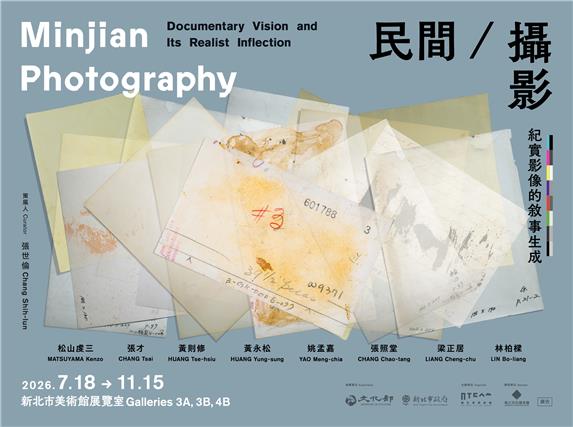
In July 1941, Kanaseki Takeo, Ikeda Toshio, and others founded the magazine Minzoku Taiwan (Folklore Taiwan) in Taipei, to record the island's festivals, crafts, and everyday life. Most of its photographs were taken by Matsuyama Kenzo; City God Festival, in the first issue, carries both his name and Kanaseki's.
One group of photographs in the exhibition shows the Yuedi Temple in Tainan being pulled down to widen a road: rubble, workmen, and a street going about its day. On the back are notes in English by the American diplomat George H. Kerr. Transparent display walls let the front and back of each print be read together.
Under the long years of martial law after the war, mainstream photography pursued the polished beauty of the salon, and folk customs and local places became, for photographers, a way in to social reality. In 1971 Huang Yung-sung, Yao Meng-chia, Linda Wu, and Hsi Song founded the English-language magazine ECHO, followed in 1978 by a Chinese edition, Hansheng, which through photography and editing set down folk crafts and ways of life issue by issue.
The exhibition at the New Taipei City Art Museum, curated by Chang Shih-lun, brings together work by eight photographers: Matsuyama Kenzo, Chang Tsai, Huang Tse-hsiu, Chang Chao-tang, Huang Yung-sung, Yao Meng-chia, Liang Cheng-chu, and Lin Bo-liang, along with contact sheets, manuscripts, original magazine layouts, and documentary films. The slash in its title marks how photography and minjian, the life of ordinary people, have shaped each other. Waiting for Mazu, taken by Lin Bo-liang on Huayu Island in Penghu in 1988, is also on view.
Knowledge cardsPhotography
Japan's yokai, moving from handscrolls and ukiyo-e into kimono, toys, and dishes.
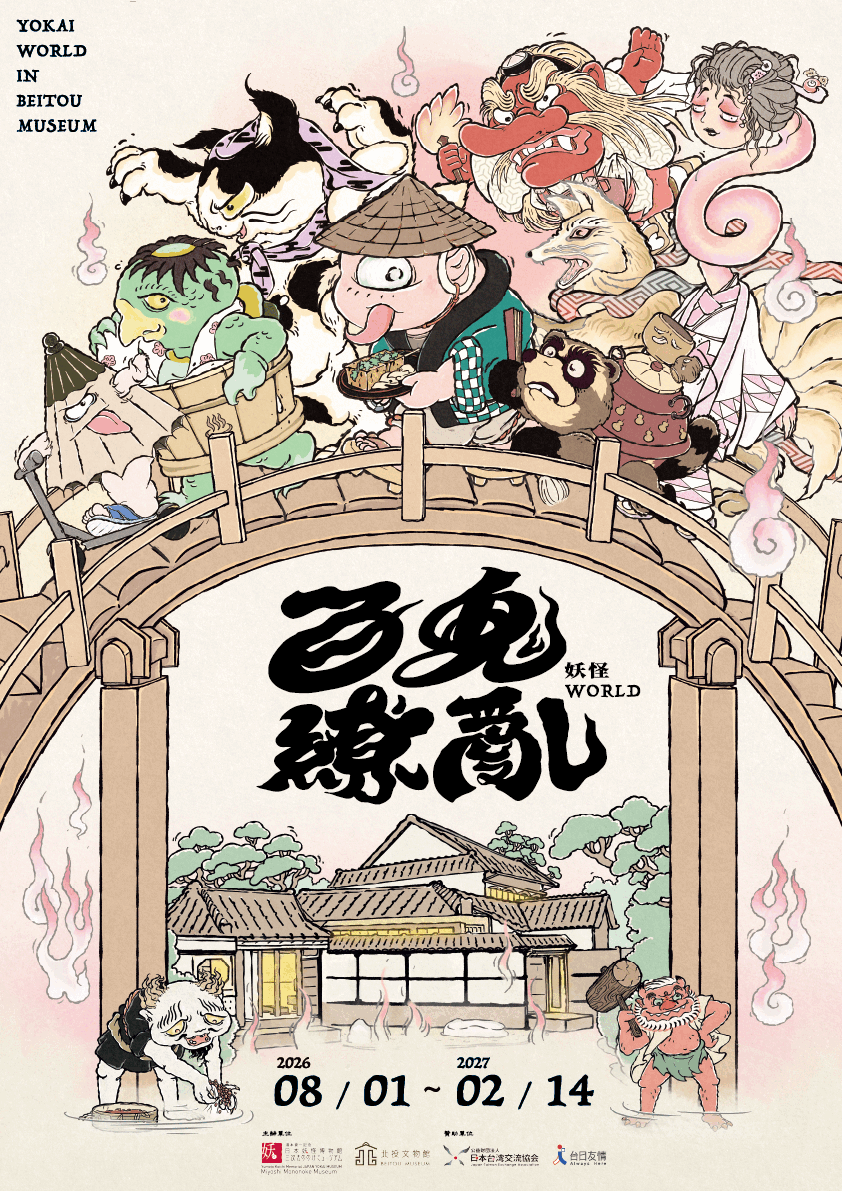
In 1749, in Miyoshi in the province of Bingo, a sixteen-year-old samurai boy named Ino Heitaro went into the hills on a dare; afterwards, for a whole month, strange things kept happening in his house. The story was later written down as the Ino Mononoke Roku, in text versions and as handscrolls. In 2019 the city of Miyoshi, in Hiroshima Prefecture, opened Japan's first museum devoted to yokai, the Yumoto Koichi Memorial Japan Yokai Museum, built on the collection of some five thousand items gathered by the yokai researcher Yumoto Koichi.
The special exhibition at the Beitou Museum is organized with that museum. The Beitou Museum begins with the Oxford English Dictionary, whose December 2025 update took in the word "yokai." Yet people were drawn to yokai long before manga and anime. Yokai began in awe of nature and unease before the unknown, and over time they settled into everyday life, living alongside people.
So the exhibition holds not only handscrolls and nishiki-e prints but also things people carried: kimono, netsuke (small carvings hung from the sash), and inro; sugoroku board games and toys; plates and vases; and even sword fittings such as tsuba and kozuka. The Mizuki Shigeru Memorial Museum and the Lafcadio Hearn (Koizumi Yakumo) Memorial Museum are co-organizers.
The building that houses the exhibition began as the Jiashan Inn, a hot-spring hotel completed in 1921. After the war the Ministry of Foreign Affairs took it over as a dormitory and guesthouse; it was renamed the Beitou Museum in 1987 and designated a Taipei city monument in 1998.
Knowledge cardsYokai
- Works change during the run
Everyday flooding in South Florida, and the advertising images that fill the world's big cities.

Anastasia Samoylova was born in Moscow and now lives in Miami and New York. Miami is a city where real-estate advertising and flooding exist side by side. In FloodZone (2016–2019), billboards promising luxury homes and an ideal life stand next to flooded streets, demolition, and building sites.
Photographs of disaster usually rely on sudden, shocking scenes of destruction. Samoylova avoids them on purpose, and photographs instead a low, constant unease. The Kuandu Museum of Fine Arts draws the line between weather and climate: weather is what happens now, storms, rain, and floods; climate is a lasting condition of the environment, and also a state of mind that a group of people share. Floridas (2016–2021) uses soft pastel tones to photograph pink flamingos, abandoned buildings, and brightly painted churches, putting beauty and denial in the same frame.
The central work, Image Cities (2021–2022), was made as she travelled alone through seventeen large cities, among them London, Paris, Tokyo, and Amsterdam. With telephoto lenses, reflections, and compressed space, she layers advertisements, buildings, and passers-by into a single picture.
The exhibition is co-organized by the Kuandu Museum of Fine Arts and UP Gallery. It opens with her early series Breakfasts and ends with Atlantic Coast (2020–2025).
Knowledge cardsPhotography
Lim Kac-keong's paintings, and what he meant by "looking."
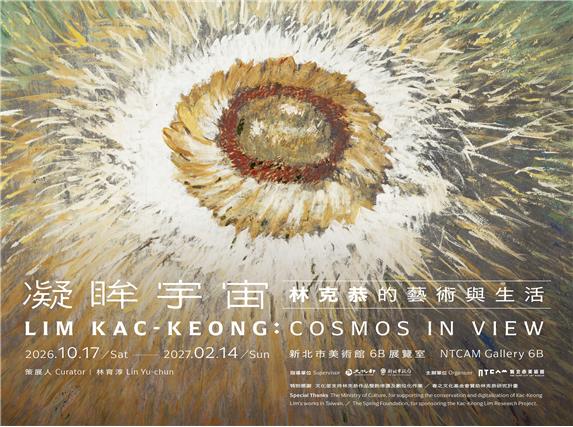
The exhibition begins with English Countryside, from 1922, when Lim Kac-keong was in his early twenties and studying art in Europe. Born into the Lin Ben Yuan family of Banqiao, he spent his boyhood in the Shuzhuang Garden on Gulangyu, off Xiamen, and as a young man studied at art academies in Britain, France, and Switzerland for twelve years. His early realist work carries that training in English watercolour and the European academy.
From 1938 to 1949, as war and upheaval spread, he moved his family again and again between Xiamen, Hong Kong, and Australia, settling in Taiwan only after the war, where he spent nearly twenty years teaching art. Painting, he said, holds no secret trick: what matters most is looking, and painting what you truly see, what you see with the eye of the spirit.
After the war he kept experimenting with figures, landscapes, the nude, and abstract form; in his last years he brought thoughts on the cosmos, Eastern philosophy, and his sense of life into his paintings. Between Lake and Mountains of 1962 and Sunflowers of 1968, the light in his pictures gradually became an image of the cosmos.
The New Taipei City Art Museum began researching Lim in 2020, and the more than three hundred paintings his family donated returned from the United States to Taiwan in 2025. This exhibition draws on more than a hundred works and documents, weaving a timeline with themed sections to look back over his ninety-odd years.
Knowledge cardsTaiten
Opening soon
Ryuichi Sakamoto's 1999 opera LIFE, and the installations taken apart from it.
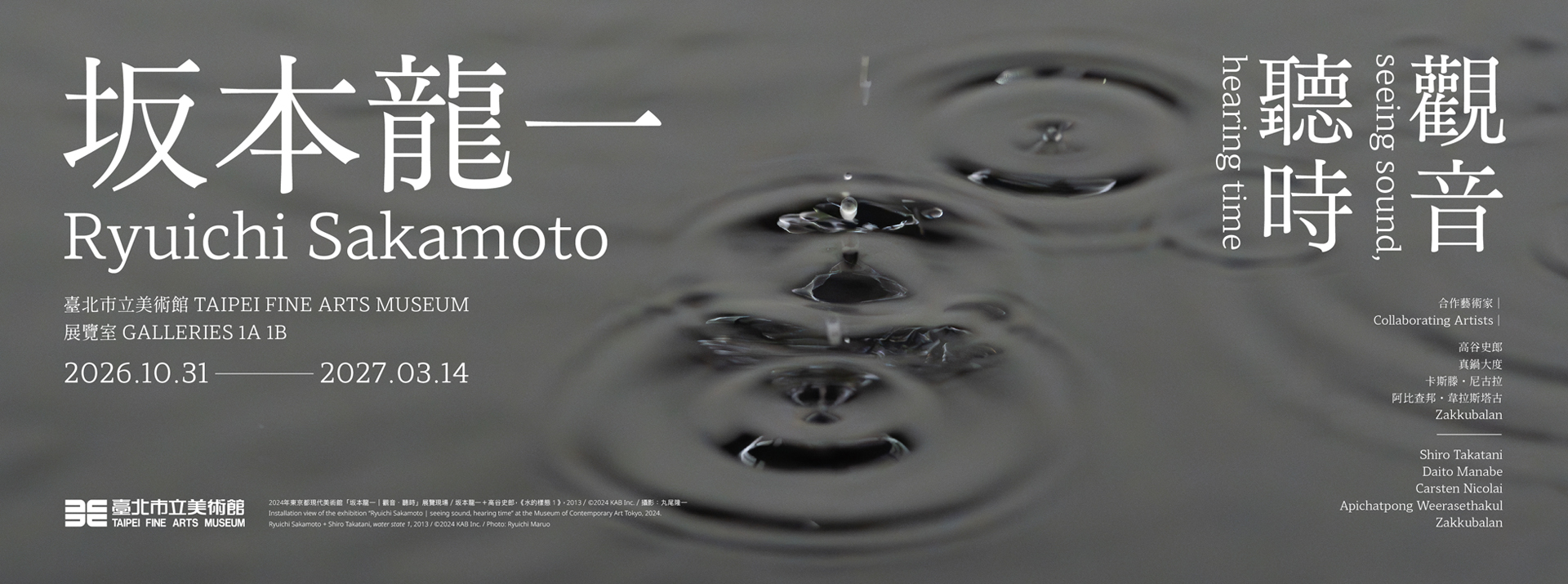
In 1999 Ryuichi Sakamoto staged his opera LIFE at the Nippon Budokan in Tokyo and at Osaka-jo Hall. He meant it as a summing-up of the twentieth century, a century of struggle and division, and as a vision of coexistence for the twenty-first. The stage images were entrusted to Shiro Takatani of the art collective Dumb Type, and their collaboration began there.
In 2007 the Yamaguchi Center for Arts and Media (YCAM) commissioned a new work from the two. They took the opera's sound and images apart and set them in a gallery again, as LIFE – fluid, invisible, inaudible ...: nine acrylic water tanks hang in a darkened room in a three-by-three grid. Ultrasound raises mist inside each tank, projectors above cast images into the water and mist, and speakers sit at both ends of the tanks. A program arranges the sounds and images at random, so the work never stays the same.
This way of moving music out of time and into space went on into more collaborations. With Daito Manabe he made sensing streams, which turns electromagnetic signals the eye cannot see into images and sound. Carsten Nicolai (Alva Noto) made a number of albums with him from 2002; the two works by Nicolai shown here both grow out of his long fascination with Jules Verne's Twenty Thousand Leagues Under the Seas.
The Taipei Fine Arts Museum shows seven large installations, with a selection from the archive of the opera LIFE, curated by Sachiko Namba. The exhibition has travelled to Beijing, Chengdu, Tokyo, and Hong Kong, and now tours to Berlin and Taipei. LIFE – fluid, invisible, inaudible ... is one of the seven.
Knowledge cardsVideo artSound artInstallation art
How the Qing empire dealt with the countries around it, from tribute to treaties.
Before his armies crossed into China, the Manchu ruler Hong Taiji gave his state a new name, written in Manchu documents as daicing gurun, the Great Qing. The Qing took up the Chinese tradition of the celestial court and received envoys from every direction under the binli, the ancient rites for receiving guests.
Countries that presented formal letters, sent missions to court at fixed intervals, and offered local products as tribute became the Qing's vassal states. Those it dealt with through trade and border disputes, without formal diplomatic ties, were trade states; those bound to it by treaty were allied states. In the nineteenth century, as Western powers forced their way in, the court set up the Zongli Yamen in 1861 to handle foreign affairs, and in 1901 turned it into the Ministry of Foreign Affairs.
Treaty ports opened one after another, foreign envoys came to live in Beijing, and disputes with foreigners multiplied. Qing foreign relations slowly moved from the passive to the active, until the empire took part in signing agreements to settle international disputes together and became a member of the international community. Modern diplomatic ideas and protocol took shape gradually over the same years.
The exhibition, in Gallery 103 of Exhibition Hall I at the museum's Northern Branch, is in three sections, The Tributary Order, Expedient Measures, and Securing the Realm. It shows Qing diplomatic documents, official compilations, and maps from the museum's collection, along with records deposited by the Ministry of Foreign Affairs. The name of the work changed along the way, from vassal affairs to foreign matters, and then to foreign affairs.
Knowledge cardsTribute and the rites for guests
About this anthology: chosen each month by the Anthology editors. Every exhibition is checked against the venue's official site (as of Oct 19, 2026), and no listing is paid for. If dates or prices change, please refer to the venue's own announcement.
The Chinese original of each title and venue name is shown in gray below it.
A little more art in your life
Every month, we write a letter about exhibitions we love and why we recommend them. Subscribing is free, and you can cancel at any time.
We will use your email address only to send the newsletter. Privacy
Seoul · Tokyo
Anthology in other cities. Each is its own local edition, opening with this month's anthology.