112 days left#Media art
Ryuichi Sakamoto | seeing sound, hearing time
Chinese original:
坂本龍一︱觀音.聽時
A look back at Ryuichi Sakamoto's (1952–2023) installation work since the 2000s: seven large installations and selections from the archive of his 1999 opera LIFE. With long-time collaborators including Shiro Takatani, Daito Manabe, Carsten Nicolai, and Apichatpong Weerasethakul, he used water, mist, weather data, and electromagnetic waves to turn music, which normally only passes through time, into works that can be seen in space and felt with the body.
Featured in: Taipei Anthology: December · Taipei Anthology: November · Taipei Winter Exhibitions 2026–27
1 / 5 Image: Taipei Fine Arts Museum
- Dates
- Oct 31, 2026 – Mar 14, 2027
- Venue
- Taipei Fine Arts Museum (臺北市立美術館) · Yuanshan (Fine Arts Museum)臺北市中山區中山北路三段181號
Getting there
MRT Yuanshan Station, Exit 1; walk through the Expo Park Yuanshan area
- Hours
- 09:30–17:30 · Closed: Mon
- Admission
- Full price NT$30Original: 全票 30 元
- Artists
- Ryuichi Sakamoto
- Shiro Takatani
- Daito Manabe
- Carsten Nicolai
- Apichatpong Weerasethakul
- Zakkubalan
- Curators
- Yuko Namba
The calendar entry covers the whole run, so you won't need to look the dates up again. Please check opening hours and closing days before your visit.
Tickets and booking
Booking required; opens Dec 3 10:00.
Booking required: entry by timed slot.
Timed-entry booking · NT$30
Open now
Slots Oct 31 – Nov 29, 2026
Timed-entry booking · NT$30
Open now
Slots Dec 1, 2026 – Jan 3, 2027
Timed-entry booking · NT$30
Opens Dec 3, 2026, 10:00 Taipei time
Slots Jan 5 – Feb 14, 2027
Timed-entry booking · NT$30
Opens Jan 5, 2027, 10:00 Taipei time
Slots Feb 16 – Mar 14, 2027
From the venue's and organizer's announcements, checked Nov 21, 2026. Tickets can sell out early or change; please check the official page before you buy. Source: 臺北市立美術館:坂本龍一︱觀音.聽時 參觀資訊
Entry notes
TFAM is open Tuesday to Sunday, 9:30–17:30, and until 20:30 on Saturdays. It is closed on Mondays.
- TFAM is open Tuesday to Sunday, 9:30–17:30, and until 20:30 on Saturdays. It is closed on Mondays. (Source: 臺北市立美術館, 2026)
- Tickets are OPENTIX e-tickets only, up to 4 per account for the same slot, and everyone needs one whatever their age. A few walk-in places are kept each day: buy a ticket on site and join the waiting line, with no guarantee of entry. For the 17:00, 18:00, and 19:00 slots on Saturdays, anyone can choose the free (NT$0) ticket. (Source: 臺北市立美術館:坂本龍一︱觀音.聽時 參觀資訊, 2026)
- There are no group tickets and no group visits by reservation. Free (NT$0) tickets, for children under 6, visitors with disabilities and one companion, visitors 65 and over, and others, must also be booked on OPENTIX and verified with ID at the door; on the first Wednesday of each month, residents of Yuanshan Village can also book a free ticket. (Source: 臺北市立美術館:坂本龍一︱觀音.聽時 參觀資訊, 2026)
- Bookings are currently open for visits up to January 3, 2027. Later sessions go on sale at 10:00 Taiwan time: January 5 to February 14 on December 3, 2026, and February 16 to March 14 on January 5, 2027. (Source: 臺北市立美術館:坂本龍一︱觀音.聽時 參觀資訊, 2026)
- Booking is online through OPENTIX, with a small number of on-site standby places kept each day. One account can book up to 4 tickets per slot, and everyone entering needs a ticket regardless of age. Each slot is one hour, check-in opens 20 minutes before it starts, and there is no time limit once inside. (Source: 臺北市立美術館:坂本龍一︱觀音.聽時 參觀資訊, 2026)
- On-site standby means buying a ticket at the museum and joining the queue; one ticket per person, entry is not guaranteed, and the queue closes at 17:00 Tuesday to Sunday and 20:00 on Saturday. For the Saturday 17:00, 18:00 and 19:00 slots, everyone can book a NT$0 ticket. (Source: 臺北市立美術館:坂本龍一︱觀音.聽時 參觀資訊, 2026)
- If you cannot come, you can refund on OPENTIX before your slot ends, with a 10% fee of the ticket price per ticket. An exchange counts as a refund and you rebook afterwards. If the museum announces a cancellation or closure that day, the refund is in full. (Source: 臺北市立美術館:坂本龍一︱觀音.聽時 參觀資訊, 2026)
From the organizer's announcements and press reports. Arrangements can change; please check the official site before your visit.
Guided tours
The exhibition has an audio guide and a guidebook (PDF), both linked from the official exhibition page; language and fee are not stated there.
- Audio guideThe exhibition has an audio guide and a guidebook (PDF), both linked from the official exhibition page; language and fee are not stated there.
Source: 臺北市立美術館 坂本龍一︱觀音.聽時. From the venue's and organizer's announcements. Schedules, languages and fees can change; please check the official site before your visit.
Organizers and partners
Organized by: Taipei Fine Arts Museum
- Organized by
- In cooperation with
- The Estate of Ryuichi Sakamoto / KAB Inc.
- Dumb Type Office Ltd.
Organizing this exhibition? Write to us to add or correct anything here: hello@anthology-art.org
Written for this exhibition

After the northeast monsoon arrives, Taipei's rain never comes down all at once. It falls for a spell and stops for a spell, and even in the stops no one dares to fold the umbrella. Outside the qilou, the covered walkway in front of the shops, a whole row of scooters is parked, every seat wrapped in a plastic bag, and the raindrops are much clearer on the plastic than on the asphalt; farther off there is the awning, the drain cover, a plastic stool in front of some shop. When the rain eases there is nothing to do, so I stand there and listen. After a long while I realised that rain has no sound of its own: when it falls on a thing, it is the sound of that thing.
Knowledge cards
Video art錄像藝術Art made with video technology, shown as a single-channel work, an installation of screens and projections, or video sculpture.Read moreClose
01About
Video art became a practice of its own in the mid-1960s, when portable consumer recording equipment let artists work outside television studios. Nam June Paik showed altered television sets in Wuppertal, Germany, in 1963, and many accounts date the start of video art to 1965, when he filmed Pope Paul VI's procession in New York with his new Sony Portapak and showed it the same day in a Greenwich Village café. Video art often sets aside the conventions of cinema and may have no actors, dialogue, or plot. Labels say which kind a work is: Wang Ya-hui's Still Life in Daylight (2005) is a video installation of 4 minutes 36 seconds, and her Notebook (2020) a single-channel video, in colour and silent, of 9 minutes 1 second.
02In the gallery
Check the running time on the label first; if the work loops, you can start partway and stay until it returns to what you first saw.
Wall label terms in Chinese
- 錄像藝術
- Video art
- 單頻道錄像
- Single-channel video
- 錄像裝置
- Video installation
- 片長
- Running time
03Notes
Video art often ignores the conventions of film; it can have no actors, dialogue, or plot.
This time, at Ryuichi Sakamoto | seeing sound, hearing time —
If the video tells no story, what do you think it wants you to look at?
04Related
Sound art聲音藝術Art that uses sound both as its medium and as its subject.Read moreClose
01About
Among its forerunners, the Futurist Luigi Russolo built noise machines from 1913 that imitated industrial machinery and the sounds of war, and John Cage's 4′33″ (1952) is a score of four minutes and thirty-three seconds of silence. From the 1950s and 1960s visual artists and composers used kinetic sculpture and electronic media to explore the space around them. Ryuichi Sakamoto, from the 2000s, studied how sound is heard and felt in space.
02In the gallery
Stand in a few different places inside the work and listen to how the sound changes; notice the moments when it stops, too.
Wall label terms in Chinese
- 聲音藝術
- Sound art
- 聲音裝置
- Sound installation
- 時基藝術
- Time-based art
- 樂譜
- Score
03Notes
In sound art, the size of a space is often measured by ear.
This time, at Ryuichi Sakamoto | seeing sound, hearing time —
Close your eyes. How large does the space around you feel?
04Related
Other cards (1)Hide other cards
Installation art裝置藝術Large-scale, mixed-media constructions, often made for a specific place or a limited time, that the viewer often walks into.Read moreClose
01About
An installation is not a set of separate artworks but one whole experience, centred on how the viewer perceives it. The artist Ilya Kabakov said that the main actor in the total installation, the centre toward which everything is addressed, is the viewer. Forerunners include Kurt Schwitters' Merzbau and the “environments” Allan Kaprow made from about 1957; from the 1960s installation became a major strand of modern art. In Taipei, Chen Chao-hua uses altered compressors and condensing techniques so that frost forms and melts again and again in the gallery, and in When Tomorrow is Forgotten at MOCA Taipei, one artist, drawing on their own care work, brings the spaces, objects, and traces of labour from care settings into the exhibition. A label reading “dimensions variable” means the size of the work changes with the space it is shown in.
02In the gallery
Pause at the entrance to take in the whole space before you step in; once inside, notice what changes as you move.
Wall label terms in Chinese
- 裝置
- Installation
- 複合媒材
- Mixed media
- 特定場域
- Site-specific
- 尺寸依場地而定
- Dimensions variable
03Notes
The parts of an installation add up to one experience, and what matters is how you perceive it.
This time, at Ryuichi Sakamoto | seeing sound, hearing time —
Having walked through it, where do you think the work begins, and where does it end?
04Related
Nearby, after this one
Same venue · Taipei Fine Arts Museum
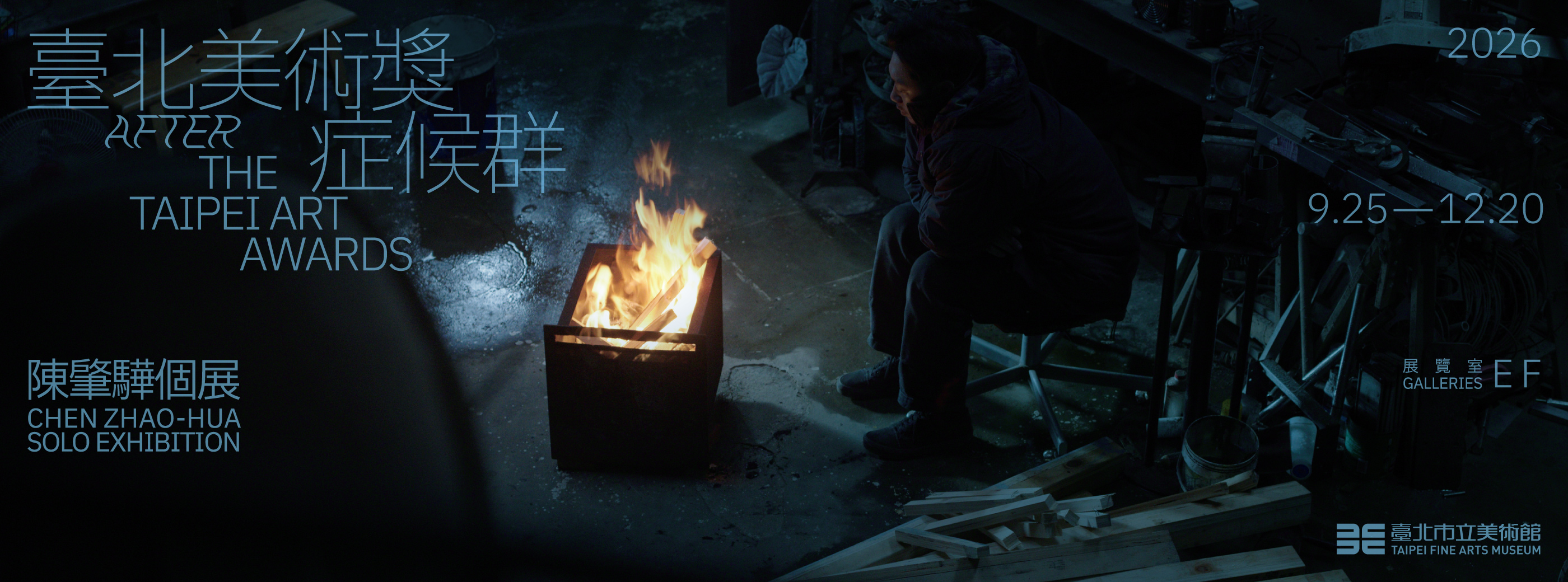
Same neighborhood · Yuanshan (Fine Arts Museum)
Shows open on the same days as this one are listed first (regular closing days only).