Essay
RainRyuichi Sakamoto | seeing sound, hearing time, Taipei Fine Arts Museum
After the northeast monsoon arrives, Taipei's rain never comes down all at once. It falls for a spell and stops for a spell, and even in the stops no one dares to fold the umbrella. Outside the qilou, the covered walkway in front of the shops, a whole row of scooters is parked, every seat wrapped in a plastic bag, and the raindrops are much clearer on the plastic than on the asphalt; farther off there is the awning, the drain cover, a plastic stool in front of some shop. When the rain eases there is nothing to do, so I stand there and listen. After a long while I realised that rain has no sound of its own: when it falls on a thing, it is the sound of that thing.
Ryuichi Sakamoto did the same thing in his sixties. In 2014 illness made him stop all his work, and once he had recovered, you would have expected a man who had written melodies for decades to go back to the piano and turn those days into a piece. He did not. He took a phone out into the streets of New York, Tokyo, Kyoto and Paris and recorded noise, animals, leaves, water, and rain. In 2017 these sounds became an album called async, which means “not synchronised”. Music usually has many sounds line up in the same moment, everyone counting the beat together and arriving at the same chord; he said most people feel pleasure in synchrony, and what he wanted to make was music whose parts do not line up with one another.
Bookshops often play Merry Christmas Mr. Lawrence. Many people can hum along with the melody without necessarily remembering who wrote it. The man who wrote it, after he recovered, began to record rain.
Plays from Spotify. Nothing is sent to Spotify until you press play.
*
This exhibition at the Taipei Fine Arts Museum shows the Sakamoto of what came after. It is called “seeing sound, hearing time”. There is no stage in the galleries, and no piece to be heard from beginning to end. The seven installations were mostly made by him together with artists he had worked with for many years, and the sound follows water, mist, weather data and electromagnetic waves. On the afternoon of the opening, the curator Yuko Nanba and two of the people who made these works with him came to the museum and sat in the audiovisual room on the basement level to talk about the exhibition: Shiro Takatani and Albert Tholen. What is written below is what can be seen in the photographs on the official website, and what I read about why he did it this way.
*
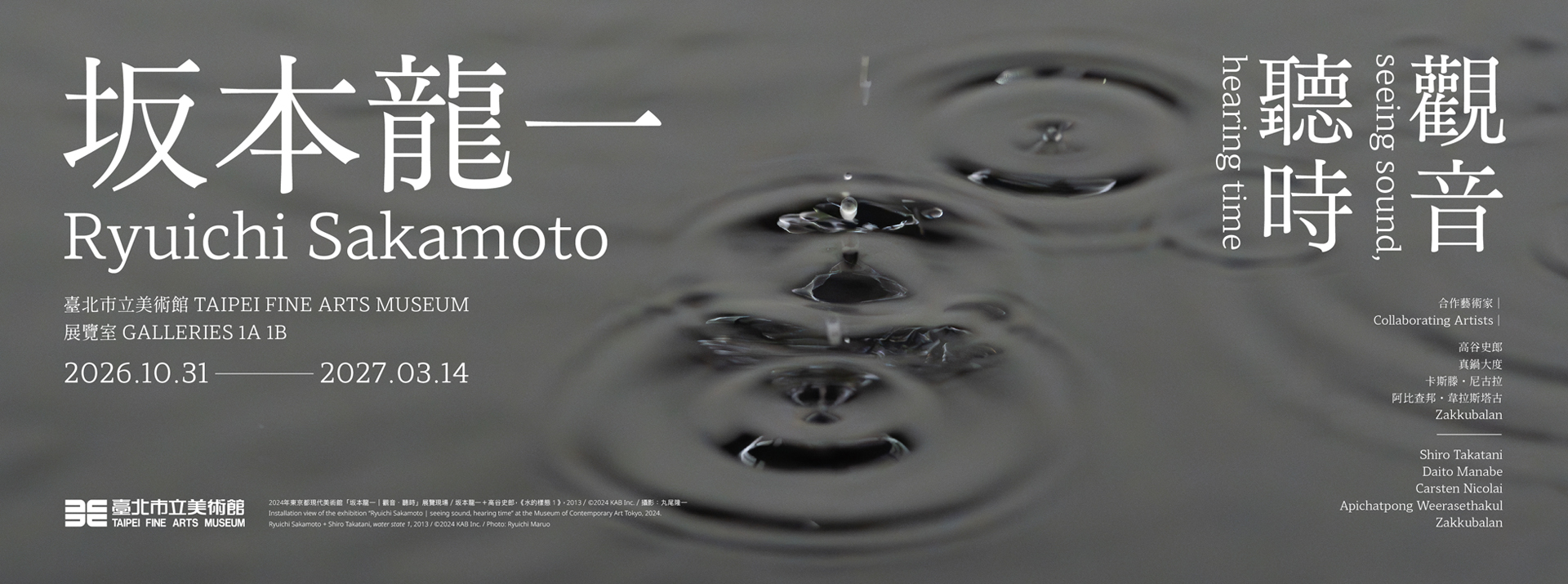
A black surface of water is like a mirror, with a few rings of ripples spreading across it. This is water state 1, which he made with Shiro Takatani. I had assumed the drops were part of the machinery, falling every few seconds like a fountain's; only later did I read that each drop follows rainfall data from around the Earth at that moment: when it is raining somewhere, a drop falls here. So the rhythm of the ripples is not arranged by anyone; it is where in the world it is raining at this moment.
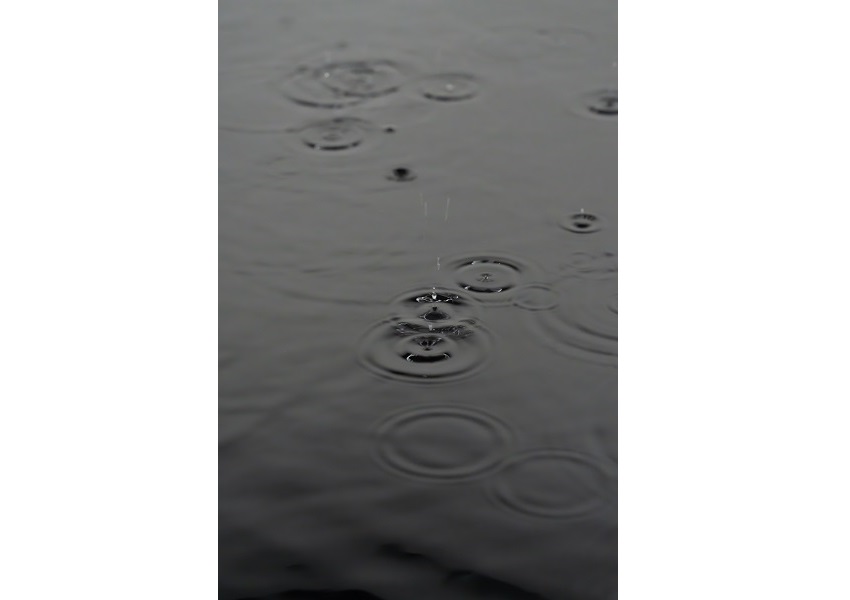
He had wanted to make a work out of water, and had thought about it for a long time. He wrote that about seven tenths of the Earth's surface is water, and so are our bodies, but water is hard to use directly as a material; paint water or film it and what comes out is water at one remove, the look of water, not water. He waited until 2013. That year he was artistic director of the tenth-anniversary festival of an arts centre in Yamaguchi, and its research and development team built a device that could let great numbers of drops fall, each on its own, so that one drop can differ from the next. With that machine water no longer had to be represented; water itself could be the work. So the drop that falls onto the black surface is not water from a tap, but rain that is falling somewhere right now.

*
Several rows of glowing tanks hang in mid-air, and patches of light lie on the floor, their edges rippled like water. This is LIFE–fluid, invisible, inaudible…, a work by him and Shiro Takatani from 2007, whose starting point was an opera eight years earlier.

In 1999 Sakamoto's first opera, LIFE, was staged in Osaka and Tokyo. What he set out to do was large: to sum up a twentieth century full of struggle and division, and then to propose how people might live together in the twenty-first. The visuals went to Shiro Takatani, a founding member of the art collective Dumb Type, and the two men's collaboration began with this opera. When an opera is finished, the usual thing is to keep a recording, or to stage it again a few years later. They did not do that. Eight years later the two of them took the opera apart and put it back together as a room: nine tanks hang in mid-air, filled with artificial mist, the opera's images are projected onto the mist one stretch at a time, and the sound falls from overhead. What once had to be sat through in a theatre for two hours became a place you can walk into and out of whenever you like, and how long you stay is up to whoever walks in. Making an opera took a great deal of effort, and taking it apart, I imagine, took just as much.
*
Two screens stand side by side in a dark room. On the left someone in blue clothes lies asleep on their side; on the right is the green of a wood. The one on the right is async–first light, a work by Sakamoto and the Thai director Apichatpong Weerasethakul; the one on the left is Apichatpong's own Durmiente.

The green of that wood is not very clear. Its edges are blurred and its colour leans warm, because it was not shot on a good camera. Sakamoto handed small cameras called Digital Harinezumi to people close to him and asked each of them to film their own everyday lives. It is a digital camera like a toy; its resolution is low, and what it takes cannot be sharp. A man of music handed the lens over, and what he handed over was a toy, with no rule about what to film, and the footage that came back was very soft. Apichatpong made async–first light from this footage and set beside it a film he had made himself of a person asleep; the wood and the sleeper stand side by side in a dark room, and the viewer stands between them.
*
On one wall hang twenty-four iPhones and iPads, each one lit, like a row of small windows. This is async–volume, by Sakamoto and Zakkubalan; the photograph was taken in Tokyo in 2024.

Zakkubalan is two people, Neo Sora and Albert Tholen. Neo Sora is Sakamoto's son, and he is also the one who later made the documentary Ryuichi Sakamoto | Opus. This work also uses the toy camera, and what it films is Sakamoto's home in New York: the studio, the living room and the garden. So what is inside those small windows is the places where a father spent his ordinary days, filmed by his son, one screen to a corner. Once you know who is behind the lens, the wall looks less like a work and more like standing outside a family's house and looking at their lit windows.
*
On a long wall, a thin strip of light runs across, full of dense lines. This is Sensing Streams, by Sakamoto and Daito Manabe; the photographs show the 2024 Tokyo version, in which the strip of light is sixteen metres long. What is drawn on the strip is the electromagnetic waves used by phones, WiFi and radio. These signals pass through the city every second, and through our bodies too; people just cannot feel them, so they have to be drawn before they can be seen. Daito Manabe is an artist who also writes programs and composes, and he is good at turning data into something that can be seen and heard.


When I was waiting out the rain under the walkway, my phone was in my pocket. What was passing through the walkway and through me then was not only rain but also these unseen signals; it is just that rain can be heard and the signals cannot.
*
The exhibition also has two video works by the German artist Carsten Nicolai, PHOSPHENES and ENDO EXO. Nicolai makes electronic music under the name Alva Noto, and since 2002 he has released albums and toured with Sakamoto. The music in these two videos comes from Sakamoto's last album, 12.
12 has twelve pieces, titled with numbers like 20210310 and 20220123. The first time I saw them I took them for serial numbers; only later did I learn they are recording dates. Sakamoto said that at the end of March 2021 he touched a synthesizer, and after that, as if keeping a diary, whenever he felt like recording on a given day he recorded that day's sketch. An album usually has its sketches polished, put in order and given names; he kept the dates, and he kept the sketches. Twelve pieces, twelve days in a little over a year. The album came out on 17 January 2023, his seventy-first birthday; a little over two months later, he died. So what you hear in Nicolai's videos is not, I think, a finished piece of music, but a certain day.
*
Leaving the galleries, on the corridor near the exit there is an abandoned piano, which the Taipei Fine Arts Museum has turned into an interactive installation you can play yourself, called Sound Box. It holds sounds sampled from everyday life, which can be layered one on top of another, and the sounds outside the museum at that moment are recorded into it too.
It is still raining on and off in Taipei these days. The black surface of water in the exhibition lets a drop fall whenever it rains anywhere in the world, so in these days quite a few of those drops must be falling for Taipei. I wonder whether the people who have seen the exhibition will go and listen too, because rain falling on a plastic bag and rain falling on an awning make different sounds.
I hope you will go and see it for yourself: Ryuichi Sakamoto | seeing sound, hearing time.
— Yu
Knowledge cards: Video art · Sound art · Installation art
The Chinese original of each title and venue name is shown in gray below it.