8 days left#History & heritage
Marked for Life
Chinese original:
生命的印記
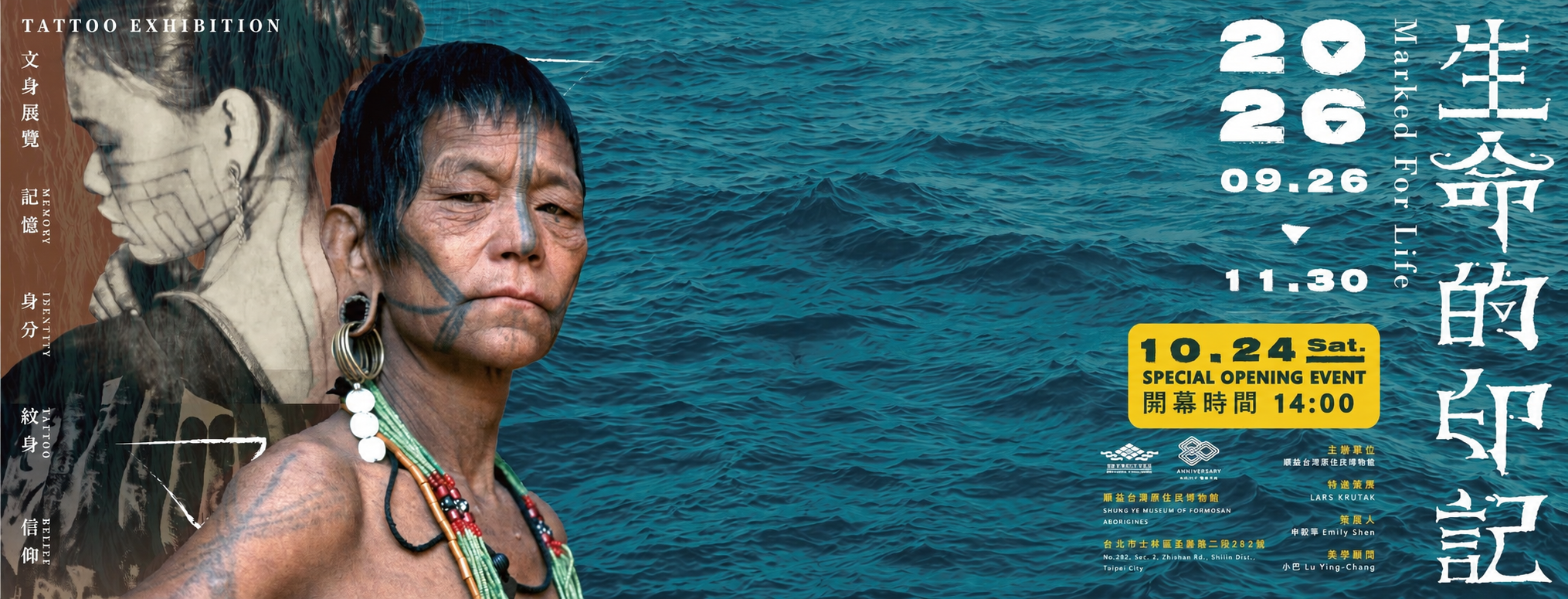
The Shung Ye Museum of Formosan Aborigines introduces traditional tattooing in Taiwan and across the Austronesian world through four themes, memory, identity, belief, and cultural belonging, showing how tattoos keep personal experience and collective history on the body. Film, photography, research materials, and tattooing practice show how tattooing relates to individuals, families, and communities.
- Dates
- Sep 26 – Nov 30, 2026
- Venue
- Shung Ye Museum of Formosan Aborigines (順益台灣原住民博物館) · National Palace Museum臺北市士林區至善路二段282號
Getting there
MRT Shilin Station Exit 1, then bus 255, S18 or S19 to the Wesley Girls' High School stop
- Hours
- 09:00–17:00 · Closed: Mon
The calendar entry covers the whole run, so you won't need to look the dates up again. Please check opening hours and closing days before your visit.
Knowledge cards
Facial tattooing and traditional tattooing in Taiwan紋面與傳統紋身Facial tattooing is a tradition of the Atayal, Seediq, and Truku peoples, marking adulthood.Read moreClose
01About
Taiwan's Council of Indigenous Peoples describes facial tattooing, called ptasan in Atayal and patasan in Seediq and Truku, For the Atayal and Seediq it was a mark of adulthood that also served as adornment and as protection against evil, and men needed experience in hunting or headhunting, women skill in weaving, before they could be tattooed. The Truku, too, tattooed only after adulthood, and women had to learn weaving first. The Atayal and Seediq believed that when a soul reached the home of the ancestral spirits, the ancestors would recognize their descendants by the marks. The practice was banned under Japanese colonial rule and was interrupted. Tattooing was not limited to the face: among the Paiwan, traditional leaders and nobles had their arms and wrists tattooed, and commoners could earn the right to a tattoo through achievement.
02In the gallery
In film or photographs, first find where the pattern sits on the face: forehead, cheeks, chin. Then compare how it differs between men and women and between peoples.
Wall label terms in Chinese
- 紋面
- Facial tattooing
- ptasan/patasan(泰雅/賽德克、太魯閣)
- ptasan / patasan (Atayal / Seediq, Truku)
- 紋身
- Tattooing
03Notes
Facial tattooing marked adulthood, and for the Atayal and Seediq it was also how ancestors recognized their descendants.
This time, at Marked for Life —
Do you first notice where on the body a pattern sits, or its shape?
04Related
Photography攝影Making images by recording light, chemically on a light-sensitive material such as film, or electronically with an image sensor.Read moreClose
01About
In 1826 or 1827 Nicéphore Niépce first fixed an image captured with a camera, after an exposure of at least eight hours. His associate Louis Daguerre developed the daguerreotype, the first photographic process to be publicly announced and commercially viable; its details were made public in Paris in August 1839. Later materials cut exposures from minutes to seconds, and then to a fraction of a second. Labels may name how a print was made: the gelatin silver print is the most common process in black-and-white photography, and a chromogenic print, or C-print, is a colour print made from a colour negative, a transparency, or a digital image. A photograph is not always taken at the moment the shutter meets the scene. For Landscape Sublime (2013–), Anastasia Samoylova printed stock landscape images from the internet, built them into collages in her studio, and photographed them again; for Image Cities (2021–2022) she used telephoto lenses, reflections, and spatial compression to layer advertising, buildings, and passers-by into dense compositions.
02In the gallery
Choose one photograph, take in the whole frame, then step closer and look at its edges: what did the photographer keep inside the frame, and what was left out?
Wall label terms in Chinese
- 照片
- Photograph
- 曝光
- Exposure
- 明膠銀鹽相片
- Gelatin silver print
- 顯色印相(C-print)
- Chromogenic print (C-print)
03Notes
A photograph isn't always the instant the shutter fell; it may be staged or collaged and photographed again.
This time, at Marked for Life —
Looking at what's inside and outside the frame, was it caught in a moment, or arranged?
04Related
Nearby, after this one
Same neighborhood · National Palace Museum
Shows open on the same days as this one are listed first (regular closing days only).

