2 days left
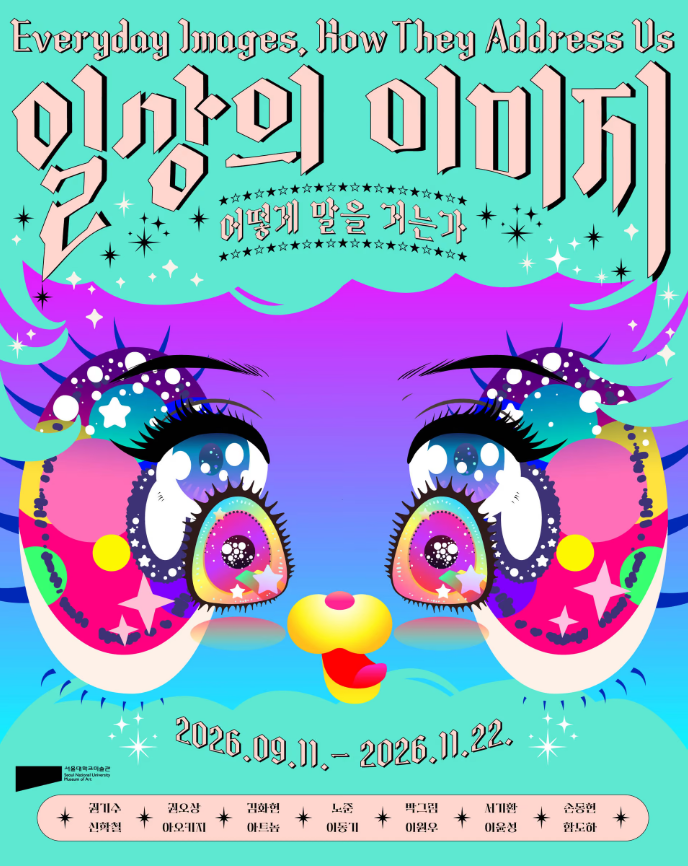
Images of Everyday Life: How Do We Engage with Them?
Korean original:
일상의 이미지, 어떻게 말을 거는가
The Seoul National University Museum of Art looks at how pop elements have appeared and changed in Korean contemporary art. Industrialisation, television advertising, comics and character culture, and the internet and digital media have all supplied artists with new images. Works by 14 artists range from critical uses of mass-media imagery and borrowed comic characters to combinations of traditional painting with pop images and today's digital pictures. On the 2nd and 3rd floors.
- Dates
- Sep 11 – Nov 22, 2026
- Venue
- Seoul National University Museum of Art, 2nd–3rd Floors (서울대학교미술관 2-3층) · Gwanak서울특별시 관악구 관악로 1 서울대학교 미술관Open in Naver Map
- Hours
- Tue–Sun 10:00–18:00 · Closed: MonClosed: Mon, Chuseok Day (Sep 25), university founding day (Oct 15)Original: 화-일 10:00~18:00 (매주 월요일, 추석 당일(9/25), 개교기념일(10/15) 휴관)
- Admission
- FreeOriginal: 무료
The calendar entry covers the whole run, so you won't need to look the dates up again. Please check opening hours and closing days before your visit.
Knowledge cards
Pop art팝아트An art movement that brought imagery from popular and mass culture, such as advertising, comics, product packaging and celebrities, into painting, sculpture and printmaking.Read moreClose
01About
Pop art emerged in Britain and the United States in the mid-to-late 1950s. In Britain Eduardo Paolozzi and Richard Hamilton explored American consumer imagery in collage and painting; in the United States Robert Rauschenberg and Jasper Johns brought everyday objects and commercial symbols into their work; by the early 1960s Andy Warhol, Roy Lichtenstein and others had made it internationally known. Pop art raised the banal, the kitsch and the mass-produced to the status of high art, blurring the line between high and low culture, and often used mechanical means of reproduction; images are sometimes removed from their known context, isolated, or combined with unrelated material. It is marked by irony and ambiguity: some works seem to celebrate the glossy abundance of postwar capitalism, while others question the sameness brought by mass production and media saturation.
02In the gallery
Find the borrowed images: an advert, a cartoon character, a logo, a celebrity. Are they enlarged, repeated, or set beside something unrelated?
Wall label terms in Korean
- 대중문화
- Popular culture
- 키치
- Kitsch
- 콜라주
- Collage
03Notes
Pop art brought images from advertising, comics, and products into art.
This time, at Images of Everyday Life: How Do We Engage with Them? —
Where did the borrowed image first appear? Now it's in a gallery, has its meaning changed?
04Related
Nearby, after this one
Same district · Gwanak
Shows open on the same days as this one are listed first (regular closing days only).