772 days left#History & heritage
Unfolding the Daedong Yeojido
Korean original:
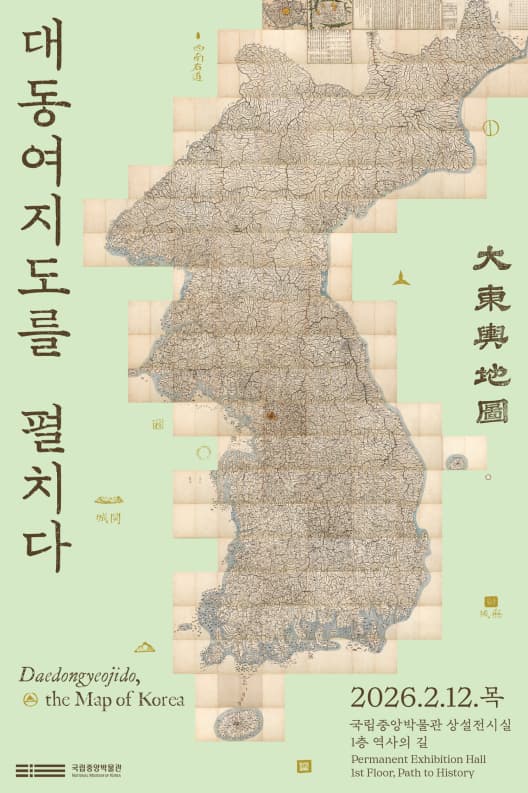
대동여지도를 펼치다
Kim Jeong-ho's Daedongyeojido of 1861 divides the country from south to north into 22 tiers, each made into a folding volume. The National Museum of Korea has printed its copy in high resolution on traditional hanji and unfolded all 22 volumes into a single map about 6.7 metres tall and 3.8 metres wide. Mountain ranges and rivers are drawn in fine detail, roads are marked with a dot every 10 ri, and a key much like a modern legend explains the symbols. On the Path of History on the 1st floor of the permanent galleries.
- Dates
- Feb 12, 2026 – Dec 31, 2028
- Venue
- National Museum of Korea (국립중앙박물관) · Yongsan (National Museum)서울특별시 용산구 서빙고로 137 국립중앙박물관Open in Naver Map
Getting there
Exit 2, Ichon Station, then the 'Museum Path' to the west gate
- Admission
- FreeOriginal: 무료
- Artists
- 金正浩
- Organized by
The calendar entry covers the whole run, so you won't need to look the dates up again. Please check opening hours and closing days before your visit.
Knowledge cards
Printmaking판화Art made by cutting, etching, or drawing an image on a plate or block, inking it, and pressing it onto paper; one plate can usually print many sheets.Read moreClose
01About
Prints fall roughly into four kinds. Relief printing cuts away what is not wanted and inks the raised surface, as in woodcut; intaglio fills with ink the lines cut or bitten with acid into a metal plate, as in etching; lithography relies on oil and water repelling each other; and screenprinting pushes ink through a mesh. Goya's Disasters of War uses etching for the lines and aquatint for areas of tone; its 82 plates were made between 1810 and 1820 but only published in 1863. Kim Jeong-ho's Daedongyeojido of 1861 is a map printed from woodblocks. There are exceptions: a monotype is painted on a smooth plate and printed only once, so each one is unique.
02In the gallery
Read the technique on the label (woodcut, etching, lithograph, screenprint, monotype), then look closely below the image for a pencilled number and signature, such as 14/50.
Wall label terms in Korean
- 볼록판(목판)
- Relief (woodcut)
- 오목판(에칭)
- Intaglio (etching)
- 애쿼틴트
- Aquatint
- 모노타이프
- Monotype
03Notes
Prints come from relief, intaglio, planographic, and stencil plates, and each leaves different lines and ink.
This time, at Unfolding the Daedong Yeojido —
From the lines and the ink, which kind of plate do you think it was? What told you?
04Related
Nearby, after this one
Same venue · National Museum of Korea
Same neighborhood · Yongsan (National Museum)
Shows open on the same days as this one are listed first (regular closing days only).