National Museum of Korea
Korean original:
국립중앙박물관
Korea's national museum traces its origins to the Imperial Household Museum opened at Changgyeonggung Palace in 1909 under the Korean Empire; after the Japanese Government-General Museum of the colonial era, it was founded as the National Museum after liberation in 1945 and took its present name in 1972. In October 2005 it moved into a new building, 404 meters long, on land returned from the US base in Yongsan, the largest museum in Korea by area. It holds about 210,000 objects (2024) and drew a record 4.18 million visitors in 2023.
- Area
- Yongsan (National Museum)
- Address
- 서울특별시 용산구 서빙고로 137
- Getting there
- Exit 2, Ichon Station, then the 'Museum Path' to the west gate
- Hours
- 09:30–17:30 (Wed and Sat 09:30–21:00; last entry 30 min before closing; closed Jan 1, Lunar New Year's Day and Chuseok; permanent and special galleries also closed the first Monday of Mar, Jun, Sep and Dec)
- Admission
- Free
Directions and admission checked against the venue's website on Oct 20, 2026.
First visit
- Backpacks and school bags go in the lockers on the ground floor.
- No flash, tripods, selfie sticks, or gimbals, and no photography for commercial use.
- No food inside the museum.
From the venue's visitor guidelines, checked on Oct 21, 2026.
Guided tours
Regular tours of the permanent exhibition (정기해설): free, no reservation. The highlights tour takes about 1 hour: Monday to Friday at 10:30, 11:00, 13:00 and 15:00, Saturday and Sunday at 11:00, 13:00 and 15:00, meeting at the Korean Empire area on the 1st floor of the Permanent Exhibition Hall. Individual galleries also run their own tours, mostly at 11:00, 13:00 and 15:00. The site says the schedule changes monthly; in November some galleries have no tours on certain days (for example the Calligraphy and Painting Gallery is closed 23 to 26 Nov). Check the site's table for each gallery.
- TourRegular tours of the permanent exhibition (정기해설): free, no reservation. The highlights tour takes about 1 hour: Monday to Friday at 10:30, 11:00, 13:00 and 15:00, Saturday and Sunday at 11:00, 13:00 and 15:00, meeting at the Korean Empire area on the 1st floor of the Permanent Exhibition Hall. Individual galleries also run their own tours, mostly at 11:00, 13:00 and 15:00. The site says the schedule changes monthly; in November some galleries have no tours on certain days (for example the Calligraphy and Painting Gallery is closed 23 to 26 Nov). Check the site's table for each gallery.
- TourRegular tours for foreign visitors: free, in English, Japanese and Chinese. Monday to Friday at 10:30 and 13:00; on Saturday and Sunday English and Japanese at 10:30 and 13:00, Chinese at 13:00. Meet at the Korean Empire area on the 1st floor of the Permanent Exhibition Hall. The site states that Korean residents may join only when accompanied by a foreign visitor.
- Audio guideNational Museum of Korea exhibition guide app (전시안내 앱): free; bring your own earphones. It explains exhibits automatically by Bluetooth beacon in Korean, English, Chinese, Japanese and Vietnamese; the AR service is in Korean and English. Download from Google Play, the App Store or ONE store; location and Bluetooth must be on (Android 7.0 or later, iOS 14.0 or later). The page does not mention audio-guide device rental.
- GroupsGroup and outside-guide booking: groups of 10 or more can apply for group visits; school groups of 30 or more book in advance; groups that give their own commentary must also book. A 'Smart Curator' exhibition commentary (스마트 큐레이터) for families runs Monday to Friday in November, with online registration until 29 Nov on a first-come basis. Times, language, capacity and fee are not listed; contact 02-2077-9000.
Source: 國立中央博物館(국립중앙박물관) 정기해설, 國立中央博物館(국립중앙박물관) 전시안내 앱, 國立中央博物館(국립중앙박물관) 예약 안내. From the venue's and organizer's announcements. Schedules, languages and fees can change; please check the official site before your visit.
On now and coming up
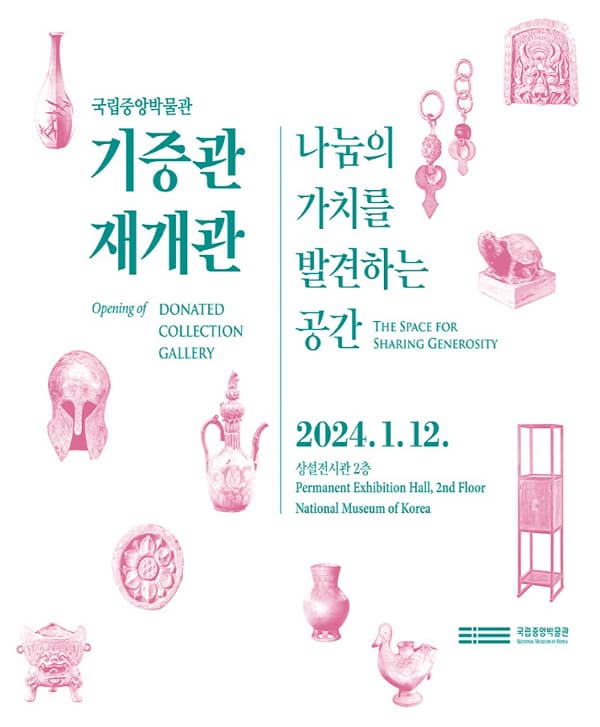
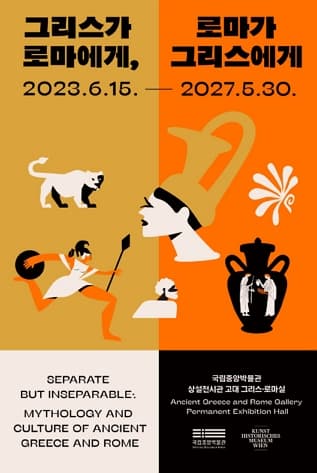
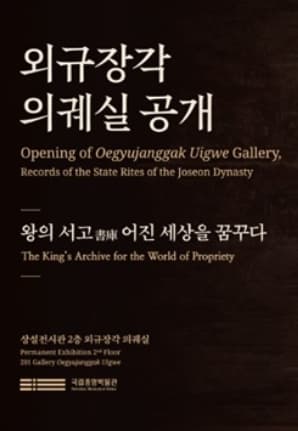
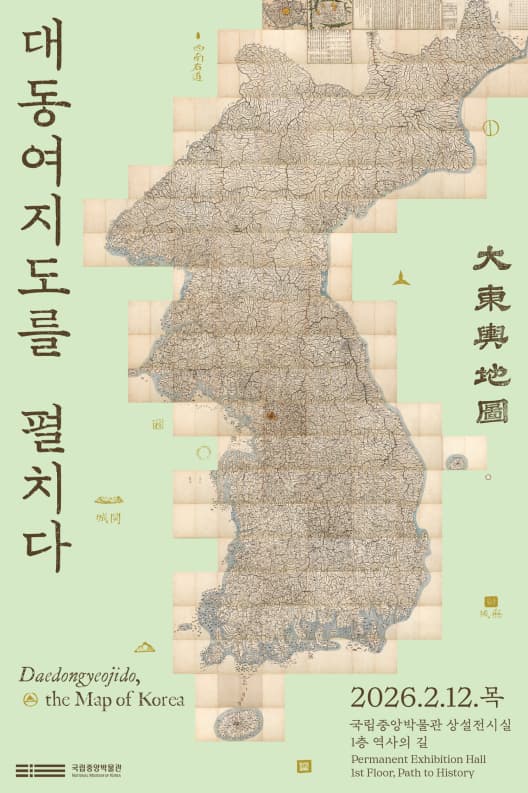
Exhibitions (Open now 7 · Opening soon 3)
The Korean original of each title and venue name is shown in gray below it.

Past exhibitions
- Our Dining TableJul 1 – Oct 25, 2026
- Islamic Art: A Journey of Radiant LightNov 22, 2025 – Oct 11, 2026
Related knowledge cards
- CeramicsObjects and works shaped from clay and fired in a kiln; by firing temperature and material they fall roughly into earthenware, stoneware, and porcelain.
- Seohwa: calligraphy and paintingA Korean tradition that joins writing and painting as one art, tied to learning and self-cultivation.
- Permanent and special exhibitionsMany museums distinguish ongoing permanent displays from special exhibitions with set dates.
- Modern SculptureSculpture's move from statues on pedestals commemorating people and events toward three-dimensional work concerned with material, weight, and the space around it.
- PrintmakingArt made by cutting, etching, or drawing an image on a plate or block, inking it, and pressing it onto paper; one plate can usually print many sheets.
- Sohn Kee-chung's Ancient Greek Bronze HelmetA Corinthian bronze helmet meant as the prize for the 1936 Berlin Olympic marathon, which reached the winner, Sohn Kee-chung, only fifty years later.
- RococoA decorative style that arose in Paris in the 1730s and lasted into the 1780s, marked by flowing curves, asymmetry, and pastels with gilding.
- Oegyujanggak UigweIllustrated records of the Joseon royal court's state rites; the set once kept at the Outer Gyujanggak on Ganghwa Island was taken by French troops in 1866 and returned to Korea in 2011.
- Roman copies of Greek sculptureThe Romans collected and copied masterpieces of Classical Greek sculpture on a large scale; many Greek originals are lost and are known today only through these copies.
- Avant-gardeArt that breaks new ground by bringing in or trying out new forms or subjects. The word is French and originally meant the troops that march ahead of an army.
- Henri MatisseHenri Matisse (1869–1954) was a French artist, regarded as the leader of the Fauvist movement around 1905. His career spanned almost six and a half decades and included painting, drawing, sculpture, printmaking, cut-outs, and book illustration. Around 1905 he structured his compositions with arbitrary bright colours and energetic brushwork, later developing flatter pictorial space; these formal innovations affected several generations of younger painters.
- Wassily KandinskyWassily Kandinsky (1866–1944) held three nationalities over his life: Russian, German and French. He read law and economics before moving to Munich in 1896, at the age of thirty, to study painting, and in 1911 he founded the Blue Rider (Der Blaue Reiter) with Franz Marc; by 1913 the horse and rider, hills, towers and trees that recur in his work no longer led the picture, giving way to line and colour. He taught at the Bauhaus from 1922, and after its closure in 1933 settled in a suburb of Paris, where he kept working.
- Paul KleePaul Klee (1879–1940) was a German citizen all his life and never joined any particular art movement, yet he took part in the Blue Rider (Der Blaue Reiter) alongside Kandinsky, Marc and others. He went to Munich in 1898 to study art, discovered colour on a trip to Tunisia in 1914, and taught at the Bauhaus from 1921 to 1931; he excelled at drawing and watercolour, and around 80 per cent of his output is on paper. In 1933, under pressure from the National Socialists, he was dismissed from his teaching post and returned to Bern at the end of the year; in 1939 alone he produced 1,253 works.
- René MagritteRené Magritte (1898–1967) was a Belgian painter widely associated with Surrealists such as Salvador Dalí and Max Ernst, yet he pursued a different goal: a heightened awareness of reality. He studied at the Académie Royale des Beaux-Arts in Brussels from 1916, moved to the Paris region after his first solo exhibition in 1927, and produced around 200 works in the next three years; in his last decade the bowler-hatted man took centre stage more and more often, and in 1965 he went to New York when the Museum of Modern Art opened a retrospective of his work.
- Alberto GiacomettiAlberto Giacometti (1901–1966) was a Swiss artist. He arrived in Paris in 1922 to study sculpture, discovered African art and Cubism in the mid-1920s, then joined the Surrealists and broke with them in 1935. He spent the Second World War in Switzerland; after returning to Paris in 1945 he began the elongated standing figures and the distinctive portrait paintings of his later work, and in 1962 he won the grand prize for sculpture at the Venice Biennale.
- Marc ChagallMarc Chagall (1887–1985), born Moyshe Segal, was a painter, lithographer, etcher and designer. In Paris he was influenced by Cubism and other avant-garde movements, yet he differed from the Cubists in his love of fantasy; he left Russia in 1922, lived in Paris from 1923 to 1940, was a refugee in the United States from 1941 to 1947, settled at Vence in 1950, and from 1957 took on a number of stained-glass commissions.
- Salvador DalíSalvador Dalí (1904–1989) was a Spanish artist. He studied at the Academia de Bellas Artes de San Fernando in Madrid, held his first one-man show in 1925, went to Paris and joined the Surrealists in 1929, and in 1930 developed his "paranoiac-critical" method. He spent 1940 to 1948 in the United States, turning to what he called his "classic" period, returned to Europe in 1948 and settled at Port Lligat in Spain; the Teatro-Museo Dalí opened in Figueres in 1974.
- Sophie Taeuber-ArpSophie Taeuber-Arp (1889–1943) was a Swiss painter, designer and dancer who took an active part in Zurich Dada, joined the Constructivist movement and championed concrete art and geometric abstraction. She settled in Zurich in 1914, met Jean Arp in 1915 and through him entered the Dada circle, and from 1916 to 1929 taught textile design at the Zurich school of applied arts; she became a member of Cercle et Carré in 1930 and joined Abstraction-Création in 1931. Her textiles, puppets, architecture and design challenged the boundaries between fine and applied art.
- Ferdinand HodlerFerdinand Hodler (1853–1918) was a Swiss painter. After an apprenticeship as a sign painter he trained from 1867 under the view painter Ferdinand Sommer in Thun; his early style was rooted in realism, in the mid-1880s he became associated with the earliest Symbolist circles, and he then turned to Symbolist subjects with an increasingly brighter palette. His art is marked by expressive line, bright colour and the rhythmic arrangement of shapes he called Parallelism; from 1900 he gained wide attention through the Berlin, Munich and Vienna Secession shows, and for more than a decade he devoted himself to the mountain and lake landscapes of Switzerland.
- Constantin BrâncușiConstantin Brâncuși (1876–1957) was a sculptor of Romanian origin who moved to Paris in 1904 and became a French citizen in 1952. He belonged to no organised movement, yet in the early 1920s he moved in the circle of Francis Picabia, Tristan Tzara and other Dadaists. From 1907 he began simplifying his figures to the point of abstraction, took up direct carving in wood and stone, and made the pedestal part of the work.
Further reading
On days when work is packed full, I paint, I write, and I get the website right one part at a time, finishing one thing before starting the next. Each of them has to look good, so all day I am thinking about how to make it better, and by evening the day feels solid. There are also days with nothing scheduled, nothing to finish and no one to show it to, and on those days I cook, eat and clean the house, and when that is done the day is over.