This exhibition ended on Oct 25, 2026.
Ended#History & heritage
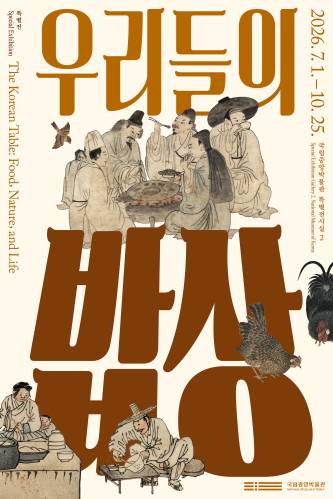
Our Dining Table
Korean original:
우리들의 밥상
On now and coming up
Same venue · National Museum of Korea
Same genre · History & heritage
The National Museum of Korea looks at the everyday Korean dining table through more than 420 objects, including vessels excavated from the Tomb of King Muryeong. Asking who people ate with, how, what, and why, it shows how the table has changed along with life and nature. Admission is free from 23 to 25 October during the Hansik (Korean food) Festa.
- Dates
- Jul 1 – Oct 25, 2026
- Venue
- National Museum of Korea (국립중앙박물관) · Yongsan (National Museum)서울특별시 용산구 서빙고로 137 국립중앙박물관Open in Naver Map
Getting there
Exit 2, Ichon Station, then the 'Museum Path' to the west gate
- Admission
- Adults ₩5,000 · Children & youth ₩3,000Original: 성인 5,000원 / 어린이 및 청소년 3,000원
Knowledge cards
Ceramics도자Objects and works shaped from clay and fired in a kiln; by firing temperature and material they fall roughly into earthenware, stoneware, and porcelain.Read moreClose
01About
Fired at high temperature, clay changes permanently and hardens. Earthenware can be fired in an open fire at around 600°C and is normally fired below 1,200°C; unglazed, it lets water through. Stoneware is fired at about 1,100–1,300°C and is dense and watertight. Porcelain, usually made with kaolin, is fired at 1,200–1,400°C and is hard and slightly translucent. Glaze is a glassy coating on the surface that makes a piece watertight and also decorates it. The earliest way of shaping was by hand: pinching, joining slabs, or building up coils of clay ring by ring; throwing on the potter's wheel came later. On the Korean peninsula, Goryeo celadon developed the sanggam inlay technique in the early 12th century, and in the Joseon period buncheong ware and white porcelain led.
02In the gallery
Look closely at the surface: is the glaze glossy or matte? Where it is thin, does the colour of the clay show through?
Wall label terms in Korean
- 토기
- Earthenware
- 석기(炻器)
- Stoneware
- 자기
- Porcelain
- 유약
- Glaze
- 코일링
- Coiling
03Notes
A pot can be pinched, coiled, or thrown on the wheel, and each leaves its own marks.
This time, at Our Dining Table —
Up close, what marks of making can you see?
04Related
A little more art in your life
This exhibition has ended. Every month, we write a letter about exhibitions we love and why we recommend them. The next one you want to see may be in it. Subscribing is free, and you can cancel at any time.
We will use your email address only to send the newsletter. Privacy