101 days left#Design & architecture#Media art
After the Rain: A New Nature Is Taking Shape
Chinese original:
After the Rain:雨後,新自然生成中
CMP Art Museum brings Studio Swine and A.A. Murakami together, presenting their two lines of work side by side for the first time. Studio Swine, founded in 2011, works across design, sculpture and film, with an interest in how materials circulate and in the regional identity of their origins. A.A. Murakami, founded in 2020, makes immersive installations of 'ephemeral art' that join art and science. Under the title of a new nature after rain, the show asks how design and art relate.
Featured in: Exhibitions Beyond Taipei 2026–27 · Taichung Winter Exhibitions 2026–27
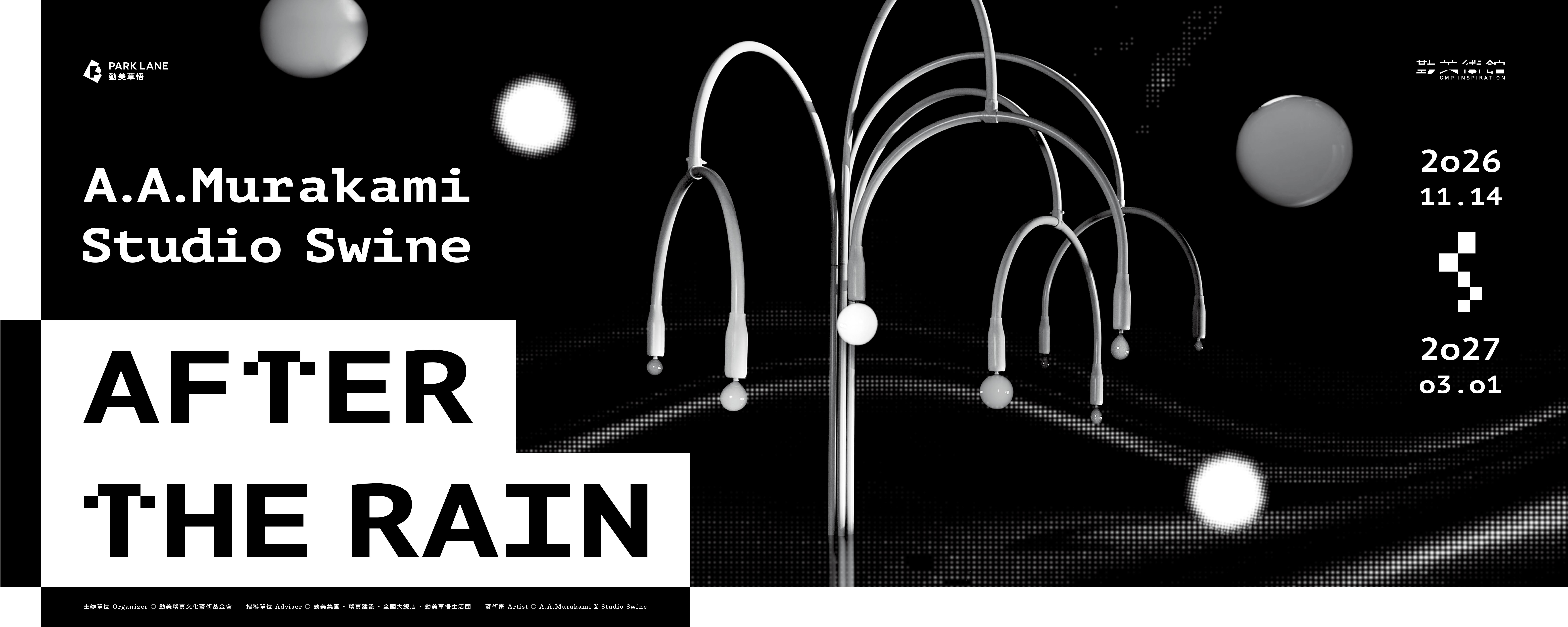
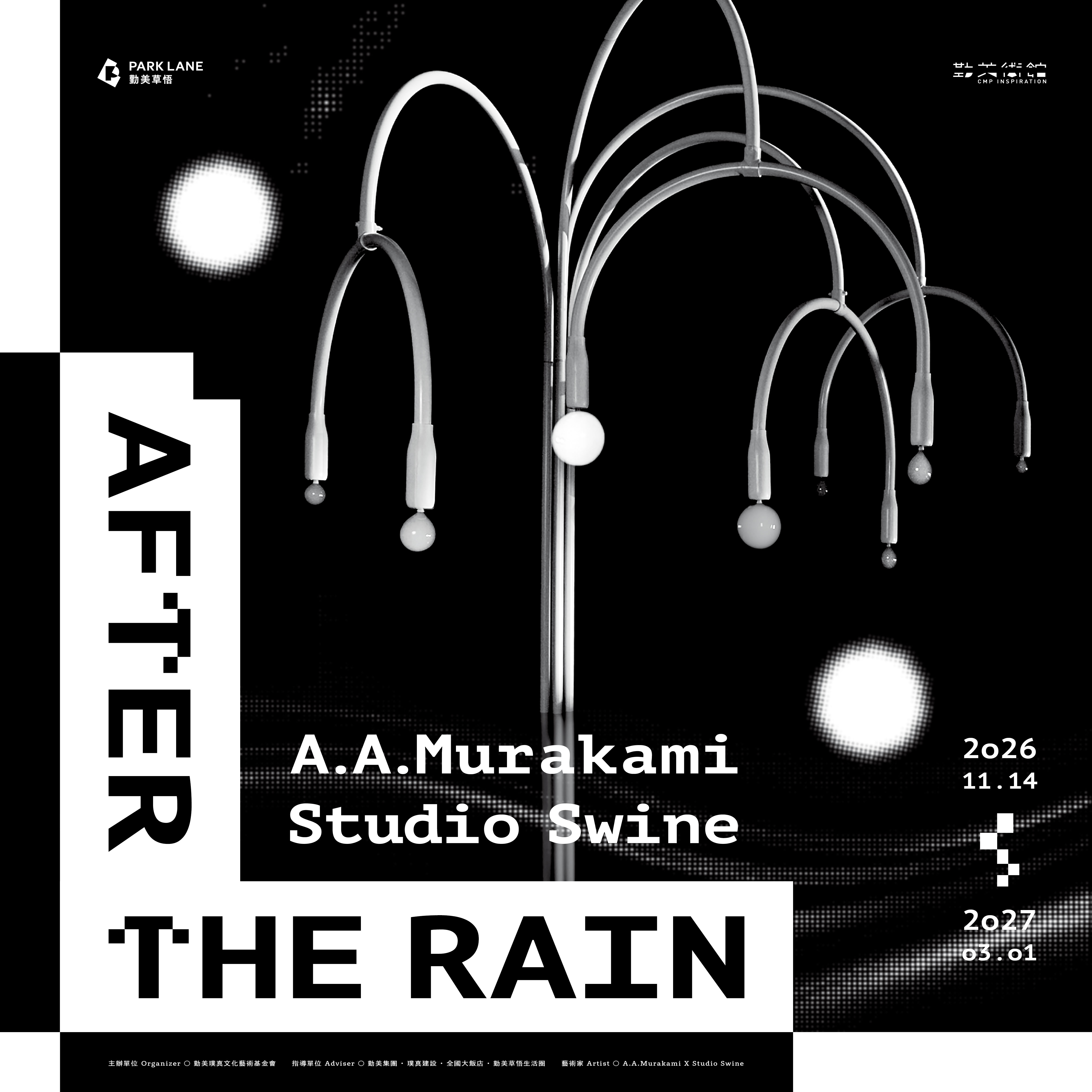
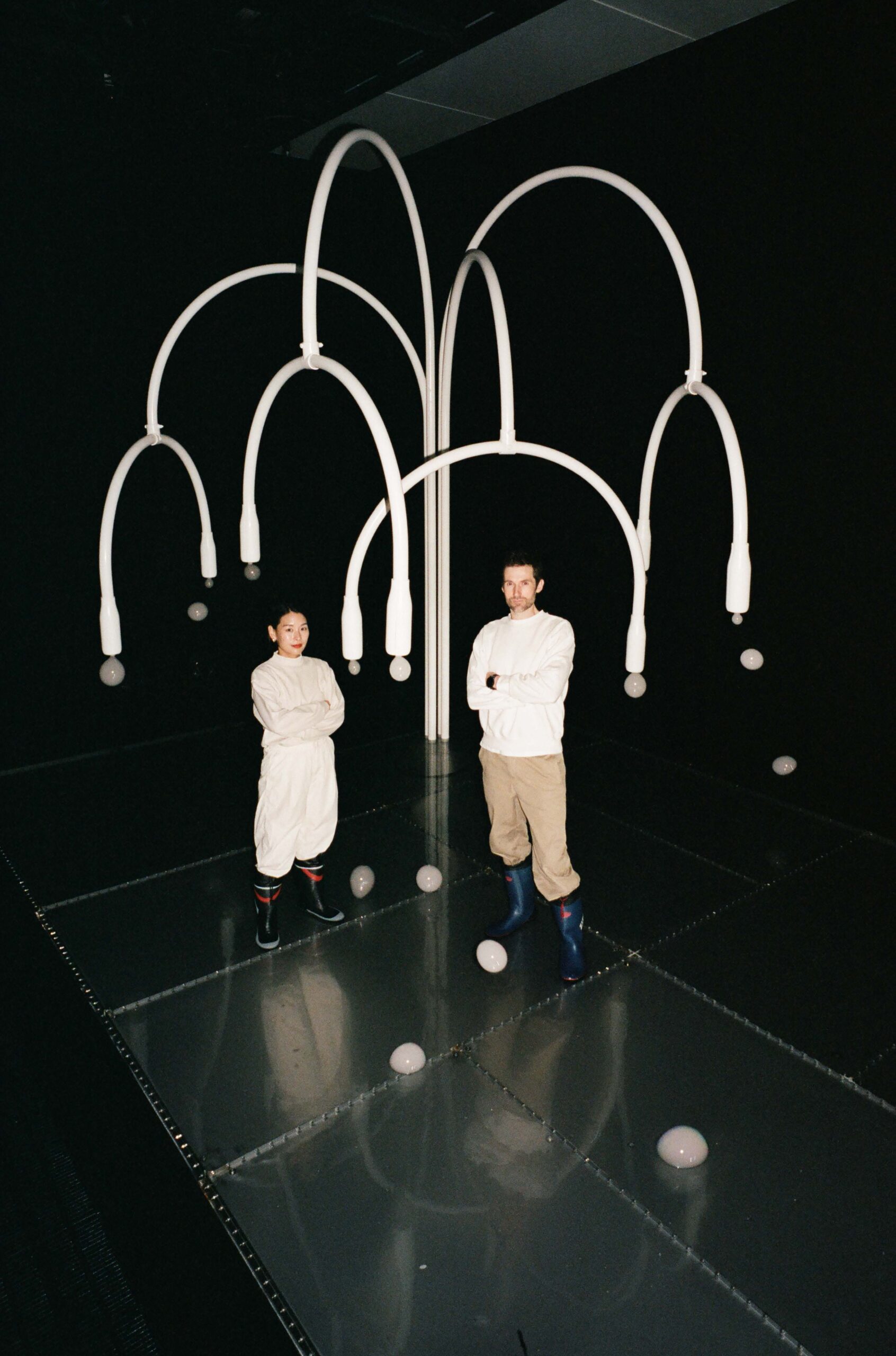
1 / 3 Image: CMP Block Museum of Arts
- Dates
- Nov 14, 2026 – Mar 1, 2027
- Venue
- CMP Block Museum of Arts (勤美術館) · Taichung台中市西區館前路79號
Getting there
Take the HSR to Taichung Station, go from Exit 6 to Platform 13 and board HSR shuttle bus 159 to the Kuang San SOGO (Meicun Rd.) stop, then walk about 5 min; from Taichung Railway Station, take a city bus to the Calligraphy Greenway (Citizen Square) or National Museum of Natural Science stop, then walk about 5 min
- Hours
- 10:00–18:00 · Closed: Mon
- Admission
- Full price NT$350Original: 全票 350 元
- Artists
The calendar entry covers the whole run, so you won't need to look the dates up again. Please check opening hours and closing days before your visit.
Entry notes
Tickets are sold on site, and the museum does not say that a reservation is required. The last time to redeem a ticket for entry is 17:00 on opening days, and each ticket is valid for one entry only during the run. When it is crowded, visitor flow is controlled and entry times depend on the situation on site. Closed on Mondays.
- Tickets are sold on site, and the museum does not say that a reservation is required. The last time to redeem a ticket for entry is 17:00 on opening days, and each ticket is valid for one entry only during the run. When it is crowded, visitor flow is controlled and entry times depend on the situation on site. Closed on Mondays. (Source: 勤美術館, 2026)
From the organizer's announcements and press reports. Arrangements can change; please check the official site before your visit.
Knowledge cards
Immersive exhibition沉浸式展覽An exhibition that surrounds visitors with projection, sound, light, or virtual reality, so that they walk into the picture instead of standing in front of it.Read moreClose
01About
The idea of wrapping the viewer in a picture is older than electronics. In 1787 the painter Robert Barker patented a painting that ran all the way round a circular room, seen by viewers standing on a platform at the centre; such paintings came to be called panoramas, and in 1793 a rotunda built to show them opened in Leicester Square, London. Today most immersive exhibitions use projection. Projection mapping uses software to fit images onto walls and floors, and even onto trees and buildings, so that the picture follows uneven surfaces. Another way is virtual reality: with a headset on, the view changes as you turn your head.
02In the gallery
First stand still and watch for a while, then walk or reach out, and compare whether the images change because of you. Notice, too, where the projection comes from.
Wall label terms in Chinese
- 全景畫
- Panorama
- 投影映射
- Projection mapping
- 虛擬實境(VR)
- Virtual reality (VR)
- 互動
- Interactive
03Notes
Immersive shows surround you with projection, sound, or virtual reality, so you walk into the picture.
This time, at After the Rain: A New Nature Is Taking Shape —
Stand still, then move or reach out. Are you looking at the work, or inside it?
04Related
Installation art裝置藝術Large-scale, mixed-media constructions, often made for a specific place or a limited time, that the viewer often walks into.Read moreClose
01About
An installation is not a set of separate artworks but one whole experience, centred on how the viewer perceives it. The artist Ilya Kabakov said that the main actor in the total installation, the centre toward which everything is addressed, is the viewer. Forerunners include Kurt Schwitters' Merzbau and the “environments” Allan Kaprow made from about 1957; from the 1960s installation became a major strand of modern art. In Taipei, Chen Chao-hua uses altered compressors and condensing techniques so that frost forms and melts again and again in the gallery, and in When Tomorrow is Forgotten at MOCA Taipei, one artist, drawing on their own care work, brings the spaces, objects, and traces of labour from care settings into the exhibition. A label reading “dimensions variable” means the size of the work changes with the space it is shown in.
02In the gallery
Pause at the entrance to take in the whole space before you step in; once inside, notice what changes as you move.
Wall label terms in Chinese
- 裝置
- Installation
- 複合媒材
- Mixed media
- 特定場域
- Site-specific
- 尺寸依場地而定
- Dimensions variable
03Notes
The parts of an installation add up to one experience, and what matters is how you perceive it.
This time, at After the Rain: A New Nature Is Taking Shape —
Having walked through it, where do you think the work begins, and where does it end?