Out of Town
Beyond Taipei 2026–27From autumn to spring, in the museums of Taichung, Tainan, and Kaohsiung
By the Anthology editors ·
Chosen by the Anthology editors and checked against each venue's official site. No paid listings. About this anthology
On now
The British Museum's ancient Egyptian collection, on what it meant to be pharaoh.

The colossal head numbered EA1063 is dated by the British Museum to about 1854–1808 BC and may be Amenemhat III. "May," because Egyptian royal statues were often re-inscribed and reused by later kings, and their faces were idealized on purpose, so a face alone rarely settles who it is.
A pharaoh was a ruler, and also a bridge between gods and people. The Egyptians believed the king kept the world in order and made offerings to the gods in their temples. On another plaque in the exhibition, Amenemhat IV presents offerings to Atum, the creator god; it dates to about 1808–1799 BC, just after the reign of the king before him.
Royal power also had to be seen. A relief of King Sanakht striking an enemy belongs to the Third Dynasty, about 2686–2613 BC, among the oldest pieces here. The pose, the king raising his mace and gripping the enemy by the hair, recurs in Egyptian art for more than two thousand years after. Of a colossal statue of Ramesses II, a single fist survives.
The Chimei Museum shows 280 objects in partnership with the British Museum, in seven themes on how a pharaoh became king and how he ruled, with gold jewelry, papyri, and clay-tablet diplomatic letters. The museum says it is the largest exhibition of pharaonic objects ever brought to Taiwan.
Daito Manabe sets artificial life and AI agents running in the museum, and visitors' movements change them.
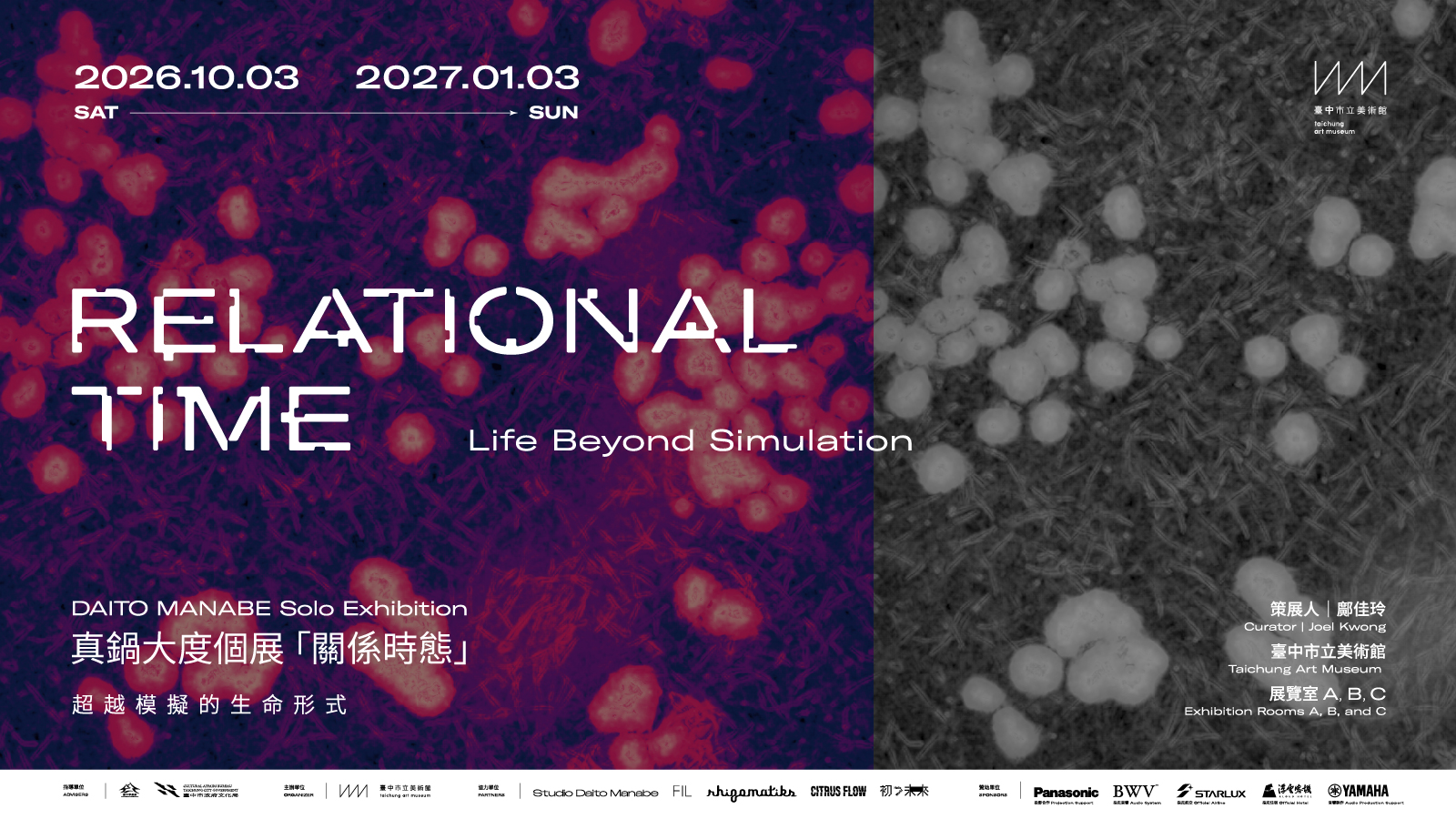
At the closing ceremony of the 2016 Rio Olympics, in the segment handing over to Tokyo, Daito Manabe worked on the technical development and designed its visual and lighting systems. He is a programmer and a composer; he founded Rhizomatiks in 2006 and has worked with Perfume, Ryuichi Sakamoto, and Björk.
His early work dealt with feedback between the body and machines, turning movement, muscle activity, and physiological signals into sound and image. His research later extended to neural networks and brain organoids (small brain tissues grown in the lab), treating biological activity as material for generating work. In recent years he has turned to societies made of people, artificial life, and AI agents, watching how they adapt and cooperate, and how they produce an order no one designed, and making those processes into music and moving images.
This solo exhibition is not a retrospective. The museum says it gathers several threads of his long research into one new presentation, made of three linked environments: a society of AI agents generated in real time and running on its own, a shifting ecology formed through interaction between people and machines, and a network of sound flowing through the building. The system keeps remembering, adjusting, and responding; where visitors pause and how they move change what the work becomes.
The curator is Joel Kwong of Hong Kong, who has organized art and technology exhibitions for many years and is now program director of the Microwave International New Media Arts Festival. The exhibition is in Rooms A, B, and C of the Taichung Art Museum.
Michael Craig-Martin draws telephones, light bulbs, and headphones in outline and saturated color.

An Oak Tree, from 1973, is a glass of water on a glass shelf set high on the wall. Beside it is a text in question-and-answer form, in which the artist says he has changed this glass of water into an oak tree: its appearance has not changed, but its substance has.
The work is often taken as a defining piece of Conceptual art: what a thing is depends on whether we are willing to believe the person who says so. In the fifty years since, Craig-Martin has kept working on the distance between an object and its image. He takes everyday things such as telephones, light bulbs, and glasses out of their context, keeps only the outline, and fills it with bright, saturated color, so that they become a kind of visual sign.
He was born in Dublin in 1941, educated in the United States, and moved to Britain in 1966. He later taught at Goldsmiths in London, where his students included the generation later called the Young British Artists, among them Damien Hirst. The museum places him where Pop art, Minimalism, and Conceptual art meet.
This is his first solo exhibition in Taiwan, curated by the Kaohsiung Museum of Fine Arts with the artist's team, running from the early conceptual works and large wall drawings to painting, sculpture, prints, and digital work. The last piece is Cosmos (2024), a digital animation that gathers the images he has drawn over forty years, shown here for the first time anywhere. The artist calls it the sum of his working life.
From Lin, a shaman on the coast, to the Mazu of every town in Taiwan: how one goddess has been shaped again and again.
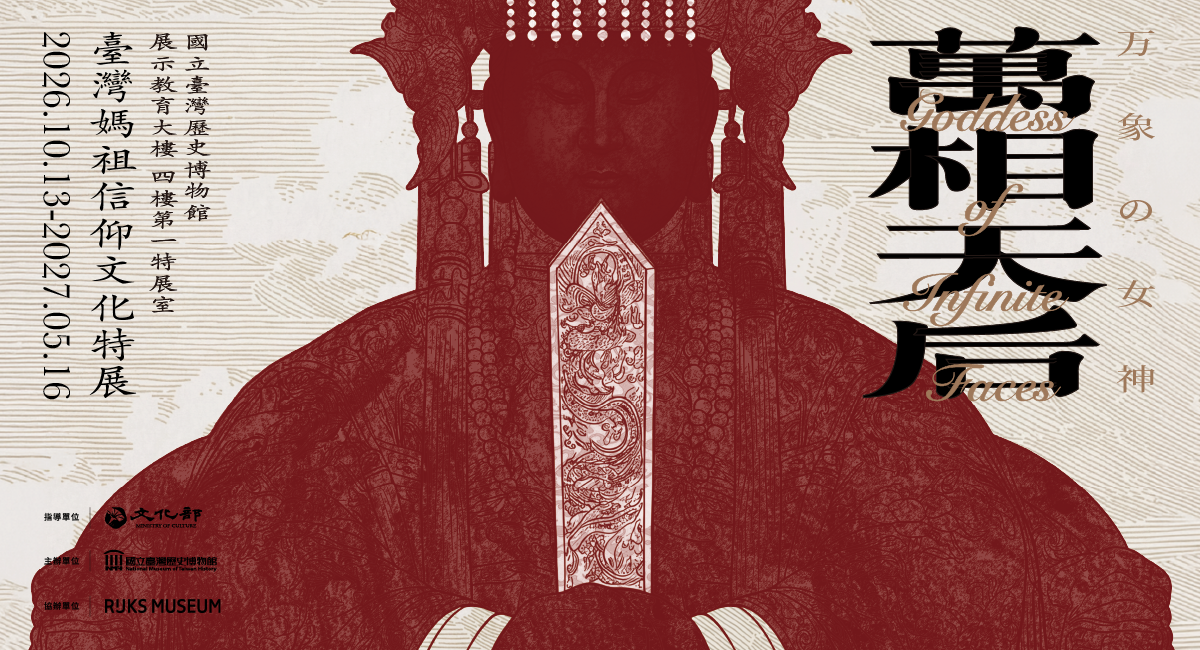
The Mazu miracle paintings and the Qing-dynasty Tianhou Zhaoyinglu on view record the same kind of story: in the Kangxi reign, Mazu appeared and protected the Qing army as it crossed the strait and took Taiwan. In this way a goddess of the coast became tied to the work of the state, and the court granted her title after title.
The exhibition's argument is that Mazu's miracles were not written once and for all; they were built and retold again and again between the state, local communities, and personal experience, which is why she has so many forms. The first section uses images and texts from the seventeenth to the nineteenth century to show how she went, step by step, from Lin, a shaman on the coast, to Empress of Heaven. The second follows the trade routes, tracing how the belief spread across East Asia and overseas, took root in Taiwan, and then traveled out into the world again.
Taiwan's Mazu has many faces. Because places and communities differ, so do her statues, crowns and robes, ritual vessels, and plaques; the third section brings these together. The fourth looks at how spiritual power attaches to things: incense burners, incense carrying poles, even cosmetics and personal belongings, and rituals such as pilgrimage, processions, and passing objects over the incense burner. The last section returns to the present, looking at how digital media spread the belief and how the ritual grounds link people into a network.
The objects come from the museum's own collection, institutions in Taiwan and abroad, and important pieces from Mazu temples around Taiwan. The exhibition is in Special Exhibition Gallery 1 on the fourth floor of the museum's Exhibition and Education Building.
Opening soon
The first Tainan Art Biennale sets out from a roundabout, along seven paths.

Tang Te-chang Memorial Park, in the center of Tainan, is a roundabout from which seven roads lead out. The first Tainan Art Biennale takes its title, Unfolding Circuits, from it: seven paths, seven curators, seven sub-themes. Tang Te-chang was a lawyer who was executed in this park during the February 28 Incident; the park was later named after him.
Here a circuit is more than a road. The museum writes that it is also the rebirth of spaces after changes of regime, the forms in which folk belief and resistance keep returning, and the continuing energy of contemporary art in daily life. Each of the seven curators looks at Tainan from a different position.
Vanished Circuit, curated by Apex Lin, revisits the long-overlooked history of "art design" in Taiwan from 1895 to the 1960s, with Shiotsuki Toho, Ishikawa Kinichiro, and Kinoshita Seigai. Historical Circuit, curated by Kao Jun-honn, centers on the Tapani Incident of 1915 and works through it with reenactment, theater, sound, and workshops. There are also Environment Circuit, on alleys, roundabouts, and temple neighborhoods; Regenerative Circuit, on the cycles of materials and rebirth; Landscape Circuit, on religious art, folk crafts, and bodily perception; and Mobility Circuit, which treats movement through the city as a rhythm.
The exhibition spreads across 16 core venues and 16 satellite venues. Besides the Tainan Art Museum, they include the Tainan Confucius Temple, the Taiwan Prefectural City God Temple, Chuan Mei Theater, the Justice Museum, and the National Museum of Taiwan Literature, scattered through the old city.
The YAGEO Foundation Collection, from the Renaissance to now, rearranged around a fable.
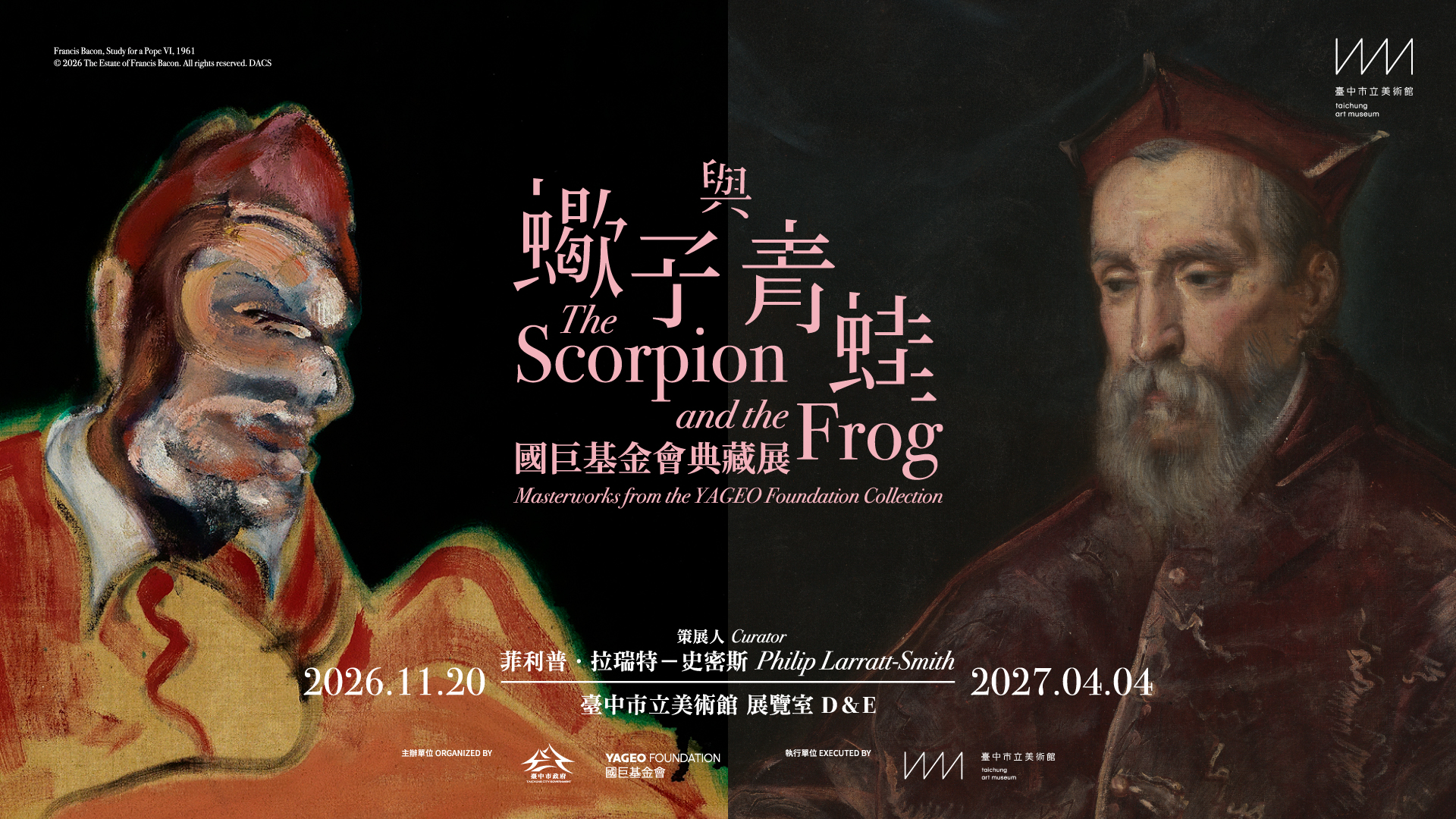
A scorpion asks a frog to carry it across a river. The frog is afraid of being stung; the scorpion says that if it stung the frog, they would both drown. Halfway across, the scorpion stings the frog anyway, because that is its nature. The museum calls it a Russian fable; in the exhibition the frog stands for reason and morality, the scorpion for desire, fate, and human nature.
The curator, Philip Larratt-Smith, does not arrange the works by period, type, or medium. He sets works centuries apart against each other: the sacred and the secular, the conscious and the unconscious, the realist and the abstract, the spirit and the senses. Francis Bacon's Study for a Pope VI (1961) hangs in the same room as Tintoretto's Portrait of Cardinal Marcantonio da Mula. Bacon's popes start from Velázquez's Portrait of Innocent X; his pope is distorted and full of psychological tension. Tintoretto paints a figure of religious authority, realistic and composed. About four centuries separate the two.
David Hockney's Christopher Isherwood and Don Bachardy is also shown in Taiwan for the first time. It depicts the writer Isherwood and his partner Bachardy, each in his own chair; Isherwood turns to look at Bachardy, who looks out of the picture. The museum uses it to speak of reason and instinct rising and falling.
Of the 66 works, 55 are shown publicly in Taiwan for the first time. The artists also include Artemisia Gentileschi, Klimt, Sanyu, Picasso, Rothko, Warhol, Richter, Jeff Koons, and Hiroshi Sugimoto. Larratt-Smith is based in New York and has been curator of the Easton Foundation, which looks after Louise Bourgeois's artistic legacy, since 2019.
About this anthology: major exhibitions outside Taipei, chosen by the Anthology editors and updated as shows open and close. Every exhibition is checked against the venue's official site or announcement (as of Oct 20, 2026), and no listing is paid for. If dates or prices change, please refer to the venue's own announcement.
The Chinese original of each title and venue name is shown in gray below it.
A little more art in your life
Every month, we write a letter about exhibitions we love and why we recommend them. Subscribing is free, and you can cancel at any time.
We will use your email address only to send the newsletter. Privacy