7 days left#Craft
Layers of Mountain Colors—Tang Rong Solo Exhibition
Chinese original:
山彩疊疊-唐榕個展
Tang Rong takes traditional ink landscape painting into ceramics: incised lines, glaze colors, and overglaze painting each answer to the forms and colors of the landscape tradition. She moved from studying ink painting to working in clay, and the show follows that path, looking at how the landscape subject passes between flat surface and solid object. Ink moves by flowing and porcelain holds firm, and the two sit side by side. In the B1 Ceramics Gallery.
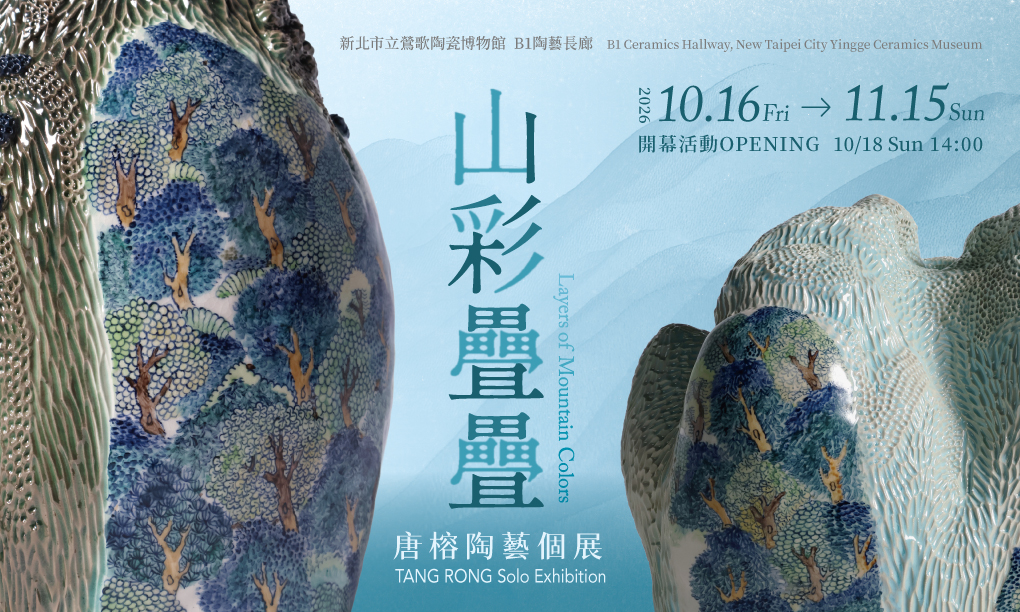
- Dates
- Oct 16 – Nov 15, 2026
- Venue
- New Taipei City Yingge Ceramics Museum (新北市立鶯歌陶瓷博物館) · Yingge, New Taipei
- Address
- 新北市鶯歌區文化路200號About 10 min walk from TRA Yingge Station (Wenhua Rd exit); buses stop at “Ceramics Museum”Open in Google Maps
- Hours
- 09:30–17:00
- Admission
- NT$80Original: 80 元
Visit planning
The calendar entry covers the whole run of the exhibition. Please check opening hours and closing days before your visit.
Nearby, after this one
Same venue · New Taipei City Yingge Ceramics Museum
Related exhibitions
Same genre · Craft


Credits
- Artists
- 唐榕
Knowledge cards
Ceramics: clay and kiln陶瓷:泥與窯火Material made by shaping clay and firing it at high temperature in a kiln; the glaze and the kiln fire both decide how it ends up.Read moreClose
01About
Ceramics are made by shaping raw material and then firing it at high temperature in a kiln; firing is what sets the form and gives it hardness and heat resistance. Earthenware is clay fired at a lower temperature and stays porous, taking in water. Porcelain, made from kaolin and similar materials, is fired to about 1,200–1,400 °C and comes out dense, low in permeability, and usually white and translucent. A glaze is a glassy coating: in the kiln it melts, fuses to the clay body, and makes the piece less able to hold water. Overglaze decoration is painted on top of a glaze that has already been fired, and needs a second firing at a lower temperature to fuse with it. The kiln is not only a last step, it takes part in the making. In the shows at the New Taipei City Yingge Ceramics Museum from October 2026 to January 2027, Yang Yixue lets porcelain cubes sag and shift under gravity and kiln fire; Wang Yiting sets what happens inside a kiln, where clay, feldspar and glaze melt, crystallize and crack, beside the way fossils form; and Tang Rong incises, glazes, and paints over the glaze to echo ink landscape painting.
02In the gallery
Look at the surface: where is the glassy shine of the glaze, and where does bare clay show? Then look for signs the kiln fire pulled or pressed the form, such as dents and cracks.
Wall label terms in Chinese
- 胎土
- Clay body
- 釉
- Glaze
- 釉上彩
- Overglaze decoration
- 燒成
- Firing
- 瓷器
- Porcelain
03Notes
Ceramics are shaped clay fired in a kiln, and the kiln fire takes part in the making.
This time, at Layers of Mountain Colors—Tang Rong Solo Exhibition —
Which parts were made by hand, and which look like the kiln's doing?