Opens in 34 days#Design & architecture
1920s–1930s Modern Music Score Illustrations — Women Expressing Music, Tokyo, and the Beauty of Art Deco —
Japanese original:
1920-30 モダン楽譜イラストレーション ―音楽を表現する女性・東京・アールデコの美―
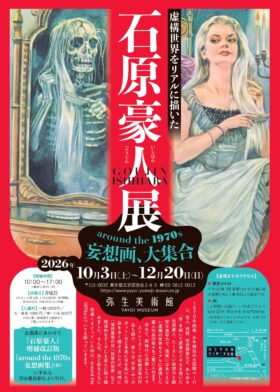
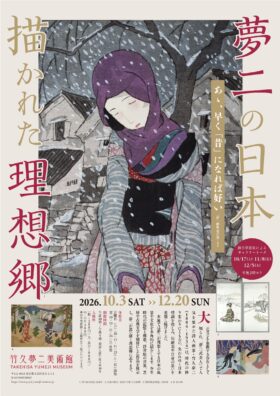
A hundred years ago, sheet music was the most familiar way to enjoy music, and its cover illustrations drew great attention; Takehisa Yumeji and many other designers took up the brush. From the late Taishō to the early Shōwa era, harmonica scores of film music, jazz, and popular songs were published in great numbers and modern design flourished. The Takehisa Yumeji Museum gathers sheet-music covers of the 1920s and 30s, focusing on modern girls and café waitresses, Tokyo and city scenes, and refined Art Deco.
1 / 5 Image: Yayoi Museum of Art · Takehisa Yumeji Museum
- Dates
- Dec 26, 2026 – Mar 28, 2027
- Venue
- Yayoi Museum of Art · Takehisa Yumeji Museum (弥生美術館・竹久夢二美術館) · Bunkyo東京都文京区弥生2-4-3
Getting there
7 min walk from Exit 1 of Nezu Station (Chiyoda Line) or Exit 1 of Todaimae Station (Namboku Line)
- Hours
- 10:00–17:00 · Closed: Mon
- Admission
- General ¥1,200Original: 一般 1,200円
- Artists
- Takehisa Yumeji
- 今井久麿
- 須山ひろし
- 藤澤龍雄
The calendar entry starts on opening day and covers the whole run, so you won't need to look the dates up again. Please check opening hours and closing days before your visit.
Entry notes
Open 10:00–17:00 with last entry at 16:30; closed on Mondays (open on 11 January and 22 March; closed on 12 January and 23 March) and from 30 December to 4 January. Adults ¥1,200, university and high school students ¥1,000, elementary and junior high school students ¥500; one ticket admits you to both the Yayoi Museum and the Yumeji Museum.
- Open 10:00–17:00 with last entry at 16:30; closed on Mondays (open on 11 January and 22 March; closed on 12 January and 23 March) and from 30 December to 4 January. Adults ¥1,200, university and high school students ¥1,000, elementary and junior high school students ¥500; one ticket admits you to both the Yayoi Museum and the Yumeji Museum. (Source: 弥生美術館・竹久夢二美術館:次回の展覧会, 2027)
From the organizer's announcements and press reports. Arrangements can change; please check the official site before your visit.
Knowledge cards
Art Decoアール・デコA style of design in furniture, decorative objects, and architecture from the 1920s and 1930s, recognizable by its geometric forms.Read moreClose
01About
The name comes from a Paris fair of 1925, the International Exhibition of Modern Decorative and Industrial Arts, though it became a common label only in the 1960s. The style can be read both as the heir of Art Nouveau and as a reaction against it. Furniture, ceramics, textiles, jewellery, and glass all show it, and it was a leading look for cinemas and hotels. What mainly separates it from Art Nouveau is Cubism, which pushed Art Deco designs toward fragmented, geometric forms, although some designs kept plant motifs and flowing curves. Its inspirations were wide-ranging: Egyptian art of antiquity, Aztec art and other art from ancient Central America, the look of modern ships, trains, and cars, the Bauhaus school, and the modern buildings and designs of architects like Le Corbusier and Ludwig Mies van der Rohe. At the time it also circulated under other names, such as style moderne, and people did not yet see it as one distinct, coherent style.
02In the gallery
Find an object or a design and pick out its geometric shapes, then look for any plant-like curves that survive among them. Does anything recall a ship, a train, or a car?
Wall label terms in Japanese
- アール・デコ
- Art Deco
- アール・ヌーヴォー
- Art Nouveau
- 幾何学的
- Geometric
- キュビスム
- Cubism
03Notes
Art Deco usually reads as geometric, a look that came largely from Cubism.
This time, at 1920s–1930s Modern Music Score Illustrations — Women Expressing Music, Tokyo, and the Beauty of Art Deco — —
On an object, a building, or a pattern, do you see straight lines and geometric shapes, or curves?
04Related
Illustration (sashie)挿絵・イラストレーションPictures made for printed matter such as books, magazines, newspapers, and sheet music; in Japan they were called sashie, and the word “illustration” came into use from the late 1950s.Read moreClose
01About
Sashie are pictures placed in text-based media such as magazines, newspapers, and books, for example to help readers understand. In the Edo period, ukiyo-e artists drew black-and-white illustrations for kusazōshi and yomihon; after the Meiji Restoration, ukiyo-e artists were hired to illustrate newspaper serial novels, and Tsukioka Yoshitoshi and his pupil Mizuno Toshikata established that genre. In the 1900s, as printing moved from woodblocks to photomechanical plates, it became easier for Western-style painters to take up illustration, and when the magazine Shirakaba featured Aubrey Beardsley in 1911, many illustrators were influenced. From the late 1920s, as magazines spread, painters such as Nakahara Jun'ichi and Fukiya Kōji worked as illustrators full-time. Takehisa Yumeji won wide popularity through magazines, poem-picture books, and sheet-music covers, and his women, unlike earlier ukiyo-e-style illustrations, were taken up by young people as reflecting a modern sense of beauty. Around 1970, Ishihara Gōjin and others filled the large illustrated-explainer pages of boys' magazines with monsters and strange phenomena drawn in minute detail. The word “illustration” took root after the war; in the 1960s it became a genre independent of graphic design, and illustrators became an independent profession from the 1970s on.
02In the gallery
On a cover or a page, look at how the picture meets the title and the text: does it leave room for the words, or make the lettering part of the picture?
Wall label terms in Japanese
- 挿絵
- Sashie (illustration)
- 口絵
- Frontispiece (kuchi-e)
- イラストレーション
- Illustration
- 装幀
- Book design (sōtei)
- 夢二式美人
- Yumeji-style beauty
03Notes
An illustration sits beside words, leaving room for them or drawing them into the picture.
This time, at 1920s–1930s Modern Music Score Illustrations — Women Expressing Music, Tokyo, and the Beauty of Art Deco — —
Beside what words, song, or story did an illustration first sit? What gave you the idea?