Out of Town
Exhibitions Beyond Seoul 2026–27From autumn to spring, in the museums of Wonju, Gwangju, Daegu, and Ulsan
Chosen by our editor and checked against each venue's official site. No paid listings. About this anthology


1 / 3 Image: Asia Culture Center
The Impressionists at the Asia Culture Center in Gwangju, and a house by a river painted by Cézanne.
In Paul Cézanne's Country House by the River (around 1890), a house with a red roof sits between clumps of trees on either side, and the water below reflects it. House, water, and trees all seem built up from patches of colour laid one on another.
The painting hangs in the exhibition's first section, Water Landscapes and Reflections. In the same section is Claude Monet's Water Lily Pond (1907), most of which is sky and clouds reflected in the water. The center writes that the Impressionists went out of the studio to catch the moment when light and colour change from one instant to the next in nature.
Cézanne looked somewhere a little different. As the center puts it, he went beyond the impression of the moment before his eyes to search for the unchanging structure and form of things, and opened the door to Cubism and the art of the twentieth century. In one section, one painter follows the changing light and the other looks for the form that does not change.
All the works come from the collection of the Israel Museum in Jerusalem: originals by eleven Impressionist and Post-Impressionist painters, among them Monet, Renoir, Van Gogh, Cézanne, Pissarro, and Gauguin. The exhibition is in Halls 6 and 7 of the ACC Creation's complex exhibition space at the Asia Culture Center, until 21 February 2027.


1 / 3 Image: Daegu Art Museum
Roger Dutilleul was among the very first to buy paintings by Modigliani, Picasso, Braque and Miró.
Dutilleul was a collector in the north of France in the early twentieth century. When he died in 1956, his nephew Jean Masurel inherited most of the collection. It was Masurel who had bought the first Léger gouache, in the 1920s. In the early 1970s, feeling that the collection had grown too large to belong to one person, Masurel thought of founding a museum in his home region.
In 1979 Masurel and his wife Geneviève donated 186 works, and in 1983 the Lille Métropole Museum of Modern, Contemporary and Outsider Art (LaM) opened. With an art brut collection added later, LaM has shown more than 8,000 works to French audiences over forty-odd years.
In From Picasso to Kiki Smith: Portraits of Modernity, an exchange exhibition the Daegu Art Museum and LaM have put together from each other's collections, this collection comes to Korea for the first time: about a hundred works, from Modigliani, Picasso, Léger, Braque and Miró to Kiki Smith. It opens in Daegu on 17 November.
In Picasso's Woman with a Hat (1942), on the poster, a grey-brown woman sits in an armchair, her hat curling up like a whirlpool. The painting's earlier owner was Dutilleul.

1 / 4 Image: Daegu Art Museum
The Daegu Art Museum's prints from Goya's The Disasters of War, a series he never published in his lifetime.
Beneath each of these prints Goya etched a short line. On the forty-fourth, the line reads "Yo lo vi": I saw it. The image shows people leaving a town that war has wrecked. The title of the Daegu Art Museum's exhibition, I Saw It, is the same words.
In 1792, at forty-six, Goya fell seriously ill and lost his hearing; the museum writes that his work changed visibly after that. The Disasters of War was made between 1810 and 1820, on the Spanish War of Independence and what followed from it: brutal violence, massacre, and famine. The series falls into three parts: War, Famine, and the Caprichos enfáticos.
Goya never published these prints. The series first came out in 1863, thirty-five years after his death, from the Royal Academy of Fine Arts of San Fernando in Madrid. Most of the prints shown here are from the fourth edition, printed in 1906.
This collection show marks the Daegu Art Museum's fifteenth anniversary, with 41 of the series' 82 prints in Gallery 6, until 14 February 2027. The museum says it is the first time a public museum in Korea has held work by Goya. The poster carries one scene from the series: a figure with bat's wings, a large book open before it, writing something down.
1 / 3 Image: Ulsan Art Museum 이중섭
Pictures drawn on the foil from cigarette packs: some 140 works and documents by Lee Jung-seop at the Ulsan Art Museum.
Around the Korean War, when paper was hard to come by, Lee Jung-seop drew on the foil from inside cigarette packs: eunjihwa, silver-foil pictures. He pressed lines into the foil with a stylus or something like it, laid on paint, and wiped it off before it dried, so that colour stayed only in the sunken lines.
In 1956 the Museum of Modern Art in New York took three of his foil pictures into its collection. They were bought and given by Arthur McTaggart, an American diplomat then in Seoul; MoMA's records date all three to 1950–52.
At the Ulsan Art Museum the foil pictures have their own lighting. With them are paintings on postcards and drawings in letters, most of them small. The exhibition follows the places he lived: Tokyo, Wonsan, Jeju, Busan, Tongyeong.
The exhibition is part of MMCA's programme with regional museums, held by the National Museum of Modern and Contemporary Art and the Ulsan Art Museum together. The 109 works from MMCA's collection, The Bull among them, joined by pieces from private collectors and the artist's family and by archive material, make some 140 in all, in Gallery 2 until 17 January 2027. The museum describes him as a painter whose life was short but who never stopped painting.
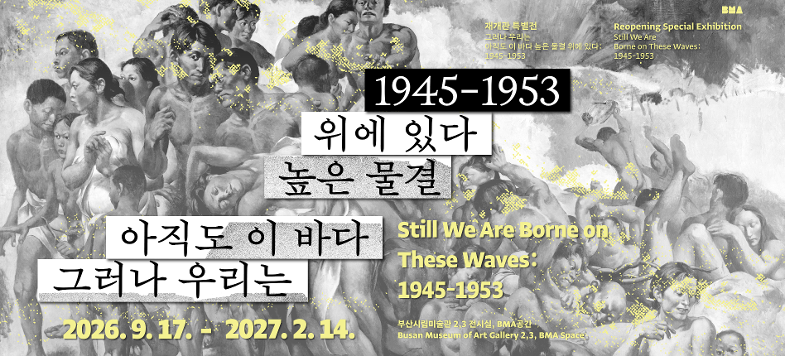

1 / 2 Image: Busan Museum of Art 그러나 우리는 아직도 이 바다 높은 물결 위에 있다 Still We are Borne on These Waves:1945-1953
The first exhibition the Busan Museum of Art opens with, after renovations that began in 2024, covers the years from 1945 to 1953.
This exhibition starts from a question. The way people living in Korean society today see reality is alike in some places and different in others, and the show asks how those views were formed. To find out, it goes back to the social reality of the years after liberation in 1945 and around the Korean War, up to 1953.
Artworks and records are looked at side by side. The eyes of the artists of that time are set against the interpretations of contemporary artists, and the show draws on earlier research by Korean institutes and scholars to follow how Korean society took shape after liberation.
The Busan Museum of Art (부산시립미술관) has been under renovation since 2024, and this is the first exhibition after its reopening. About 250 works and 450 documents come together from the museum's own collection, major Korean museums, artists and their families, and private collectors.
Inside the Busan Museum of Art, films about the ocean play one after another.
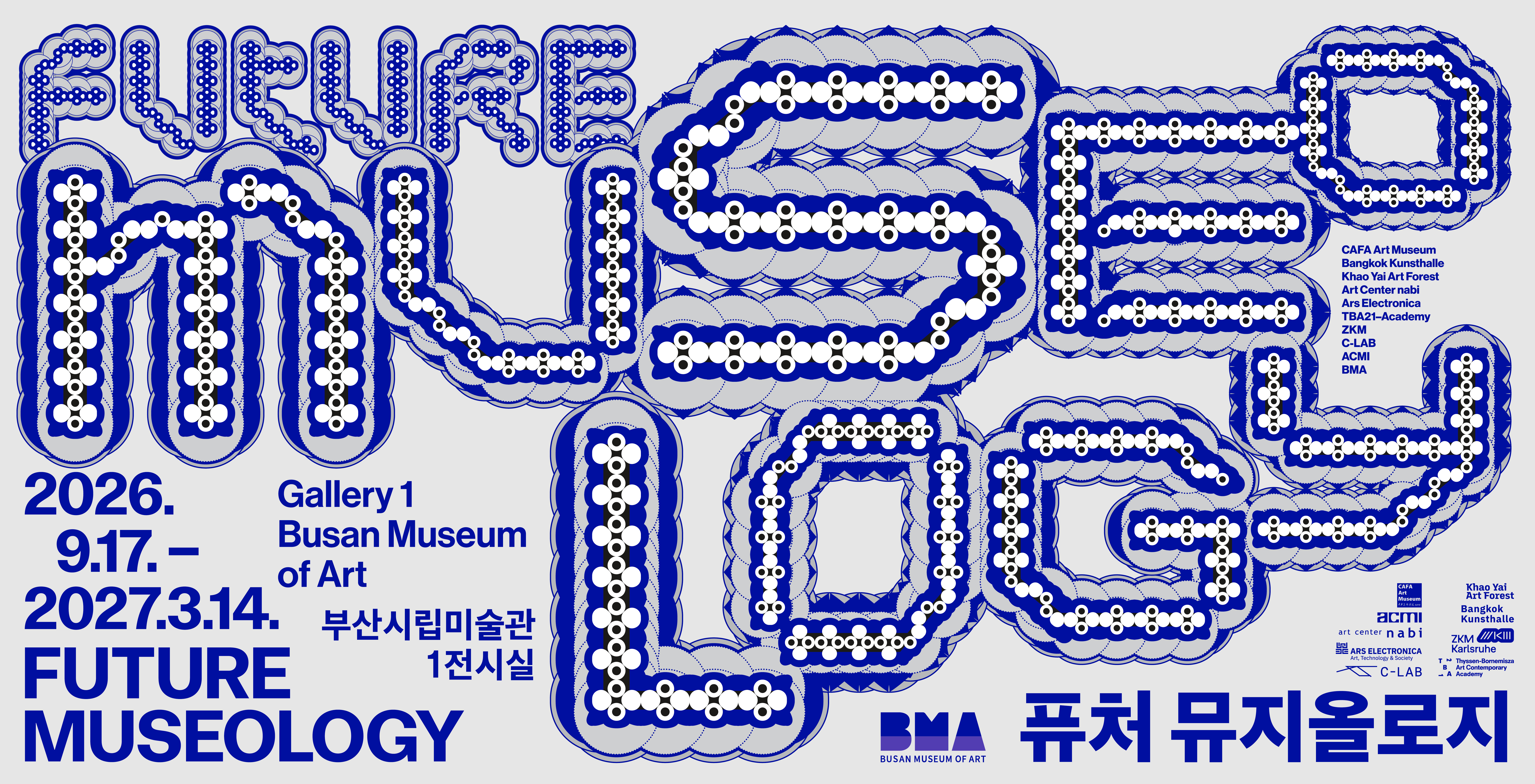
Future Museology (퓨처 뮤지올로지) is the reopening special exhibition of the Busan Museum of Art (부산시립미술관) after its renovation. With a council of nine museums in Korea and abroad, it looks for a new role for the museum: how a museum, beyond collecting and showing works, enters into relation with society and extends into a public space. It shows 30 works.
One of the participating institutions is TBA21–Academy, part of TBA21 (Thyssen-Bornemisza Art Contemporary). Within the exhibition it sets up a space called Ocean STAGE, for debate, reflection, and artistic experimentation around the ocean's present and its possible futures.
Ocean STAGE runs along two strands. One is a continuous film cycle, made up of works from the TBA21 Collection, from the online platform Ocean-Archive.org, and audiovisual works by invited artists made with the Schmidt Ocean Institute. The other is a public program of talks, workshops, and performances, in which artists from Korea and abroad share the space with scientists, researchers, citizens, and specialists from many fields.
Ocean-Archive.org is a digital platform run by TBA21–Academy, and Ocean STAGE is conceived as its physical extension. TBA21 holds that museums can, and must, go beyond preserving cultural heritage to become civic spaces for addressing the social and environmental challenges of the time. The 2028 United Nations Ocean Conference will be held in South Korea, and the project begins in Busan ahead of it.
The artists taking part in Ocean STAGE include SUPERFLEX, Jane Jin Kaisen, and Julian Charrière.
If you have seen a good exhibition that isn't written up here yet, I would be glad to hear about it: hello@anthology-art.org
Ended (2)
These exhibitions have closed. We keep what we wrote about them here.
At the 16th Gwangju Biennale, a pair of paintings by Rim Dong Sik, and what happened after he moved to a village in Gongju.
A Year before Returning to Farming and A Year of Returning to Farming (both 2009–2011) are a pair. In the first, a figure crouches before a wide landscape; in the second, the same figure stands alone before a field spread out ahead. The Biennale's guidebook writes that between them a choice has been made, and leaves an old question: should I stay or should I go?
In 1993 Rim Dong Sik moved to Wongol, a village in Gongju, South Chungcheong, and built his studio with his own hands at the foot of the hill behind it. Art and Wongol, begun that same year, carried on until Art and Village in 2003: festivals made by the artist, fellow artists, and the people of the village together. "Art is farming, farming is art," he says.
The guidebook quotes his words from the catalogue of his 2020 solo show at the Seoul Museum of Art. Watching young artists work with blocks of wood and bundles of straw, the village elders asked him, "If that is art, could the pepper stakes I drove into my field be a work too?" One spoke of a calf just born at home. He had delivered many calves in his life, and never one so pretty; tie a pink ribbon to its ear or tail and set it out at a corner of the field, and that, he thought, would be a work.
The 16th Gwangju Biennale, You Must Change Your Life, is led by artistic director Ho Tzu Nyen, with 43 artists and groups from 22 countries. It fills the five galleries of the Biennale Exhibition Hall in Buk-gu, Gwangju, until 15 November 2026.
Sep 5 – Nov 15, 2026
Iyahong, the refrain of a Jeju folk song.
The 5th Jeju Biennale follows what happened when Jeju's native culture met the civilizations of the north, and changed. The previous edition, the fourth, took drift as its thread and looked at chance connections. This one turns to another axis of Jeju's civilization: how what came along the northern route was transformed.
It looks at that northern route through exile, myth, and stone culture. The biennale holds that northern culture reached Jeju less by chance than by necessity, through clashes of political and institutional interests. So it uses these three subjects to trace how Jeju and northern cultures were joined and fused, and to rediscover Jeju's value and role in East Asia.
Iyahong in the title is the refrain of a Jeju folk song. The biennale uses the word for the process of transformation: flowing, mixing, and being born again. Heokkugok means mixing and modakchigok means gathering, both Jeju-dialect words. They describe how outside cultures were stirred and joined on Jeju, forming the island's own cultural landscape.
It runs from 25 August to 15 November 2026, 83 days in all. The venues are five: Jeju Museum of Art, the Five Hundred Generals Gallery at Jeju Stone Park, Jeju Art Platform, Art Space Iah, and Gallery Remicon. The host is Jeju Special Self-Governing Province, and Jeju Museum of Art organizes it.
Aug 25 – Nov 15, 2026
About this anthology: major exhibitions outside Seoul, chosen by our editor, Yu, and updated as shows open and close. Every exhibition is checked against the venue's official site or announcement (as of Oct 23, 2026), and no listing is paid for. If dates or prices change, please refer to the venue's own announcement.
The Korean original of each title and venue name is shown in gray below it.
A little more art in your life
Every month, we write a letter about exhibitions we love and why we recommend them. Subscribing is free, and you can cancel at any time.
We will use your email address only to send the newsletter. Privacy