Essay
Taking It AlongDo Ho Suh, National Museum of Modern and Contemporary Art, Seoul
I can never come back to this place. Every time I am about to leave somewhere, I think so. So on the last day, once everything is loaded up and the rooms are empty, I photograph every corner, even behind the doors and inside the cupboards. In an empty house the click of the shutter is unusually clear, once, then again. I used to think that once I had photographed a place I had taken it with me. After the move I understood that what a photograph keeps is the look of a corner. The place itself does not come along. Furniture, clothes and books can all be loaded up. A house cannot. The relationship between a person and a house is not quite like the one between a person and a thing. While you live there you want to leave, and after you leave it follows you, for a long time.

*
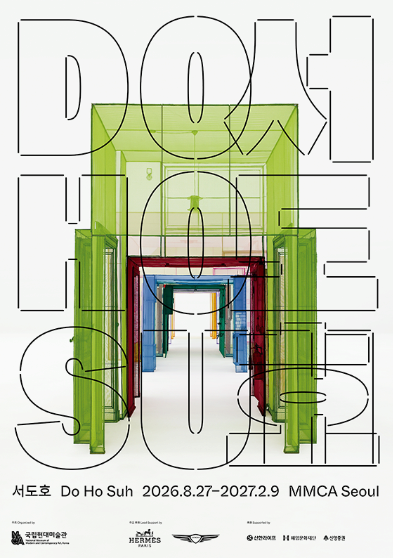
Do Ho Suh (서도호) was born and raised in Seoul and went to the United States only after finishing graduate school. He has lived abroad ever since, first in New York and now in London, with Berlin and other cities in between. Many people have seen the photograph: doorframes of translucent green, purple and yellow cloth, stacked inward layer after layer, with the shadow of a person at the very back. When I first saw it, I took it for the work of someone who had been away from home a long time, something like homesickness. But the audio guide at the National Museum of Modern and Contemporary Art says that to see his "moving homes" as beginning only after he went to the West is half the truth. The other half is in Seongbuk-dong, in Seoul.
The hanok he grew up in was built by his father. His father, Suh Se-ok (서세옥), was an ink painter. In the years when old hanoks were being pulled down one by one, his father gathered timber from the demolished houses and had a master carpenter build this house in the traditional way, modelled on a hall in Changdeokgung Palace. While others were tearing down, he was building. The son, too, later studied East Asian painting at Seoul National University, learning ink, line and empty space, but what he went on to make was very different from his father's paintings: not ink, but cloth, paper and thread.
*
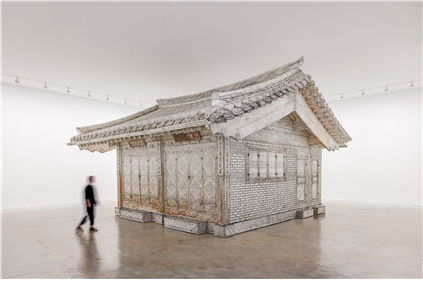
Many years after leaving Seoul, Suh came back and took a rubbing of the house his father built. He pressed hanji against it, inside and out, and rubbed it with a graphite pencil an inch at a time, the way a child rubs paper laid over a coin, until, it is said, his fingerprints wore smooth. The paper stayed on the house for almost a year. It was rained on, and the colour of the wood seeped into it. When it was peeled off it made a great noise, and he says it felt as though the house were shedding its own skin. The work is called Rubbing/Loving: Seoul Home. Rubbing sounds like loving, and he says the act of rubbing itself felt like loving, and that the work is a self-portrait of his father and himself. The white tiled house standing in the gallery, its tiles, rafters and lattices all a greyish white, is this paper. It is the size of the real house, and there is not a single piece of wood inside.
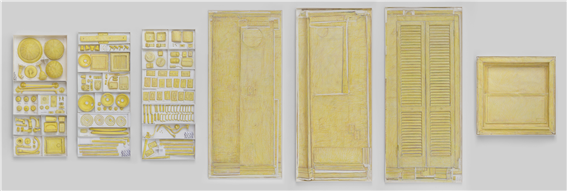
He used the same method on his home in New York. He lived in that apartment for eighteen years, longer than anywhere else since moving to the United States, and it was his studio too. He could stay so long because of the landlord, who was willing to rent to him when he had just arrived in New York and was still young, and who went on supporting his work until the two became friends. So when the landlord died and the building was sold, what he lost was more than a place to live. For most people that is where it ends, with a move. His request was to be allowed to keep this home as a work. He covered every surface in the apartment, walls, floor, ceiling, doors, window frames, switches and door handles, with paper, and rubbed it by hand with coloured pencils for several months. His own energy had built up in that space, he says, and rubbing brought the accumulated time to the surface. The work is named for the apartment's address.
*
The cloth houses came before both of these paper ones. The year Suh went to the United States to study, he moved into a dormitory room, and the first thing he did was measure it with a ruler, an inch at a time, then sew it in thin cotton at its original size and put a zip on it, like a tailor making a made-to-measure garment. The work is named for the room number, 516. It can be folded up, and it can be spread out. Only when I read this did I understand why those cloth houses look like clothes. The audio guide has a line of his: clothing is the smallest and most intimate dwelling a person can carry on the body, and architecture is its extension. So a house can be sewn, folded, and taken along.
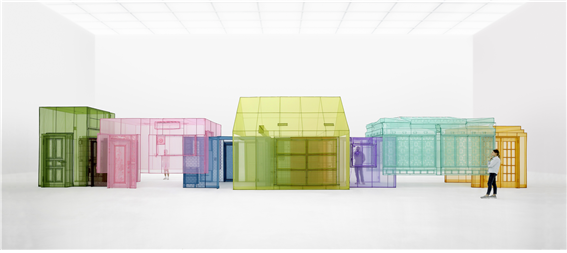
Starting from that dormitory room, he sewed the homes he had lived in, one by one, in cloth. The 22-metre coloured passage Nest/s is made from homes in Seoul, New York, London and Berlin, and what it takes from them is not the rooms or the living rooms but the places one passes through: corridors, stairs, thresholds, joined section by section and sewn into a single path in different colours. The cloth is the translucent polyester widely used today for summer hanbok, so as you walk through it you can see the museum at the far end.
*
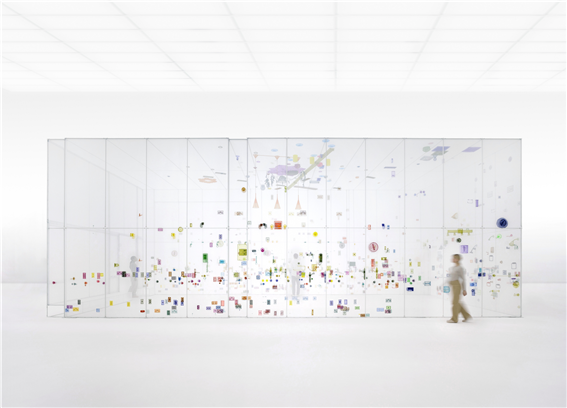
The things your hand touches every day going in and out of a home are in fact not many: door handles, locks, taps, light switches, sockets. He believes that these things, touched again and again without thinking, take on the time of a life, so what he keeps from each home he has lived in is exactly these. Another long wall of translucent cloth has the outline of the house in London where he has lived since moving there. I took the small coloured dots on it for a pattern, and only the caption told me they were these very things from homes in six cities: London, Horsham, New York, Berlin, Providence and Seoul, made in cloth at actual size, coloured by city, each placed at the position and height it had in the original home. Every home's switches sit at a different height, and looking at them for long is a little disorienting; he often likens the confusion to jet lag. The work is called Perfect Home.
*
The exhibition also holds about 200 drawings, most of them shown in Korea for the first time; he buries thread in paper pulp, which is why they have thickness. One of them is The House That Chases: in the lower left a small figure runs forward, and behind it a hanok, dragged along by countless coloured threads, follows like a fluttering cloth. When a person runs forward, the house is always behind, and it catches up.
*
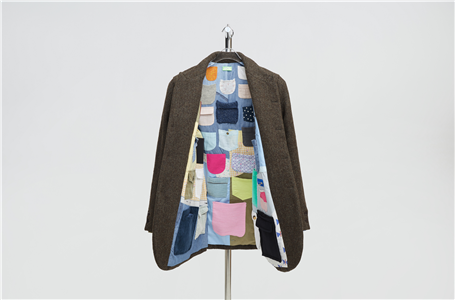
The last work is not a house but a coat. On a hanger hangs a brown wool coat, open at the front, its lining sewn full of pockets in navy, pink, pale green, white and check, no two the same size or shape. The coat is his own; the pockets were taken from his family's clothes and sewn in, and inside them are things that belong to the family. The work is called Memory of Love, and it is shown here for the first time. Time Pocket, made with his two daughters, is also in the exhibition. The pockets are on the lining, so when the coat is worn they are the side that touches the body.
Human, space, time: in Korean, all three are written with the character 間, "between", and it is there between family members too. What he has done for thirty years, taking rubbings of houses, sewing houses, sewing his family's pockets into his own coat, has all been a going back and forth in that between: between a person and a house, between one person and another.
Over these years I have moved many times and lived in several cities, and some of them I have never gone back to. I have kept the photographs from the last day of every move. In them the rooms are empty, and there is nobody inside. What cannot be taken along, Suh has, in his own way, always kept close.
I hope you will go and see it for yourself: Do Ho Suh.
— Yu
Knowledge cards: Installation Art
The Korean original of each title and venue name is shown in gray below it.