This exhibition ended on Nov 8, 2026.
Ended#Painting
Lee Daiwon: Nothing Here Makes You Sad
Korean original:
이대원: 당신을 슬프게 하는 것은 하나도 없다
On now and coming up
Same venue · MMCA Deoksugung (National Museum of Modern and Contemporary Art)

Same genre · Painting


Same neighborhood · City Hall & Deoksugung

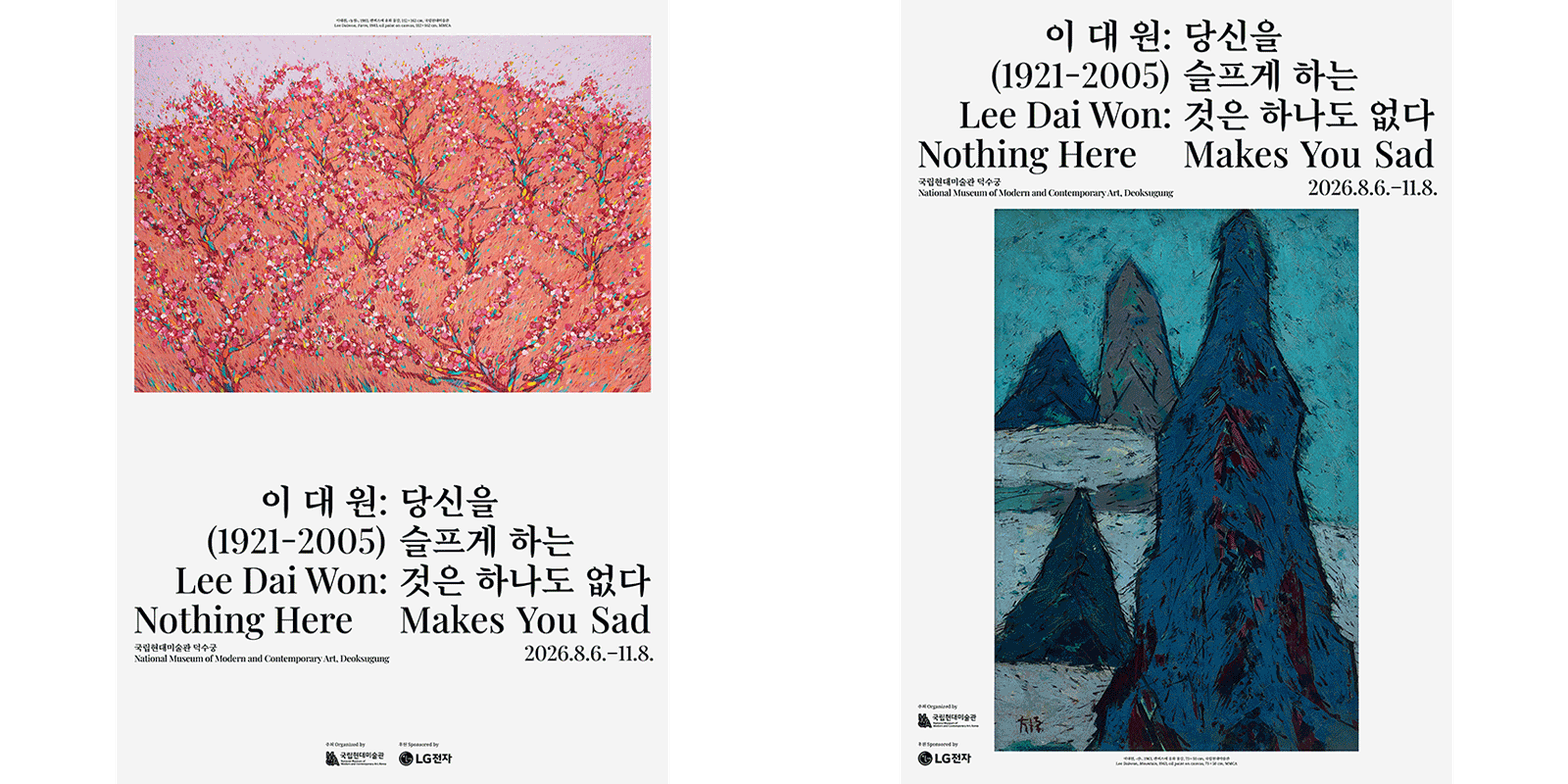
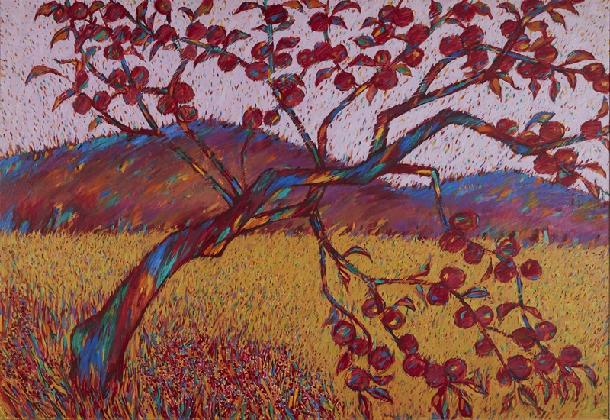
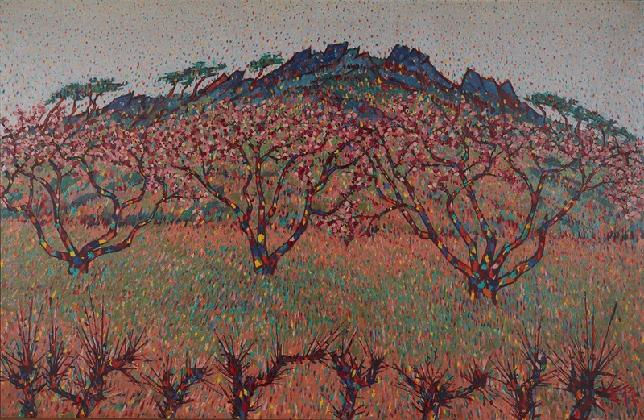
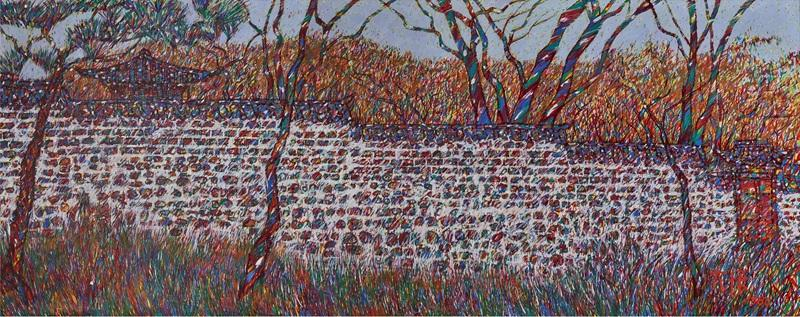
Lee Dai-won (1921–2005) filled his canvases with orchards, mountains, and ponds in primary colours, and was often called the happiest painter in the world. Every weekend for thirty years he went to a farm in Paju, sat on the ground, and painted the same landscape. The exhibition traces how embroidery thread, mother-of-pearl lacquerware, ox-horn craft, and East Asian brushwork turned into the lines, dots, and planes of colour on his canvases.
- Dates
- Aug 6 – Nov 8, 2026
- Venue
- MMCA Deoksugung (National Museum of Modern and Contemporary Art) (국립현대미술관 덕수궁관) · City Hall & Deoksugung서울특별시 중구 세종대로 99 국립현대미술관 덕수궁관Open in Naver Map
Getting there
Exit 1, City Hall Station (Lines 1 and 2)
- Admission
- ₩2,000 (Deoksugung Palace admission ₩1,000 extra)Original: 2,000원 / ※덕수궁 입장료 1,000원 별도
- Artists
Knowledge cards
Colour색채The way colour appears in a painting, shaped largely by the pigments the artist chose and by what the work is painted on.Read moreClose
01About
Colour can be described by three attributes. Hue is what makes red red, or green green, or yellow yellow. Tone is how light or dark a hue is. Temperature is how warm or cool a colour feels when set against another colour: a cool blue, for instance, against a warm orange. A single hue can be given in a nearly endless range of tones. Complementary colours are the pairs that contrast most strongly with each other; they sit opposite one another on a colour wheel, and placed side by side each makes the other look brighter. Red and green, blue and orange, and yellow and violet are such pairs. Tate links the nineteenth-century growth of scientific colour theory to impressionism, post-impressionism and fauvism; the impressionists were the first to notice that a shadow is not neutral but is tinted with the complement of the light falling on it, so yellow sunlight throws a violet shadow. A Japanese encyclopaedia starts the study of colour with Newton's 1666 finding that light is made of spectral colours, and says it advanced greatly only from the later nineteenth century. The National Museum of Modern and Contemporary Art, Korea, describes the pictures in its Lee Dae-won exhibition as built from overlapping lines, dots and planes of colour, with a light that does not float above the picture but is embedded and built up within its surface.
02In the gallery
Find two strongly contrasting colours side by side, and see whether each looks brighter next to the other.
Wall label terms in Korean
- 색채
- Colour
- 색상
- Hue
- 보색
- Complementary colours
03Notes
Colour in a picture can be read in three ways: its hue, how light or dark it is, and how warm or cool it is.
This time, at Lee Daiwon: Nothing Here Makes You Sad —
Which colour does your eye go to first, and is it light or dark, warm or cool?
04Related
Modern Korean Western-style Painting한국 근대 서양화The oil painting and other Western painting that Korean painters learned, largely by way of Japan, from the early twentieth century, and the work they made in it; in Korea it is called seoyanghwa, Western painting.Read moreClose
01About
In 1909 Ko Hui-dong entered the Tokyo School of Fine Arts to study Western painting, and returned home on graduating in 1915; he is regarded as Korea's first Western-style painter, though he later went back to ink painting. From 1922 to 1944 the Government-General held the Joseon Art Exhibition every year, with a section for Western painting, and many new painters made their debut there. Most painters of this generation trained in Tokyo: Yoo Youngkuk entered the oil painting course at Bunka Gakuin in 1935, met avant-garde art such as Cubism and Constructivism there, and later turned the mountain into the subject of his abstraction. Others drew on their own traditions: Lee Dai-won carried the methods of embroidery, mother-of-pearl lacquer, and ink brushwork into oil painting. After the Korean War, many painters saw Paris as “the capital of modern art” and moved to France.
02In the gallery
Check the year and where the painter trained on the label, then see whether the oil paint is laid flat, built up, or set down stroke by stroke like a brush in ink.
Wall label terms in Korean
- 서양화
- Western-style painting
- 유화
- Oil painting
- 조선미술전람회(선전)
- Joseon Art Exhibition
- 추상
- Abstraction
03Notes
Korea's early modern painters learned Western painting, and some carried ink-brush strokes into oil.
This time, at Lee Daiwon: Nothing Here Makes You Sad —
Looking at the brushwork, what was learned from the West, and what comes from the painter's own tradition?
04Related
A little more art in your life
This exhibition has ended. Every month, we write a letter about exhibitions we love and why we recommend them. The next one you want to see may be in it. Subscribing is free, and you can cancel at any time.
We will use your email address only to send the newsletter. Privacy