Last day today
The Splendor of Symbiosis: The Intersection of Japan’s Golden Age of Art and Taiwan
Chinese original:
共生之華—日本美術璀璨時代與臺灣之交會
Centered on modern Japanese art, the exhibition looks back at Japan from the late nineteenth century to the first half of the twentieth: the Bunten and Teiten official exhibitions took shape, art education matured in Tokyo and Kyoto, and Japan became a center of modern art in East Asia. It shows classic works in painting, sculpture, and crafts, and uses them to follow how Taiwan's first generation of artists who studied in Japan trained there, exhibited, and gradually formed their own artistic language. At the NTNU Museum of Art, Galleries 1, 2, and 2+, extended to 8 November.
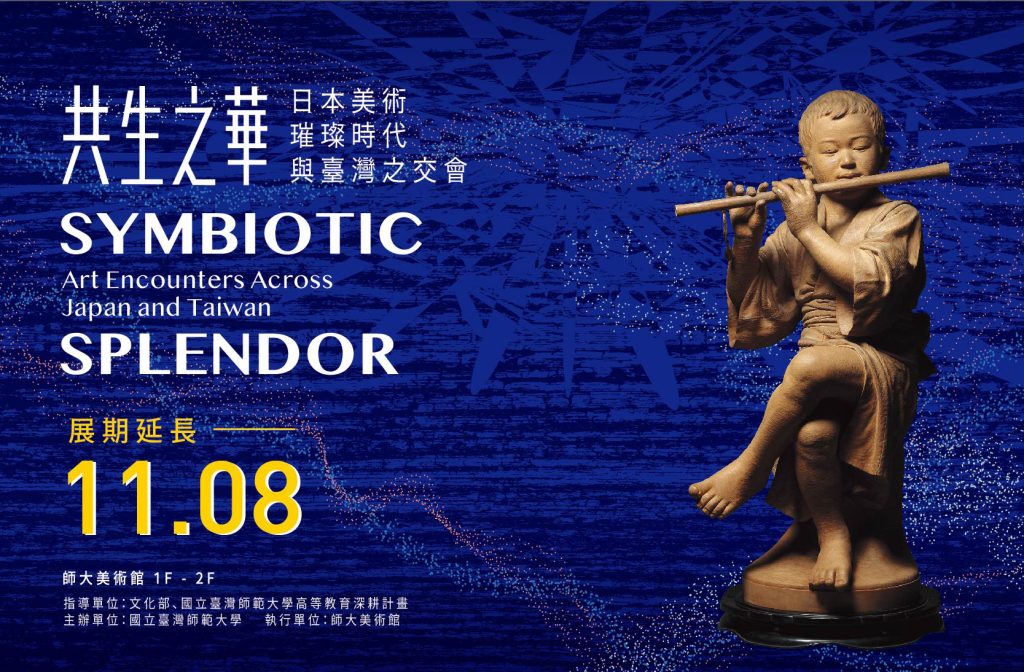
- Dates
- Jun 9 – Nov 8, 2026
- Venue
- National Taiwan Normal University Art Museum (師大美術館) · Yongkang St & Qingtian St
- Address
- 臺北市大安區和平東路一段129號MRT Dongmen Station, Exit 5, about 10 min on foot; Guting Station, Exit 5, or Taipower Building Station, Exit 3, about 12 minOpen in Google Maps
- Hours
- 09:30–17:30Closed: Mon
Visit planning
The calendar entry covers the whole run of the exhibition. Please check opening hours and closing days before your visit.
Nearby, after this one
Same district · Da'an
Shows open on the same days as this one are listed first (regular closing days only).


Credits
- Organized by
- National Taiwan Normal University
Knowledge cards
Bunten and Teiten文展與帝展The state-run art exhibitions of Japan from 1907, held first by the Ministry of Education (Bunten) and then by the Imperial Academy of Arts (Teiten).Read moreClose
01About
In 1907 the Ministry of Education began Japan's first state-run art exhibition, the Bunten, held every year with three sections: Japanese-style painting, Western-style painting, and sculpture. Works were shown after a jury examined them. In 1919 the exhibition passed to the newly founded Imperial Academy of Arts and became the Teiten; half of its jurors were recommended by the Minister of Education and half by the Academy, and a section for craft as art was added in 1927. In 1936 the Ministry took it back and renamed it the Shin-Bunten, and after the war the line continues as the Nitten, from 1946. The Symbiotic Splendor show at the National Taiwan Normal University Art Museum uses this system as its background: Taiwan's first generation of artists who studied in Japan took part in it and moved among Japanese artists. Taiwan's own Taiten likewise had a Japanese-style painting section and a Western-style painting section.
02In the gallery
Check the exhibition name and number on the label, whether it says Bunten, Teiten or Shin-Bunten, and then match it to the section the work was shown in: Japanese-style painting, Western-style painting, or sculpture.
Wall label terms in Chinese
- 文展
- Bunten
- 帝展
- Teiten
- 新文展
- Shin-Bunten
- 官展
- State-run exhibition
03Notes
Bunten and Teiten were Japan's state-run art exhibitions, and a work was shown only after a jury approved it.
This time, at The Splendor of Symbiosis: The Intersection of Japan’s Golden Age of Art and Taiwan —
When a label names the exhibition and the year a work was accepted, what kind of stage do you think it was shown on?