14 days left#Craft
2026 Namsangol Art Project 〈Layer〉: Third Selected Exhibition, 《Accumulated Hands, 木手》
Korean original:
2026 남산골 아트 프로젝트 〈겹, Layer-層〉 세 번째 선정 전시 《축적된 손, 木手》
The venue is a hanok built by Yi Seung-eop, a head carpenter (dopyeonsu, the master who led a building crew) of the late Joseon period. The craft studio studio EAST×EAST (Jo Dong-ho and Choi Dong-eun) turns traditional carpentry techniques into contemporary works. It is the third selected show of the Namsangol Art Project 〈Layer-層〉 at Namsangol Hanok Village, open daily 09:00–21:00 from 3 to 22 November, closed Mondays.
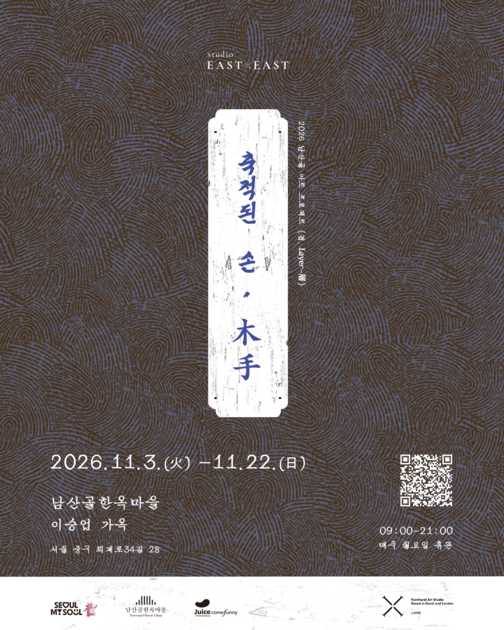
- Dates
- Nov 3 – Nov 22, 2026
- Venue
- Lee Seung-eop House, Namsangol Hanok Village (남산골한옥마을 이승업 가옥) · JungOpen in Naver MapOpen in Google Maps
- Hours
- 9:00~21:00
- Admission
- Free
Visit planning
The calendar entry covers the whole run of the exhibition. Please check opening hours and closing days before your visit.
Related exhibitions
Same genre · Craft

Credits
- Artists
- studio EAST×EAST
Knowledge cards
Daemok and somok (traditional Korean woodworking)대목과 소목The two branches of traditional Korean woodworking: daemok, carpentry for buildings, and somok, joinery for furniture and household goods.Read moreClose
01About
The division of woodworking into daemok ("greater woodwork") and somok ("lesser woodwork") first appears in the Yingzao Fashi, a book of China's Northern Song dynasty: the former makes beams, columns, rafters and other building members and assembles the house, the latter makes furniture. The master who builds is the daemokjang, in charge of the whole process from planning and design to construction and of supervising the subordinate carpenters. The timber is chosen, cut and shaped, and the separate pieces are assembled and interlocked without nails, in buildings ranging from traditional houses to palaces and temples. The know-how is handed down from generation to generation and takes decades of training and field experience to master; in 2010 "Daemokjang, traditional wooden architecture" was inscribed on UNESCO's Representative List of the Intangible Cultural Heritage of Humanity. The frame of a hanok is put up this way. The somokjang makes chests, boxes, writing equipment and other household objects. Hard zelkova is often used; when the log is sawn, the pattern of the grain is considered for each part; the parts are fitted together with tenons and mortises, again without nails, and a final coat of lacquer lets the grain show through. The name somokjang has been in use since the Goryeo period; until early Joseon, wooden furniture was made mainly for the court and the upper classes, and it spread widely among ordinary households in late Joseon. At Namsangol Hanok Village, the exhibition 축적된 손, 木手 reworks the skills of the traditional carpenter in a new way.
02In the gallery
Find a place where two pieces of wood meet and check for nails; then follow the grain and see which way it runs across one surface.
Wall label terms in Korean
- 대목장
- Daemokjang (master carpenter)
- 소목장
- Somokjang (joiner)
- 느티나무
- Zelkova
03Notes
Traditional woodwork is looked at for how the pieces of wood are joined and how the grain is used.
This time, at Accumulated Hands, 木手 —
Can you find a place where two pieces of wood meet, and tell how they were joined?
04Related
Hanok한옥The traditional Korean house: a timber frame, a roof of tiles or thatch, and ondol, floors heated by fire from below.Read moreClose
01About
A hanok's timber frame is built of posts and beams joined with mortise-and-tenon joints rather than iron nails, and carpenters shape the wood along its grain. The roof is laid with tiles of fired clay (giwa), whose curve gives the hanok its most striking outline; in the countryside roofs were also thatched. Korea has hot summers and cold winters, so a house must both let air through and keep warm: ondol carries heat from the kitchen fire under the floors, so in winter people sit and sleep on warm floors.
02In the gallery
Find where the posts meet the beams and see how the timbers lock into each other; then look up at the curve of the eaves.
Wall label terms in Korean
- 온돌
- Ondol
- 기와
- Giwa (roof tile)
- 장부맞춤
- Mortise and tenon
03Notes
A hanok's timber frame is joined without nails, and its curving roof is its most striking outline.
This time, at Accumulated Hands, 木手 —
Look up at the curve of the eaves. Does it feel light, or heavy?