This exhibition ended on Nov 1, 2026.
Ended#Media art
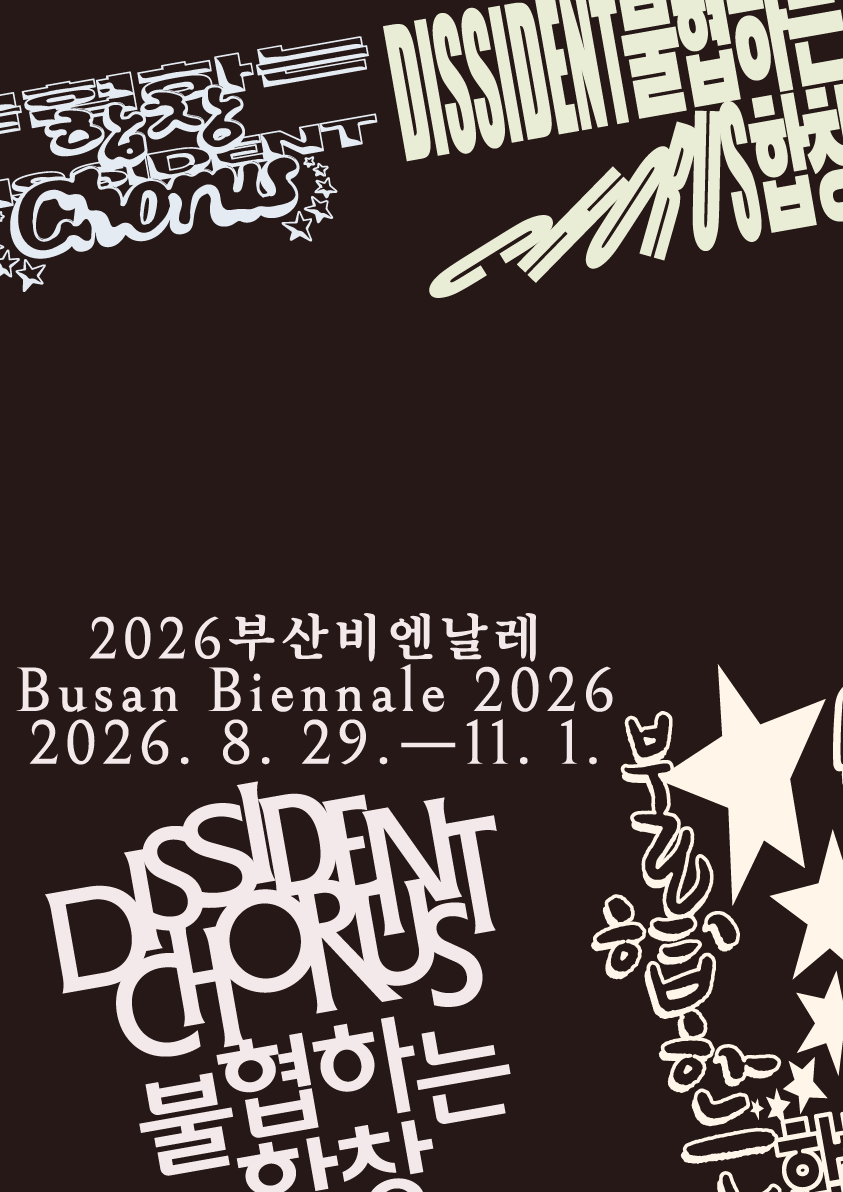
Busan Biennale 2026: Dissident Chorus
Korean original:
2026부산비엔날레 《불협하는 합창》
On now and coming up
Same genre · Media art


A biennale built around sound, music and performance, curated by Evelyn Simons and Amal Khalaf, with 46 artists and groups from 22 countries. It unfolds in three 'movements': the Busan Museum of Contemporary Art on Eulsukdo at the mouth of the Nakdong River; Space Wonji, a century-old warehouse in Yeongdo that once rented out ship equipment; and the former Busan Nam High School, left empty when the school moved in early 2026. Only the museum charges admission, and a free shuttle bus links the three sites.
- Dates
- Aug 29 – Nov 1, 2026
- Venue
- Busan Museum of Contemporary Art (부산현대미술관) · Busan부산광역시 사하구 낙동남로 1191Open in Naver Map
Getting there
Busan Metro Line 1, Hadan Station Exit 3; at the Hadan Station transfer centre, take a bus toward Myeongji and get off at the Busan Museum of Contemporary Art stop
- Admission
- Adults ₩16,000Original: 성인 16,000원
Knowledge cards
Biennale비엔날레A large international exhibition of contemporary art; the Italian word means "every two years".Read moreClose
01About
The Venice Biennale, first held in 1895, is the precedent most often named. In the 1990s biennials multiplied, and the number around the world grew from about five to more than 250. Korea's Gwangju Biennale was founded in September 1995. The fifth Jeju Biennale runs for 83 days, from 25 August to 15 November 2026, with 69 artists and teams across five venues. Its theme is a Jeju-dialect phrase, "허끄곡 모닥치곡 이야홍", roughly "mixing, gathering, stirring up the fun", and it is split into three sub-themes: exile, stone culture and myth. Exile is at the Jeju Museum of Art, stone culture at the Ogbaekjang Gallery of the Jeju Stone Park, and myth in three spaces in the old town.
02In the gallery
At each venue, first read the sub-theme at the entrance, then choose one work and think about how it connects to the main theme.
Wall label terms in Korean
- 비엔날레
- Biennale (biennial)
- 큐레이터
- Curator
- 소주제
- Sub-theme
03Notes
At a biennale, curators set a theme and the works are spread across sub-themes and venues.
This time, at Busan Biennale 2026: Dissident Chorus —
Once a work sits under the theme, what more did you see in it?
04Related
Sound Art사운드 아트Art that uses sound as its material, and often as its subject too.Read moreClose
01About
Among its forerunners, the Futurist Luigi Russolo built noise machines from 1913 that imitated the sounds of machinery and war, and John Cage's 4′33″ (1952) is a score of four minutes and thirty-three seconds of silence that lets listeners hear the sounds already in the room. Visual artists and composers went on to explore sound through electronic media and space, and a sound work need not have images, a beginning, or an end. In Seoul, the group 2mc1dj presents “screenless films” at Art Sonje, radio-drama-like works heard in front of a blank screen, while Kim Jun recorded wind, leaves, and footsteps with children from a children's hospital and made them into works.
02In the gallery
Stand or sit in a few different places in the work and listen to how the sound changes; notice the moments when it stops, too.
Wall label terms in Korean
- 사운드 아트
- Sound art
- 필드 레코딩
- Field recording
- 소리극
- Audio drama
03Notes
In sound art, the size of a space is often measured by ear.
This time, at Busan Biennale 2026: Dissident Chorus —
Close your eyes. How large does the space around you feel?
04Related
Other cards (1)Hide other cards
Installation Art설치 미술Not a single object on a wall or pedestal, but three-dimensional work that changes a whole space and that visitors move through.Read moreClose
01About
Installations are often made for a particular site, and visitors move within them, so where your body stands is part of the looking. The materials can be everyday objects, fabric, video, or sound, and a work may be taken down after the exhibition and never shown again. The term first appears in writing in 1969; earlier, in 1958, Allan Kaprow called the indoor spaces he transformed “Environments.” Do Ho Suh's Seoul Home (1999) is a life-size replica of his childhood home in Korea in polyester fabric and silk on thin metal rods; it folds up for transport, and each time it moves to a new city, that city's name is added to the title.
02In the gallery
Look from several places, outside, inside, and from a distance, and notice how the light, the sound, and your path change.
Wall label terms in Korean
- 설치
- Installation
- 장소 특정적
- Site-specific
- 환경
- Environment
03Notes
An installation changes the whole space, and where your body stands is part of the looking.
This time, at Busan Biennale 2026: Dissident Chorus —
Once you are inside the work, what changes with where you stand?
04Related
A little more art in your life
This exhibition has ended. Every month, we write a letter about exhibitions we love and why we recommend them. The next one you want to see may be in it. Subscribing is free, and you can cancel at any time.
We will use your email address only to send the newsletter. Privacy