4 days left#Photography
"Yubyeolnam" Photo Exhibition [Yu; That Is So]
Korean original:
유별남 사진전 [兪 ; 그러하다]
A solo show by Yu Byeol-nam that sets photography, sculpture, and installation side by side. It brings together documentary photographs that followed the children of Jeju 4.3, a moon jar fired in a kiln at 1500°C, and the sculptural works made in between. What runs through the different media and periods is an attitude of accepting, not resisting, what people cannot fully control. The title character 兪 is the artist's family name and also means 'so it is' or 'permitted'. In the basement of Y Art Gallery in Jung-gu, open until 22:00 on 5 November.
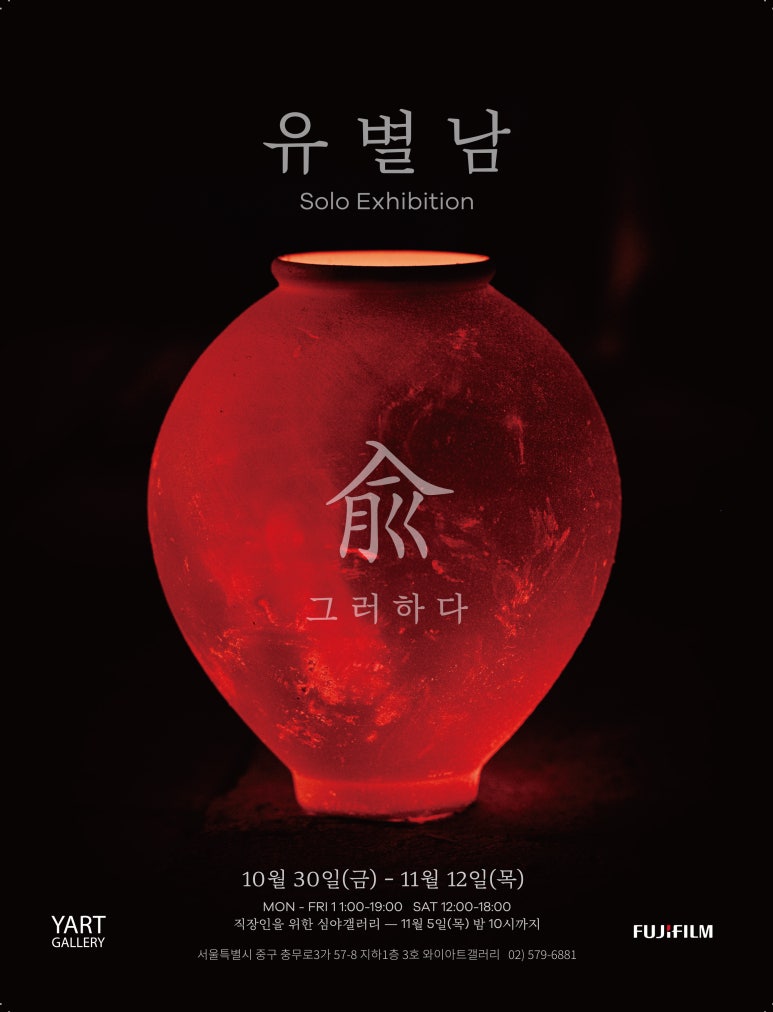
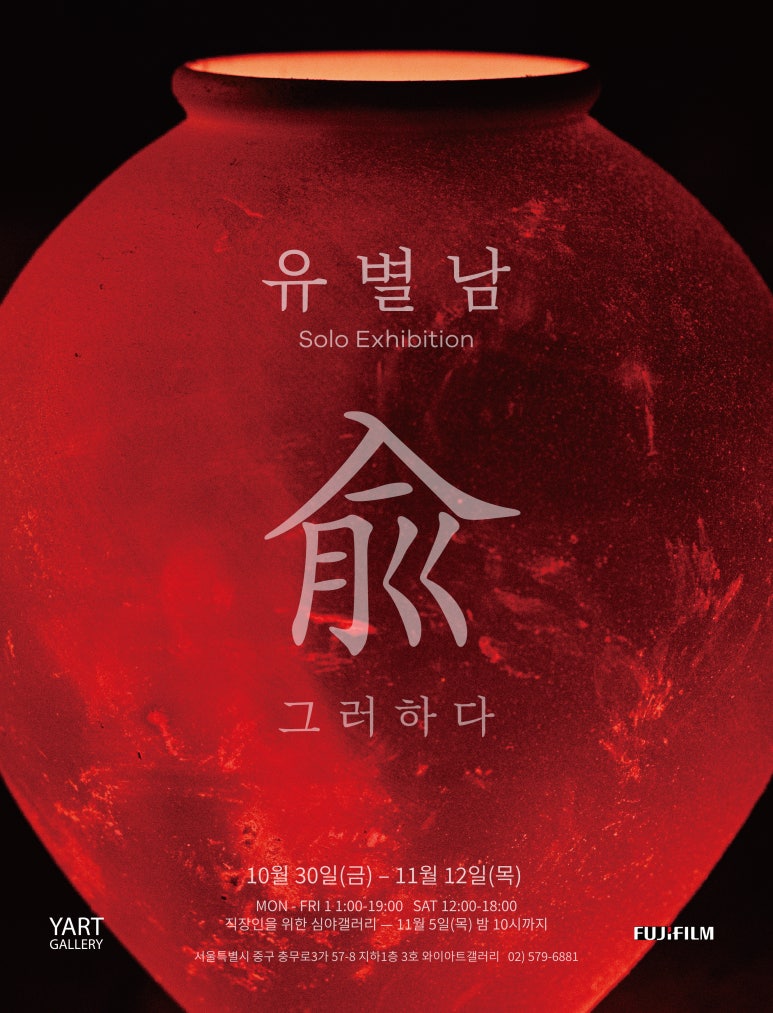
1 / 2 Image: 와이아트갤러리 (네이버 블로그)
- Dates
- Oct 30 – Nov 12, 2026
- Venue
- Wyatt Gallery (와이아트 갤러리) · Euljiro & Myeong-dong
- Address
- 서울특별시 중구 퇴계로27길 28 한영빌딩 지하1층 3호 와이아트갤러리Open in Naver MapOpen in Google Maps
- Hours
- Weekdays 11:00–19:00Sat 12:00–18:00Late-night gallery: Nov 5 (Thu) until 22:00Original: 평일 11:00~19:00 / 토 12:00~18:00 / 심야갤러리 11.5.(목) 22:00까지Closed: Sun
- Admission
- FreeOriginal: 무료
Visit planning
The calendar entry covers the whole run of the exhibition. Please check opening hours and closing days before your visit.
Nearby, after this one
Same neighborhood · Euljiro & Myeong-dong
Shows open on the same days as this one are listed first (regular closing days only).

Related exhibitions
Same genre · Photography

Credits
- Artists
- Yoo Beylnam
Knowledge cards
Ceramics도자Objects and works shaped from clay and fired in a kiln; by firing temperature and material they fall roughly into earthenware, stoneware, and porcelain.Read moreClose
01About
Fired at high temperature, clay changes permanently and hardens. Earthenware can be fired in an open fire at around 600°C and is normally fired below 1,200°C; unglazed, it lets water through. Stoneware is fired at about 1,100–1,300°C and is dense and watertight. Porcelain, usually made with kaolin, is fired at 1,200–1,400°C and is hard and slightly translucent. Glaze is a glassy coating on the surface that makes a piece watertight and also decorates it. The earliest way of shaping was by hand: pinching, joining slabs, or building up coils of clay ring by ring; throwing on the potter's wheel came later. On the Korean peninsula, Goryeo celadon developed the sanggam inlay technique in the early 12th century, and in the Joseon period buncheong ware and white porcelain led.
02In the gallery
Look closely at the surface: is the glaze glossy or matte? Where it is thin, does the colour of the clay show through?
Wall label terms in Korean
- 토기
- Earthenware
- 석기(炻器)
- Stoneware
- 자기
- Porcelain
- 유약
- Glaze
- 코일링
- Coiling
03Notes
A pot can be pinched, coiled, or thrown on the wheel, and each leaves its own marks.
This time, at "Yubyeolnam" Photo Exhibition [Yu; That Is So] —
Up close, what marks of making can you see?
04Related
Photography사진Recording an image by focusing light through a lens onto film or a sensor over a timed exposure.Read moreClose
01About
A photograph taken on film is first developed into a negative, which is then exposed onto photographic paper in a darkroom, usually enlarged, to make a positive print; a digital camera turns the light into a file instead. The exposure time decides how time appears in a photograph: a fast shutter freezes motion, while in a long exposure still buildings stay sharp, car lights draw streaks, and passers-by who are there only briefly disappear. Long exposures are easiest in low light. Rut Blees Luxemburg, born in Germany and based in London, photographs the city at night with long exposures, using only the light from street lamps and office blocks. Prints made by inkjet with pigment inks, often labelled pigment print or giclée, resist fading better than those made with dye inks.
02In the gallery
Find the things in the picture that move: water, clouds, car lights, people. Are they sharp, blurred, or gone?
Wall label terms in Korean
- 노출
- Exposure
- 장노출
- Long exposure
- 네거티브
- Negative
- 피그먼트 프린트
- Pigment print
03Notes
Exposure decides the time inside a photograph: a fast shutter freezes motion, a slow one leaves trails.
This time, at "Yubyeolnam" Photo Exhibition [Yu; That Is So] —
Judging by what moves, did the photograph catch an instant, or a stretch of time?