133 days left#Media art
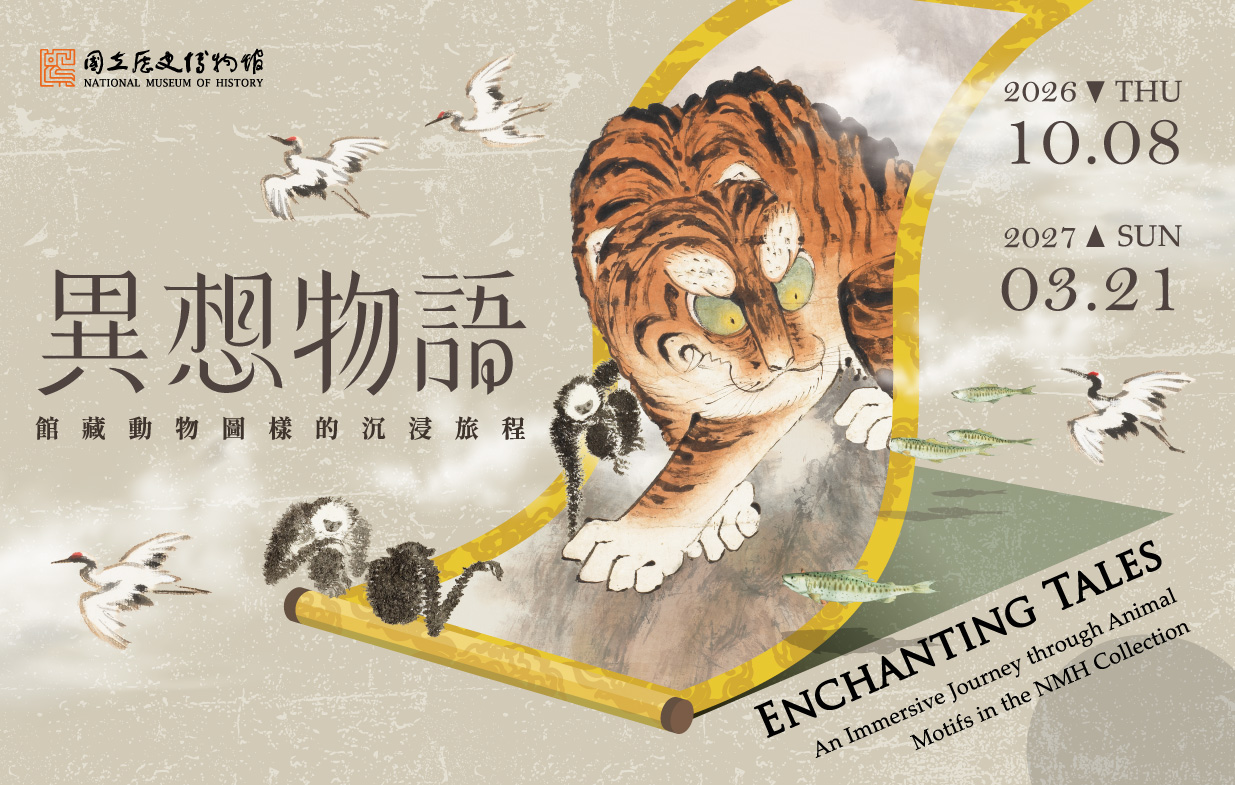
Enchanting Tales: An Immersive Journey through Animal Motifs in the NMH Collection
Chinese original:
異想物語—館藏動物圖樣的沉浸旅程
The exhibition starts from the animal motifs found on objects in the National Museum of History's collection. In Gallery 501 on the fifth floor, immersive theater, digital imagery and 3D printing let visitors meet these objects through sight, sound and touch. Using AI generation, visitors also move their bodies to create a personal "guardian beast," and the creatures together form an imagined place where animals live side by side.
- Dates
- Oct 8, 2026 – Mar 21, 2027
- Venue
- National Museum of History (國立歷史博物館) · Nanhai Academy & Botanical Garden
- Address
- 臺北市中正區南海路49號MRT Chiang Kai-Shek Memorial Hall Station, Exit 1 or 2; about 10 min walk along Nanhai RoadOpen in Google Maps
- Hours
- 10:00–18:00Closed: Mon
Visit planning
The calendar entry covers the whole run of the exhibition. Please check opening hours and closing days before your visit.
Nearby, after this one
Same venue · National Museum of History


Same neighborhood · Nanhai Academy & Botanical Garden
Shows open on the same days as this one are listed first (regular closing days only).

Related exhibitions
Same genre · Media art

Knowledge cards
Interactive art互動藝術Art that only comes together once the viewer takes part in it.Read moreClose
01About
Tate places the start of interactive art in the late 1950s, when artists were looking for less alienating, less exclusive places to show work, such as the street, the warehouse and the shop front, and the work itself grew more participatory: sculptures made to be touched and played with. One example is Niki de Saint Phalle’s Golem, a walk-in sculpture in a Jerusalem park that includes a children’s slide. Japan’s Nipponica encyclopedia traces the question of how a work and its audience act on each other through Futurism, kinetic art, Allan Kaprow’s environments, and the happenings, performance and conceptual art of the 1960s onward. The term is now most often tied to computers. The Daijisen dictionary describes the typical case as a work in which a sensor picks up a visitor’s movement, or in which input on a touch panel sets off some change. According to Nipponica, such work drew notice from the late 1970s, once the media-art festival Ars Electronica began in Linz, Austria; it adds that much of it resembles a game and that firm criteria for judging it have yet to emerge. Tate also connects interactive art with relational aesthetics, a term for art that takes human relations and their social setting as its starting point.
02In the gallery
Try one small action, such as stepping closer, moving, or touching if the work invites it, and watch what the work answers and how quickly.
Wall label terms in Chinese
- 互動藝術
- Interactive art
- 感測器
- Sensor
- 參與
- Participation
03Notes
Interactive art is completed by the viewer, so watch how the work changes when you act.
This time, at Enchanting Tales: An Immersive Journey through Animal Motifs in the NMH Collection —
What do you do, and what does the work do in return?
04Related
- Immersive exhibition 沉浸式展覽Immersive exhibitions also bring the viewer into the work, with projection, sound or virtual reality surrounding them.
- Generative Art 生成藝術In generative art a system the artist sets up decides part of the work; at some shows visitors can change its parameters.
Immersive exhibition沉浸式展覽An exhibition that surrounds visitors with projection, sound, light, or virtual reality, so that they walk into the picture instead of standing in front of it.Read moreClose
01About
The idea of wrapping the viewer in a picture is older than electronics. In 1787 the painter Robert Barker patented a painting that ran all the way round a circular room, seen by viewers standing on a platform at the centre; such paintings came to be called panoramas, and in 1793 a rotunda built to show them opened in Leicester Square, London. Today most immersive exhibitions use projection. Projection mapping uses software to fit images onto walls and floors, and even onto trees and buildings, so that the picture follows uneven surfaces. Another way is virtual reality: with a headset on, the view changes as you turn your head.
02In the gallery
First stand still and watch for a while, then walk or reach out, and compare whether the images change because of you. Notice, too, where the projection comes from.
Wall label terms in Chinese
- 全景畫
- Panorama
- 投影映射
- Projection mapping
- 虛擬實境(VR)
- Virtual reality (VR)
- 互動
- Interactive
03Notes
Immersive shows surround you with projection, sound, or virtual reality, so you walk into the picture.
This time, at Enchanting Tales: An Immersive Journey through Animal Motifs in the NMH Collection —
Stand still, then move or reach out. Are you looking at the work, or inside it?