21 days left#Craft#History & heritage
The Birth of Chinese Imports (Karamono): Exploring the Origins of Chanoyu Designs
Japanese original:
特別展 唐物誕生 ―茶の湯デザインの源流をさぐる
Tea drinking came to medieval Japan from the continent, and continental objects used for tea, called karamono, were treasured; those singled out by the taste of the day became celebrated meibutsu. The Sen-oku Hakukokan Museum Tokyo traces the birth of karamono back to ancient China, using bronze flower vases known as kodō as a way in to show what metalwork, ceramics, and lacquer share across materials. The National Treasure landscapes of autumn and winter attributed to Emperor Huizong are shown in turn.
Featured in: Tokyo Anthology: December · Tokyo Anthology: November
1 / 5 Image: Sen-oku Hakukokan Museum, Tokyo
- Dates
- Nov 3 – Dec 13, 2026
- Venue
- Sen-oku Hakukokan Museum, Tokyo (泉屋博古館東京) · Minato東京都港区六本木1-5-1
Getting there
3 min walk from the North Gate of Roppongi-itchome Station (Namboku Line), via the Izumi Garden 1F exit
- Hours
- 11:00–18:00 · Closed: Mon
- Admission
- General ¥1,500Original: 一般 1,500円
The calendar entry covers the whole run, so you won't need to look the dates up again. Please check opening hours and closing days before your visit.
Booking
No booking needed.
No booking needed.
From the venue's announcements, checked Nov 20, 2026. Slots and availability can change; please check the official page before you book. Source: 泉屋博古館東京 公式
Entry notes
Entry is not by timed reservation. Advance tickets (general 1,300 yen, students 700 yen) are sold online only, from September 14 to November 2, 2026; from November 3 tickets are sold on the day at the museum (general 1,500 yen, students 800 yen), and visitors 18 and under enter free. A second visit during the run is half price once with this show's ticket stub. Lectures and the symposium require reservations (first come, first served), and all of them require a ticket for the day.
- Entry is not by timed reservation. Advance tickets (general 1,300 yen, students 700 yen) are sold online only, from September 14 to November 2, 2026; from November 3 tickets are sold on the day at the museum (general 1,500 yen, students 800 yen), and visitors 18 and under enter free. A second visit during the run is half price once with this show's ticket stub. Lectures and the symposium require reservations (first come, first served), and all of them require a ticket for the day. (Source: 泉屋博古館東京:特別展 唐物誕生, 2026)
From the organizer's announcements and press reports. Arrangements can change; please check the official site before your visit.
Guided tours
'Art with' lecture 'Learning from Ashiya kettles and Chinese bronzes' (倣古創新 ―芦屋釜と中国青銅器に学び): Friday 27 Nov 2026, 17:30–18:30, by Ashiya caster 樋口陽介 in the lecture hall. Fee ¥500 including tax (admission separate); reservation required; 50 places, first come first served.
- TalkNov 27 (Fri)'Art with' lecture 'Learning from Ashiya kettles and Chinese bronzes' (倣古創新 ―芦屋釜と中国青銅器に学び): Friday 27 Nov 2026, 17:30–18:30, by Ashiya caster 樋口陽介 in the lecture hall. Fee ¥500 including tax (admission separate); reservation required; 50 places, first come first served.
- TalkNov 28 (Sat)Slide talk: Saturday 28 Nov 2026, 14:00–15:00 (about 60 minutes), by curator 山本堯 in the lecture hall (60 seats). Free with an admission ticket; no reservation — numbered tickets are handed out from 11:00 that day, with free seating.
- TalkNov 29 (Sun)Commemorative symposium 'Japanese traditional culture and Chinese metalwork' (日本伝統文化と中国金工品): Sunday 29 Nov 2026, 14:00–17:00, with 池坊専宗, 伊住禮次朗, 新郷英弘 and 山本堯. Admission ticket and reservation required; 50 places. The official page states that reservations have closed.
Source: 泉屋博古館東京 唐物誕生. From the venue's and organizer's announcements. Schedules, languages and fees can change; please check the official site before your visit.
Organizers and partners
Organized by: Sen-oku Hakukokan Museum, Tokyo, The Mainichi Newspapers
- Organized by
- Sen-oku Hakukokan Museum, Tokyo
- The Mainichi Newspapers
- In cooperation with
- 一般財團法人今日庵 茶道資料館
- 蘆屋釜之里
Organizing this exhibition? Write to us to add or correct anything here: hello@anthology-art.org
Knowledge cards
Kodō (胡銅)胡銅(古銅)A kind of bronze that dictionaries say was prized as a material for tea utensils; it is also written 古銅.Read moreClose
01About
In dictionaries kodo is a kind of bronze, once also read kotō, prized as a material for tea utensils and sometimes written 古銅. An encyclopedia explains it as an alloy of copper, tin and lead with a dark yellow colour. The Birth of Karamono at the Sen-oku Hakukokan, Tokyo, takes the hanaire (a vessel for flowers in the tea room) in kodo (kotō) as its way in, looks at what metalwork, ceramics and lacquer share, and sets the design of the tea ceremony (chanoyu) back into the cultural history of East Asia. The exhibited Kodō Momojiri (peach-bottom) Hanaire is from Ming China, 15th century. Bronze flower vessels of this kind were long wrapped in mystery, origin included, so the exhibition ran a casting experiment with Ashiya Kama no Sato and presents the results in a special section.
02In the gallery
Find a hanaire labelled kodo and look at its colour and surface.
Wall label terms in Japanese
- 胡銅
- Kodo
- 古銅
- Kodō (old bronze)
- 花入
- Hanaire (flower vessel)
- 青銅
- Bronze
- 鋳造
- Casting
03Notes
Kodō is the bronze of tea-room flower vessels, and where it was made is still unclear.
This time, at The Birth of Chinese Imports (Karamono): Exploring the Origins of Chanoyu Designs —
Is the surface of a metal vessel glossy to your eye, or muted?
04Related
Chanoyu (tea ceremony)茶の湯The Japanese practice of whisking powdered green tea for guests, in which the room, the utensils, and the host's care all belong to the occasion.Read moreClose
01About
Drinking powdered tea came to Japan from Song-dynasty China. Around the 12th century, Zen monks who studied there learned the new way of drinking tea, and it spread among Zen temples and samurai families, who showed their standing by furnishing the tea room with fine Chinese objects called karamono. In the Muromachi period, Murata Jukō turned to Japanese-made utensils too and found beauty in what is lacking; Takeno Jōō simplified this further into “wabi tea,” and the tea room became a small, farmhouse-like space. In the 16th century Sen no Rikyū perfected wabi tea, setting Chinese works beside humble everyday utensils, and tea spread to townspeople. The seven rules handed down as Rikyū's words are plain: make the tea so that it tastes good, lay the charcoal so that the water boils, cool in summer and warm in winter, flowers as they are in the field. For the bowl, see tea bowls; for the taste behind wabi, wabi-sabi.
02In the gallery
Read the name (mei) on a tea utensil's label. Many are named for a scene or story someone saw in the glaze or shape of the piece.
Wall label terms in Japanese
- 茶の湯
- Chanoyu (tea ceremony)
- わび茶
- Wabi tea
- 唐物
- Karamono (Chinese import)
- 銘
- Mei (name given to a utensil)
- 利休七則
- Rikyū's seven rules
03Notes
In chanoyu the season is expressed through choices: words hung in the alcove in summer, warm sweets in winter.
This time, at The Birth of Chinese Imports (Karamono): Exploring the Origins of Chanoyu Designs —
Which thing in front of you makes you feel a season?
04Related
Other cards (3)Hide other cards
“Den” (attributed to) and silk or paper「伝」と紙本・絹本On labels for Japanese classical art, den marks a maker known only by tradition, and shihon and kenpon say whether the work is on paper or silk.Read moreClose
01About
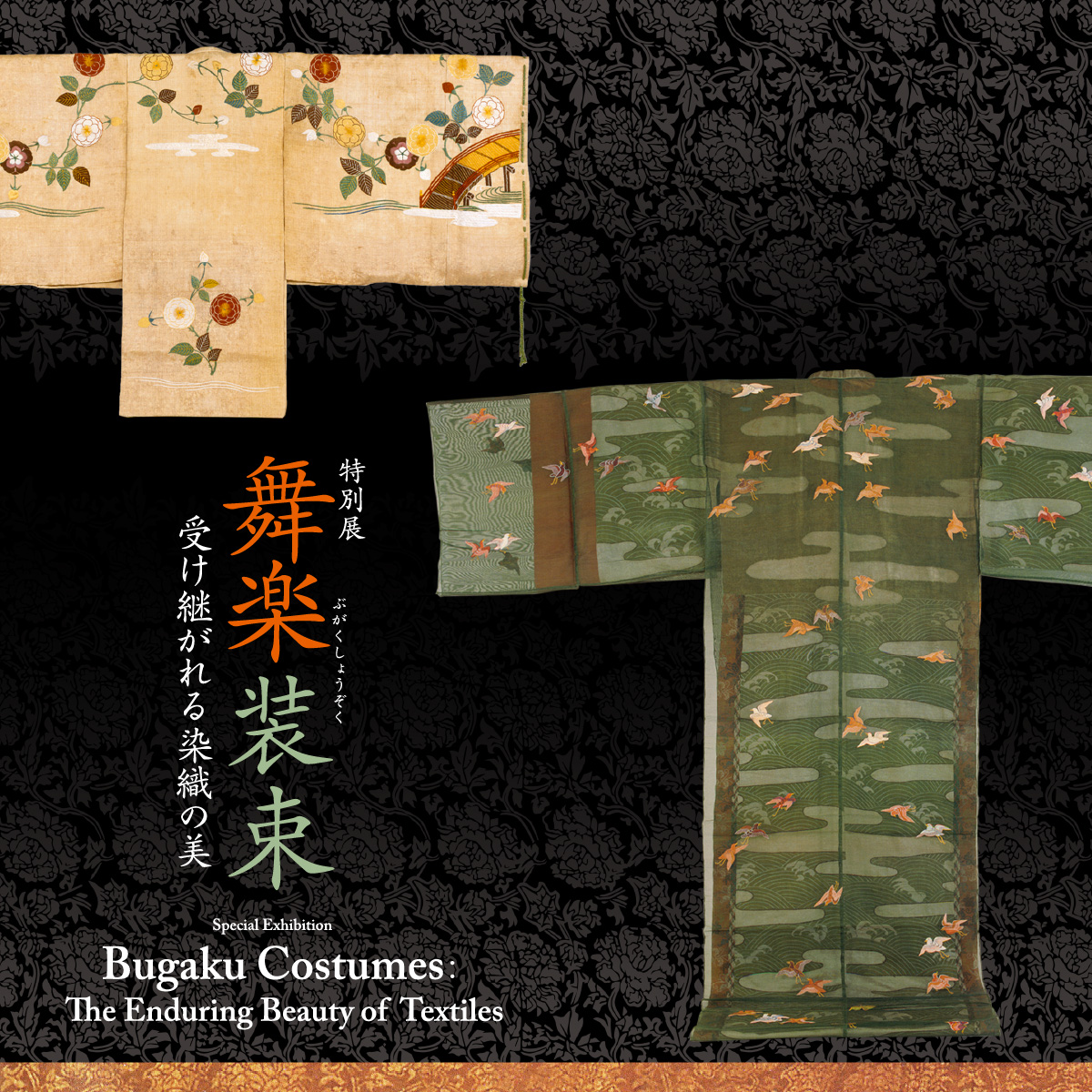
On wall labels for Japanese classical art, den (伝) sometimes comes before the maker's name. “Den Huizong hitsu” means that tradition ascribes the work to Huizong, but it is not certain. Hitsu (筆) says the named person wrote or painted it; a dictionary gives “Kūkai no hitsu” as its example. Even a work labelled this way can be designated a National Treasure. In the materials line, kenpon is a painting or calligraphy on silk and shihon one on paper; hon names the support, and a technique such as colour (chakushoku) or ink (bokuga) follows. The Birth of Karamono at the Sen-oku Hakukokan, Tokyo, shows the National Treasures Autumn Landscape and Winter Landscape, both den Huizong hitsu and shown in turn in the two halves of the run, and Autumn Field with Grazing Cattle, den Yan Ciping. The Nezu Museum's bugaku costume show includes Ranryōō-zu, den Tosa Yukihide hitsu, in colour on silk.
02In the gallery
Read the maker line for a den, then the materials line for shihon or kenpon, and then go back to the picture.
Wall label terms in Japanese
- 伝
- Den (attributed to)
- 筆
- Hitsu (by the hand of)
- 紙本
- Shihon (on paper)
- 絹本
- Kenpon (on silk)
- キャプション
- Wall label
03Notes
On a label, den means the maker is known only by tradition; shihon and kenpon say what the work is on.
This time, at The Birth of Chinese Imports (Karamono): Exploring the Origins of Chanoyu Designs —
Before reading the maker's name, what can you see in the picture itself?
04Related
Mei: the name of a tea utensil銘(茶道具の名前)A name given to one especially fine utensil such as a tea bowl or tea caddy; in a work's title it follows the word mei (銘).Read moreClose
01About
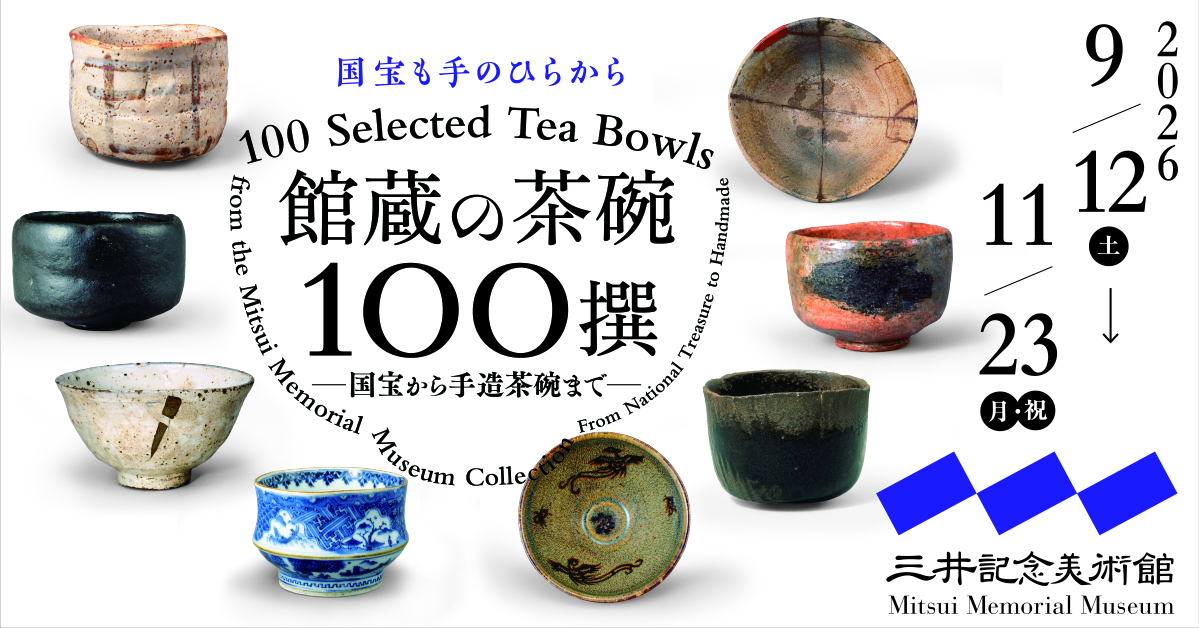
Among tea utensils such as the tea bowl, some carry a name of their own beyond a type such as “black Raku tea bowl”; this name is called mei (銘). In an exhibition's work titles it appears as Black Raku Tea Bowl, Mei Shunkan: the type, then the word mei and the name. Dictionaries describe a mei as a particular name given to an especially fine utensil, tea, sake and the like. Mitsui Memorial Museum's 100 Selected Tea Bowls from the Museum's Collection includes the National Treasure Shino Tea Bowl, Mei Unohanagaki, and the Important Cultural Properties Black Raku Tea Bowl, Mei Shunkan, Red Raku Tea Bowl, Mei Nue, and Black Raku Tea Bowl, Mei Amagumo; Large Ido Tea Bowl, Mei Shumi, also lists a “second mei, Jūmonji”, so one piece can have two names. The Birth of Karamono at Sen-oku Hakukokan, Tokyo, has Bunrin Tea Caddy, Mei Wakakusa, Celadon Tea Bowl with Flower-Shaped Rim, Mei Bakōhan, and Small Ido Tea Bowl, Mei Rokujizō. Writing on the box that holds a piece, giving its name and the maker's signature, is called hakogaki; the museum says the hakogaki and the small shikishi card inscribed with a waka, both of Unohanagaki, are by Katagiri Sekishū.
02In the gallery
Read the name after the word mei in the work's title, then compare it with the bowl's colour and shape.
Wall label terms in Japanese
- 銘
- Mei (given name)
- 箱書
- Hakogaki (box inscription)
- 別銘
- Betsumei (second name)
- 茶入
- Chaire (tea caddy)
- 茶碗
- Tea bowl
03Notes
In tea, a fine utensil may be told apart from others by a name of its own, its mei.
This time, at The Birth of Chinese Imports (Karamono): Exploring the Origins of Chanoyu Designs —
If you named a tea bowl in a few words after its shape or colour, what would you call it?
04Related
Tea bowl茶碗The bowl in which powdered tea is whisked and drunk in the tea ceremony; by origin it is called karamono (Chinese), kōraimono (Korean), or wamono (Japanese).Read moreClose
01About
Tea bowls are thought to have reached Japan from China together with tea. In the Muromachi period, tenmoku bowls imported from Song China were treasured by tea masters; such continental objects used for and around tea were called karamono, and those singled out by the taste of the time came to be valued as meibutsu, “famous objects.” Later, everyday bowls of Joseon Korea were chosen by Japanese tea masters, put to use as tea bowls, and treasured; Ido bowls are one example. Japanese-made wamono include Raku, Hagi, Karatsu, Shino, and Oribe, and enthusiasts have a saying: “first Raku, second Hagi, third Karatsu.”
02In the gallery
Look at the bowl's outline from the side first, then at the inside and the foot ring underneath.
Wall label terms in Japanese
- 唐物
- Karamono (Chinese import)
- 天目
- Tenmoku
- 井戸茶碗
- Ido bowl
- 楽茶碗
- Raku bowl
03Notes
Some prized tea bowls began as everyday Korean bowls, chosen by Japanese tea masters.
This time, at The Birth of Chinese Imports (Karamono): Exploring the Origins of Chanoyu Designs —
Is a tea bowl made to be looked at, or to be used? What tells you?