Out of Town
Kyoto Winter Exhibitions 2026–27Textile art, contemporary jewelry, geometry, and the Kano school
Chosen by our editor and checked against each venue's official site. No paid listings. About this anthology


1 / 4 Image: Kyoto National Museum
Halfway through, the exhibition closes for a week and every work is replaced.
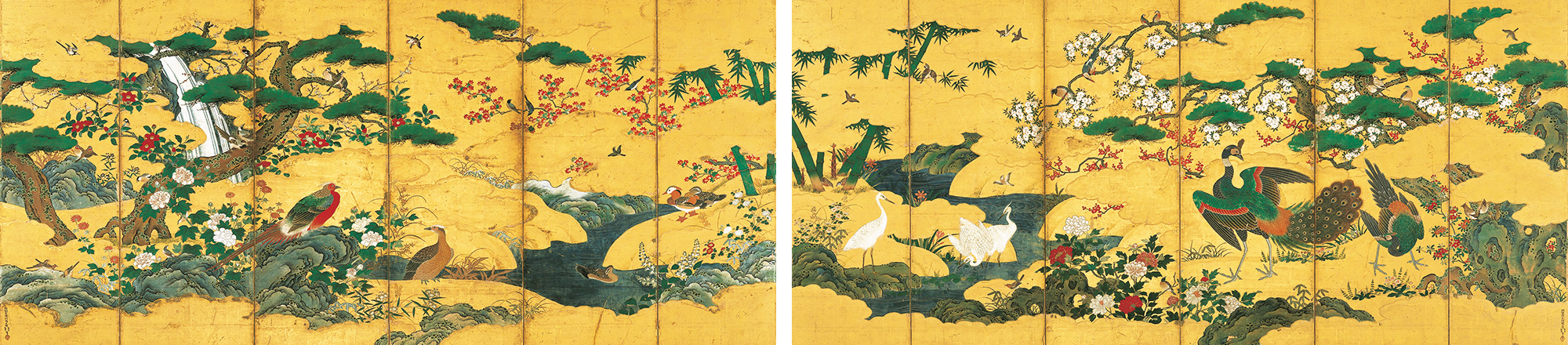
In spring 2027 the Kyoto National Museum marks its 130th anniversary with a special exhibition. The Kano school ran from the Muromachi period to the end of the Edo period and the Meiji era, and this is the first large retrospective of it in about half a century, since the 1979 exhibition Kano School Paintings at the Tokyo National Museum.
Because of their materials, Japanese paintings can be shown only for limited periods, and a visit to the owner does not always mean seeing them. So the museum gathers the representative works of each owner from Japan and abroad, and shows them at one venue only, in Kyoto.
According to the official text, the Kano school, through succession by bloodline and a strong organization, enjoyed the patronage of successive rulers, from the Ashikaga shoguns to Oda Nobunaga, Toyotomi Hideyoshi, and the Tokugawa shoguns, and kept leading the world of painting. To cover about four hundred years, the exhibition is in two parts, with the content of two special exhibitions. Part 1, Muromachi to Momoyama, runs from April 20 to May 30, 2027. After a week's pause in which every work is replaced, Part 2, Edo to Meiji, runs from June 8 to July 19.
About 150 works are shown, including National Treasures and Important Cultural Properties, as well as new discoveries, works shown for the first time, and works returning from abroad. The official site lists, among others, the National Treasure Zhou Maoshu Admiring Lotuses by 狩野正信 (15th century) for Part 1, and for Part 2 Peacocks and Pine, wall and sliding-door paintings (1626) by 狩野探幽 and Dragon and Tiger screens (1895) by 橋本雅邦.
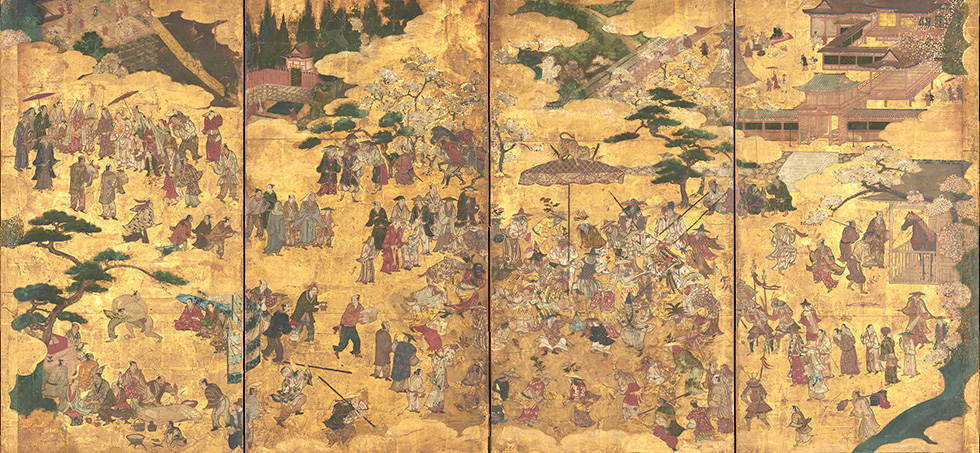
The newly discovered work announced is Screen of Pleasure-Seekers at Higashiyama (Momoyama period, 17th century). It bears no signature, but its style strongly shows the hand of 狩野孝信, and the picture vividly shows people enjoying festival dances and sumo. It appeared at auction in 2024, and will be shown for the first time in Part 1.


1 / 2 Image: Kyoto City KYOCERA Museum of Art
Raphaël Zarka turns the patterns of sundials into abstract paintings.
Raphaël Zarka (born 1977) is a French artist based in Paris. Taking geometry, architecture, and skateboarding as his clues, he explores the relations between form and space, movement and time. This is his first large solo exhibition in Japan.
His work often moves a form from its original field into another context, and the same form appears again and again across sculpture, painting, photography, and drawing. Mount Melville (2018) is a sculpture after a sundial of the late eighteenth century that stood on Mount Melville in Scotland. The original stone sundial stacks small columns, polyhedrons, and cubes, and Zarka rebuilds it in oak and concrete, releasing it from its function as an instrument for telling time so that it becomes sculpture.
The exhibition room has two entrances, and one may begin from either. It has four chapters with no fixed order, so works one has seen are met again.
From April to July 2026 he stayed at Villa Kujoyama in Kyoto, researching and making work. His new painting Sundial Abstraction was made in Kyoto and will be shown for the first time. The series starts from the geometric forms and patterns of sundials, and this time it uses traditional Japanese colors.


1 / 4 Image: Kyoto City KYOCERA Museum of Art
On a textile more than three meters tall, constellations, the moon, and a rocket are woven.
"Tenishiki" (hand-woven brocade) is a word Yamaga Seika (1885–1981) coined himself. It names a way of working rather than a technique: one artist does every step, from conceiving the design and making the underdrawing to choosing the threads and weaving. Most textiles are made through a finely divided labor system, whereas tenishiki lets the maker control color and thread freely, so that the weaving itself produces the rich color and the dimensional effects of a painting. The museum calls him a pioneer of textile art for this reason.
He was born the seventh child of a family that ran the oldest letterpress printing shop in Kyoto, and at fifteen he began studying with a Nishijin pattern designer. He learned Japanese painting from Kawabe Kakyo and textile design from Nishida Chikusetsu, and at twenty-five he was accepted by Kamisaka Sekka, whom he had long admired. Koregire, fragments of old textiles, were what he called his "teacher at his side" and studied all his life.
The turning point came in 1927. His Dutch Ship, submitted to the newly created art and crafts section of the Teiten exhibition, won a special selection prize, and at forty-two he decided to stand as a textile artist. The exhibition begins with the underdrawing for that work.
He used tenishiki to bring the festival hangings of the Gion Festival and the Nagahama Hikiyama Festival into a modern form, weaving the stories and origins of each float into symbolic patterns. According to the museum, in the decorations of the Gion Festival floats that were revived and renewed in the Showa era, he was the central artist of the new works.
He also worked with the architect 村野藤吾 on the large mural Abundance for the banquet hall Minori-no-ma of the Miyako Hotel (today the Westin Miyako Kyoto). The mural was removed in the 1992 renovation and is no longer in the hall, and part of it will be shown in this exhibition.


1 / 4 Image: The National Museum of Modern Art, Kyoto
A brooch titled Swiss Gold is made of cardboard and acrylic.
The official text says that the jewelry that truly suits you is not swayed by the gaze of others or by age, is not the jewelry of expensive brands, and is meant to express how you feel now and to help you live more strongly and richly. The exhibition introduces the attempts of makers who search for such a wish.
In 1964, when jewelry was not yet common in Japan, the Japan Jewellery Designers Association was founded, centered on 平松保城 (1926–2012) and 菱田安彦 (1927–1981). The International Jewellery Art Exhibition, held with the association at its center (Seibu department store, Shibuya, 1970 to 1986), introduced trends from Europe and America and spread the idea that there is design beyond the value of the material. From the late 1970s, works that took the nature of jewelry as their concept and responded to contemporary art also reached Japan, and these are called contemporary jewelry. In 1993 a joint exhibition of three schools in Tokyo, Munich, and Amsterdam began, centered on 伊藤一廣 (1948–1997) and Otto Künzli (born 1948).
The exhibition takes postwar Japan as its viewpoint and asks again about the possibility that expression enters the things we wear. About 350 works by more than 70 makers are shown, including a large presentation of the collection of the HICO Mizuno Jewelry College and fine pieces coming to Japan from Germany for the first time in about fifty years.
The works include a gold brooch of 1977 by 平松保城 and a silver ring of 1999 by Ishikawa Mari, Love makes blind.
If you have seen a good exhibition that isn't written up here yet, I would be glad to hear about it: hello@anthology-art.org
About this anthology: major exhibitions outside Tokyo, chosen by our editor, Yu, and updated as shows open and close. Every exhibition is checked against the venue's official site or announcement (as of Nov 12, 2026), and no listing is paid for. If dates or prices change, please refer to the venue's own announcement.
The Japanese original of each title and venue name is shown in gray below it.
A little more art in your life
Every month, we write a letter about exhibitions we love and why we recommend them. Subscribing is free, and you can cancel at any time.
We will use your email address only to send the newsletter. Privacy