Essay
ManuscriptsShojo Manga Infinity, The National Art Center, Tokyo


Near the end of a painting, there is one place that is wrong, and I look at it for a long time without touching it.
To change it, I have to lay another layer over what is already painted. If I do it badly, the patch will not match the rhythm of what is beside it, and the whole picture may be ruined; if I do not, my eye goes to that spot every time I look. In such places I often struggle for a long while before I can start. Sometimes I repaint a whole area, sometimes it is only a repair, and even after a repair I am not at ease. Once the picture is hung, what people see is its final state, and the places I changed are remembered only by me.
The sheet a manga artist hands to the printer has places like that too. A panel that went wrong is covered with white paint and drawn again, or a new one is drawn separately and pasted on top. On the printed page, you cannot tell either one.
That is what the National Art Center, Tokyo, in Roppongi is showing this time: manga manuscripts. There are more than 800 black-and-white pages and colour originals by three artists, Moto Hagio, Ryoko Yamagishi and Waki Yamato, and it is the first time a national art museum in Japan has held an exhibition of shojo manga, the manga made for girls, on this scale.
A manga manuscript was never drawn for readers to look at. It is the copy handed to the printer. So the sheet is larger than a magazine page. The dialogue is first pencilled into the balloons, and then the editor cuts out the typeset lines, which are printed separately, and pastes them in one by one. In the margins there are notes to the printer in blue, the marks of an eraser, and tape added to hold things together. All of this disappears in printing, which is why the page we see in a magazine is clean; on the manuscript it is all still there. With the colour originals the difference is in the colour: magazine covers, and the title page that opens each instalment of a serial, were painted, and some of those colours cannot be fully reproduced in print.
Because they were only copy for the printer, manga manuscripts were for a long time not thought worth keeping. Many were never returned to the artist after printing, and many were thrown away. Waki Yamato has said that an original is entirely different from the printed version, that it has force and can by now be called a work of art, and that from the raised paint and the texture of the paper you can tell a person drew it; but because it was made in order to be printed it is more fragile than an ordinary painting, the paper slowly oxidises, and the colours fade.
*
All three made their debuts in the late 1960s, at around twenty. Shojo manga magazines were read by schoolgirls, and in those years the people drawing for them were gradually changing from men to women, but the editors who decided what could be printed were still almost all men. A manga artist of their generation has recalled that editors then were sure girls liked a certain kind of subject and a certain kind of drawing, and that this was the only kind of work they handed out. The standard subjects were the beautiful girl with an unhappy lot, or love at school. What these three went on to draw was none of those.
*
The Tale of Genji is a long novel written a thousand years ago about life at the Japanese court of its day, and every student in Japan reads a short passage of it in classical Japanese class. Yamato read a digest version for students in her first year of junior high school and wondered how a story could be so beautiful. As an adult she read a complete translation into modern Japanese and badly wanted someone to turn it into manga. She asked several manga artist friends, and most of them answered "No," or "I haven't read it." In the end it was she who telephoned the editorial office and said she wanted to draw The Tale of Genji.
She was preparing the serial in the 1970s, when there was little material an ordinary person could find, and nothing to draw from for what people wore or what kind of houses they lived in a thousand years ago. So she went to a costume museum in Kyoto to look at the real things, and went to see a festival, to watch how the sleeves opened and where the folds fell when people walked in those clothes. Back in Tokyo, she and five assistants divided up the work of finding out how the houses were built and what flowers grew in the gardens, and told one another whatever they found. On one title page she painted for the serial, a woman with long hair tilts her head, her robes lie one layer over another, and every layer has a different pattern.
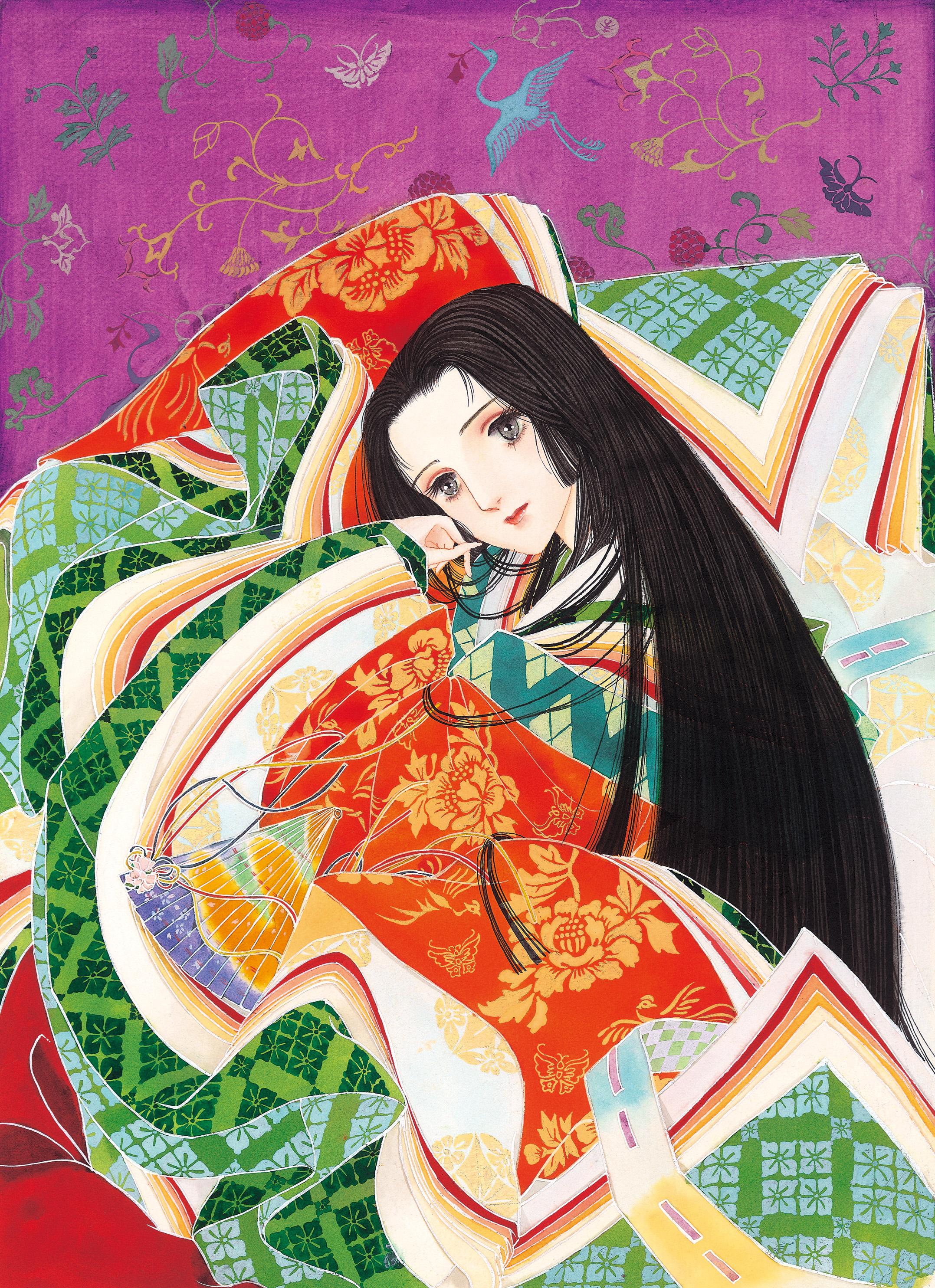
She changed the opening too. The first sentence of the original begins, roughly, "In the reign of which emperor was it," in the Japanese of a thousand years ago, and students in Japan learn it by heart at school, much as English-speaking students meet the opening lines of The Canterbury Tales. She worried that readers in their teens would not want to go on the moment they saw it, so the first page of the manga does not begin there; it begins with a boy who has lost his mother. The serial ran for fourteen years, about fifteen with the preparation, and she drew the whole of The Tale of Genji through to its end.
Her manga version, published in English as The Tale of Genji: Dreams at Dawn (Kodansha USA, 2019), is now used in Japanese high schools as something to read before the classic itself. When the Metropolitan Museum of Art in New York held an exhibition on The Tale of Genji in 2019, it showed her originals as well, the first time the Met had exhibited original manga drawings.
*
The hero of Hagio's The Poe Clan (Fantagraphics, 2019) is Edgar, a vampire who stays fourteen for ever and lives on, with another boy, from one era into the next. I had assumed that the hero of a shojo manga was made a boy so that the girls reading it would fall for him. The reason she gives herself is different: a boy is easier to draw as the hero, because if the hero is a girl, whatever she does, someone says "and you a girl" or "you're a girl, so do it this way." When she noticed this, she understood that she too had been held down all along for being a girl.
At that time she was not one of the magazine's main artists; she was glad just to be given pages and never knew when she might be dropped. The work first appeared quietly, as a single self-contained story, and she went on drawing it one story at a time. Later, when the publisher decided for the first time to collect a shojo manga serial into books, this was the one it chose. Her editor told her they would print 30,000 copies, that these might sell in a year or so, and that if they did not, her fee would be paid not in cash but in unsold copies. She asked what she was supposed to do with all those books, and the editor said, half joking, that she could sell them in the underground passage at Ikebukuro Station. The book went on sale, and the 30,000 copies were gone in three days.
An ordinary serial follows the same hero's story from one instalment to the next. Each of hers was a short story that could be read alone, set in a different period and seen by a different person watching the two boys, and only together did they make one very long story. Almost nothing in shojo manga was written that way then. Its readers were no longer only schoolgirls, either; more men began to read it. By 1976, the Valentine card the magazine gave away to its readers showed the boys from this work.

*
Yamagishi's Emperor of the Land of the Rising Sun is about Prince Shotoku as a young man. Prince Shotoku is a statesman of ancient Japan, and in 1980, when the serial began, it was his portrait on the Japanese 10,000-yen note of the time. As she draws him, he is a boy with powers ordinary people do not have; his mother fears him and keeps away from him; and the person he falls in love with is a boy from another noble house. On a title page from the first year of the serial he stands before a very large moon, head lowered, holding in both hands a sword in its scabbard.

The editorial office was strongly against it at first: putting the man on the banknote into a girls' magazine was awkward enough, let alone in a story like this. She later recalled that it was a time when one hesitated even to say the word "homosexuality." Nine years before the serial began she had drawn a short story about two schoolgirls in love, and many years afterwards she said that what she had in mind for it was in fact two boys; at the time she thought there was something wrong with her for being drawn to such stories, and that it would never be allowed, so as a last resort she made them girls. With Emperor of the Land of the Rising Sun she drew it as she had first imagined it. She believed that whether the other person is of the same sex or not, the worth of loving someone should be drawn without having to hold back, and she argued fiercely with the editorial office over it. The serial ran for four years.
She has said she is glad she finished it when her passion as an artist was at its height. In October 2026 she received the Kikuchi Kan Prize, a Japanese award given across the fields of culture, and the citation says that she brought about a revolution in a manga world set in its old ways and raised shojo manga to the level of an art.
*
In 2026 Hagio is seventy-seven, Yamato seventy-eight and Yamagishi seventy-nine, and each of them made her debut close to sixty years ago.
The Poe Clan stopped in 1976. Forty years later Hagio began drawing Edgar again. It was meant to be a single sixteen-page story, but once she started, the two boys began talking by themselves, the manuscript grew longer and longer, and it became a serial. The hardest thing, she said, was that she could not draw the same faces as forty years before. In the same autumn as her prize, Yamagishi published a new short story. She has said she never once thought of giving up drawing, and also that what she cannot help noticing now is that she has grown old, so perhaps she will draw that.

A manuscript is something very private to the person who drew it. The white that covers a mistake and the panels pasted on top do not show in the printed book; only the person who drew them knows how long she stopped there. Three manga artists have hung them on a wall and let strangers walk past in front of them, and I admire that very much. As for me, I hardly ever mention the places I changed in a painting I have finished. If one day someone points to one of them and asks why it was painted over, what will I say?
I hope you will go and see it for yourself: Shojo Manga Infinity.
— Yu
Knowledge cards: Shōjo manga · Manga
The Japanese original of each title and venue name is shown in gray below it.