Opens in 137 days#History & heritage
Japanese Calligraphy: A 1,300-Year Legacy of Beauty
Japanese original:
日本の書の美1300年
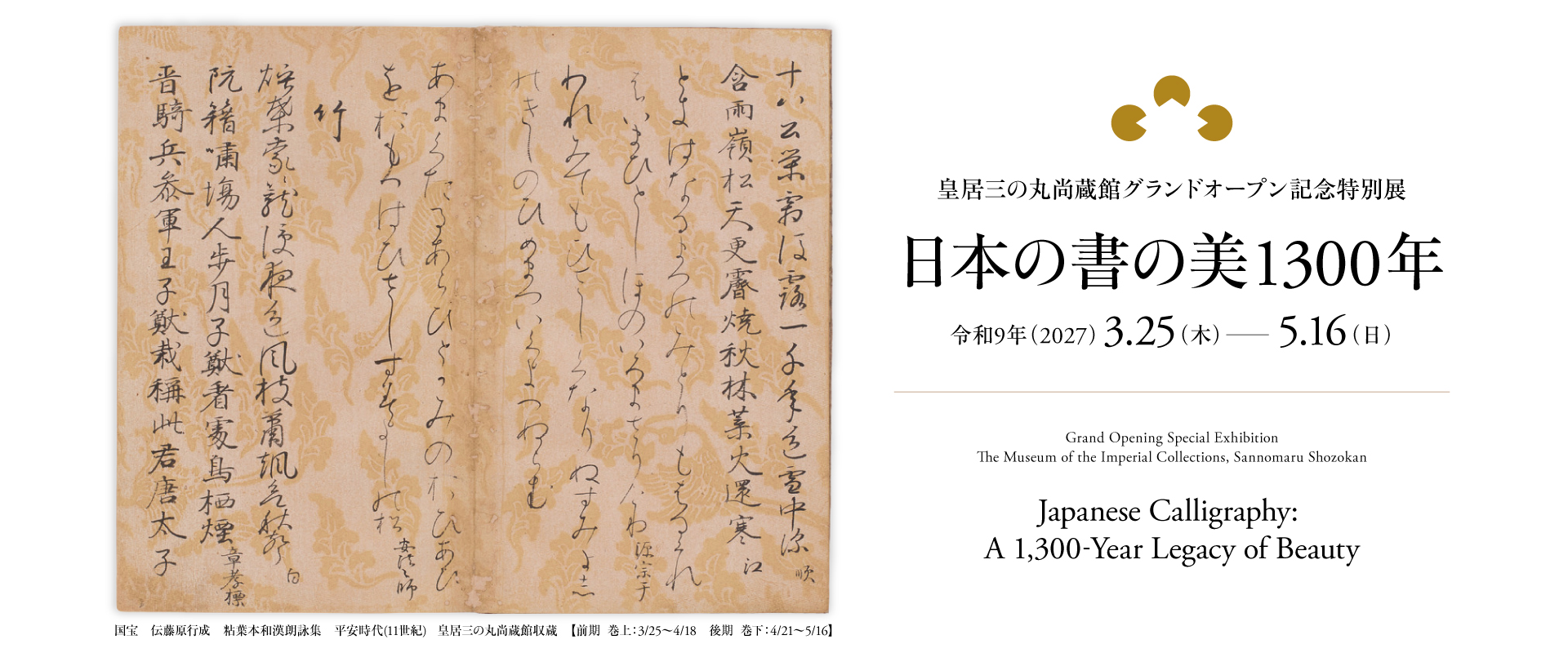
Led by Wang Xizhi's Sorantie, the exhibition follows 1,300 years of Japanese calligraphy through the museum's own works, letters in the emperors' own hand, sutra copies and the brushwork of Zen monks. A large part of the display is changed between the first and second halves. The official site so far gives only the dates, an outline of the works and the price, with no individual works shown yet, and tickets were not on sale on November 5, 2026.
- Dates
- Mar 25 – May 16, 2027
- Venue
- The Museum of the Imperial Collections, Sannomaru Shozokan (皇居三の丸尚蔵館) · Takebashi & Kitanomaru Park
- Address
- 東京都千代田区千代田1-8 皇居東御苑内Enter by Otemon Gate: about 5 min on foot from Exit C13a, Otemachi Station, then about 100 m inside; enter by Hirakawamon Gate: about 10 min from Exit 1a, Takebashi StationOpen in Google Maps
- Hours
- 09:30–17:00Closed: Mon
- Admission
- General ¥2,500Original: 一般 2,500円
Visit planning
The calendar entry starts on the opening day and covers the whole run. Please check opening hours and closing days before your visit.
Nearby, after this one
Same venue · The Museum of the Imperial Collections, Sannomaru Shozokan
Same neighborhood · Takebashi & Kitanomaru Park
Shows open on the same days as this one are listed first (regular closing days only).
Related exhibitions
Same genre · History & heritage

Credits
- Artists
- Wang Xizhi
- Organized by
- The Museum of the Imperial Collections, Sannomaru Shozokan, 讀賣新聞社, NHK
- In cooperation with
- 宮內廳, 文化廳
Knowledge cards
Kana calligraphy and wayō仮名の書と和様A Japanese style of writing that developed from the Heian period, centred on kana set down in linked and scattered lines on decorated paper.Read moreClose
01About
Kana are phonetic characters that grew out of simplified, cursive forms of Chinese characters. After Chinese characters reached Japan, calligraphers learned from Chinese writing and gradually built expressions of their own. From the middle of the Heian period a style called wayō appeared that China did not have; its full, rounded lines can be seen in the writing of Fujiwara no Yukinari. As waka poetry flourished, writing in kana developed with it. Kana calligraphy scatters lines across the sheet (chirashigaki) and links characters in a run (renmen), and it unfolds on decorated paper. Such pieces came to be prized as meihitsu, celebrated writing, used as models for study and as works to admire; from the Muromachi period, fragments of them were mounted as hanging scrolls for tea gatherings.
02In the gallery
First follow how the characters link and scatter across the sheet, then notice whether the paper itself is decorated.
Wall label terms in Japanese
- 仮名
- kana
- 和様
- wayō (Japanese-style writing)
- 連綿
- renmen (linked characters)
- 散らし書き
- chirashigaki (scattered layout)
- 名筆
- meihitsu (celebrated writing)
03Notes
Kana calligraphy is read in how characters link and scatter across the sheet, not only in their shapes.
This time, at Japanese Calligraphy: A 1,300-Year Legacy of Beauty —
As the characters run together, how does your eye get carried along?