Opens in 20 days#Painting
National Treasure: "Pine Trees in the Snow" and "The Four Seasons"
Japanese original:
国宝 雪松図と四季
Showing Maruyama Ōkyo's National Treasure screens Pine Trees in Snow has become a year-end tradition at the Mitsui Memorial Museum; the snow on the pines is not white paint but the bare paper left unpainted. Centred on this work, the show looks at how East Asian art expresses the seasons and weather through technique and visual wit in the museum's paintings and crafts, such as Sakai Hōitsu's use of diagonally applied wood grain to suggest a gale; four Maruyama-school screens of seaside views in four seasons are shown for the first time.
1 / 4 Image: Mitsui Memorial Museum
- Dates
- Dec 12, 2026 – Jan 30, 2027
- Venue
- Mitsui Memorial Museum (三井記念美術館) · Chuo東京都中央区日本橋室町2-1-1 三井本館7階
Getting there
1 min walk from Exit A7, Mitsukoshimae Station (Tokyo Metro Ginza Line)
- Hours
- 10:00–17:00 · Closed: Mon
- Admission
- General ¥1,200Original: 一般 1,200円
- Artists
- Maruyama Ōkyo
- Yamaguchi Soken
- Sakai Hōitsu
- 川端玉章
- 狩野榮信
- 龜岡規禮
- 水野年方
- Organized by
The calendar entry starts on opening day and covers the whole run, so you won't need to look the dates up again. Please check opening hours and closing days before your visit.
Booking
No booking needed.
No booking needed.
From the venue's announcements, checked Nov 20, 2026. Slots and availability can change; please check the official page before you book. Source: 三井記念美術館 公式
Entry notes
No reservation is needed to enter; to avoid crowding in the galleries, entry may be restricted.
- No reservation is needed to enter; to avoid crowding in the galleries, entry may be restricted. (Source: 三井記念美術館, 2026)
From the organizer's announcements and press reports. Arrangements can change; please check the official site before your visit.
Guided tours
A Japanese-only audio guide is available to rent for ¥800, narrated by actor Kusu Mari (楠 麻里).
- Audio guideA Japanese-only audio guide is available to rent for ¥800, narrated by actor Kusu Mari (楠 麻里).
Source: 三井記念美術館 次回展覧会ページ. From the venue's and organizer's announcements. Schedules, languages and fees can change; please check the official site before your visit.
Knowledge cards
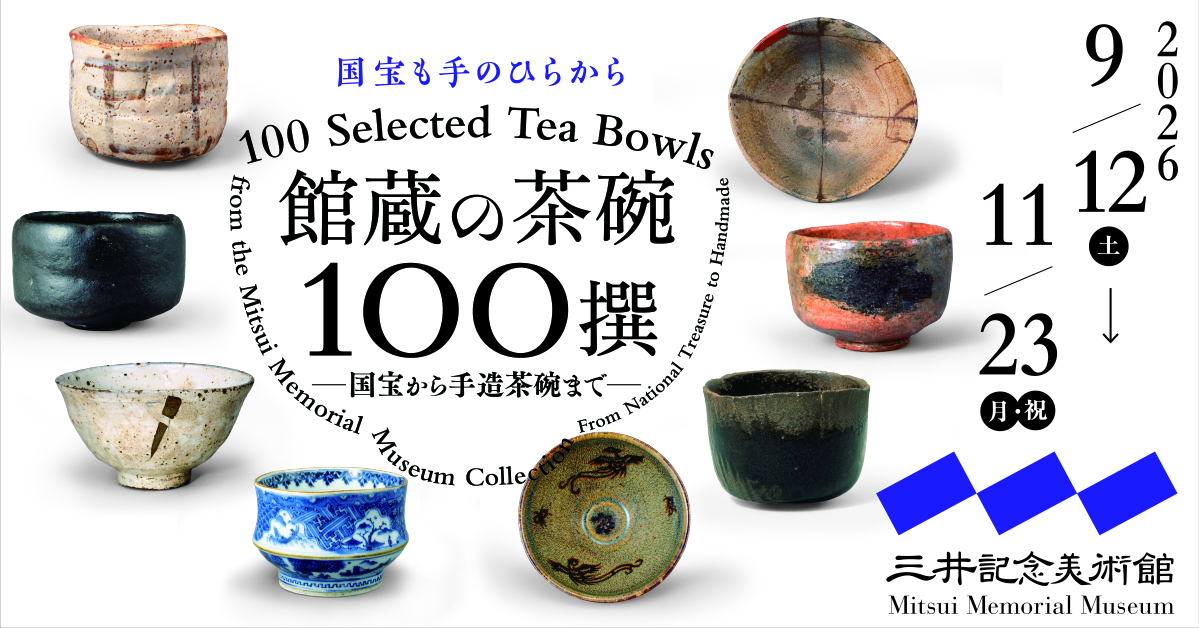
Tea bowl茶碗The bowl in which powdered tea is whisked and drunk in the tea ceremony; by origin it is called karamono (Chinese), kōraimono (Korean), or wamono (Japanese).Read moreClose
01About
Tea bowls are thought to have reached Japan from China together with tea. In the Muromachi period, tenmoku bowls imported from Song China were treasured by tea masters; such continental objects used for and around tea were called karamono, and those singled out by the taste of the time came to be valued as meibutsu, “famous objects.” Later, everyday bowls of Joseon Korea were chosen by Japanese tea masters, put to use as tea bowls, and treasured; Ido bowls are one example. Japanese-made wamono include Raku, Hagi, Karatsu, Shino, and Oribe, and enthusiasts have a saying: “first Raku, second Hagi, third Karatsu.”
02In the gallery
Look at the bowl's outline from the side first, then at the inside and the foot ring underneath.
Wall label terms in Japanese
- 唐物
- Karamono (Chinese import)
- 天目
- Tenmoku
- 井戸茶碗
- Ido bowl
- 楽茶碗
- Raku bowl
03Notes
Some prized tea bowls began as everyday Korean bowls, chosen by Japanese tea masters.
This time, at National Treasure: "Pine Trees in the Snow" and "The Four Seasons" —
Is a tea bowl made to be looked at, or to be used? What tells you?
04Related
Maruyama–Shijō school円山・四条派A school of painting begun in mid-Edo Kyoto by Maruyama Ōkyo and Goshun; it valued sketching from life and led on to the nihonga of modern Kyoto.Read moreClose
01About
Maruyama Ōkyo (1733–1795) is said to have always carried a sketchbook, recording animals, insects, and plants from every angle. When young he also made megane-e, views drawn with Western perspective that look three-dimensional through a lens. On this footing of sketching from life he painted traditional subjects as richly decorative large pictures on screens and sliding doors, favored by wealthy Kyoto townspeople such as the Mitsui family. Goshun, who had learned haikai poetry and literati painting from Yosa Buson, worked with Ōkyo after Buson's death and built a style that took in Ōkyo's realism. His pupils lived around Shijō Street, so his line was called the Shijō school; together with Ōkyo's Maruyama school it is known as the Maruyama–Shijō school. Through Kōno Bairei and Takeuchi Seihō the line ran on into the nihonga of modern Kyoto.
02In the gallery
Look at snow, mist, or water and ask where the painter laid color and where the paper was left bare. In the national treasure Pine Trees in Snow, the snow on the pines is not white paint but the white of the paper left unpainted.
Wall label terms in Japanese
- 写生
- Sketching from life (shasei)
- 眼鏡絵
- Perspective picture (megane-e)
- 障壁画
- Paintings on walls and sliding doors
- 屏風
- Folding screen
- 円山派
- Maruyama school
- 四条派
- Shijō school
03Notes
Maruyama Ōkyo is said to have always carried a sketchbook, and built rich, decorative large paintings on his sketches from life.
This time, at National Treasure: "Pine Trees in the Snow" and "The Four Seasons" —
Does the picture look drawn from the real thing? Where do you feel that?
04Related
Other cards (1)Hide other cards
National Treasures and Important Cultural Properties国宝と重要文化財Japan designates important tangible cultural properties as Important Cultural Properties, and selects especially valuable ones among them as National Treasures.Read moreClose
01About
The Agency for Cultural Affairs says that Japan designates important tangible cultural properties as Important Cultural Properties under the Law for the Protection of Cultural Properties, and designates those with exceptional value from the perspective of world culture as National Treasures. Tangible cultural properties include buildings, paintings, sculpture, crafts, calligraphy, books, historical documents, archaeological materials and historical materials; tangible cultural properties other than buildings are grouped as fine and applied arts. When you see either term, read the level first, then return to the work's date, materials, artist field and display; the designation is not the whole description of the work.
02In the gallery
After reading the designation, bring your eyes back to the work and its display conditions.
Wall label terms in Japanese
- 重要文化財
- Important Cultural Property
- 国宝
- National Treasure
- 有形文化財
- Tangible Cultural Property
03Notes
Notice the designation level before looking closer at the work.
This time, at National Treasure: "Pine Trees in the Snow" and "The Four Seasons" —
In front of a designated work, which side of it do you notice first?